




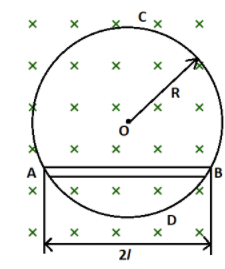
A uniform magnetic field of induction $B$ fills a cylindrical volume of radius $R$. A rod $AB$ of length $2l$ is placed as shown in figure. If $B$ is changing at the rate ${dB}/{dt}\;$, the emf that is produced by the changing magnetic field and that acts between the ends of the rod is
$\begin{align}
& A.\,\,\dfrac{dB}{dt}l\sqrt{{{R}^{2}}-{{l}^{2}}} \\
& B.\,\,\dfrac{dB}{dt}l\sqrt{{{R}^{2}}+{{l}^{2}}} \\
& C.\,\,\dfrac{1}{2}\dfrac{dB}{dt}l\sqrt{{{R}^{2}}-{{l}^{2}}} \\
& D.\,\,\dfrac{1}{2}\dfrac{dB}{dt}l\sqrt{{{R}^{2}}+{{l}^{2}}} \\
\end{align}$
Answer
 Verified
641.7k+ views
Hint: Consider a concentric circle smaller than the given one, which is tangent to line $AB$. Then find the electric field from that circle, which will help in getting the emf that is produced in the changing magnetic field.
Formula used:
$EMF(\varepsilon )=\int{\overrightarrow{E}\overrightarrow{dl}}$
Complete step by step answer:
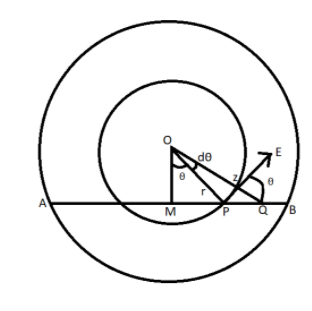
Consider a point on the circumference of a circle of radius $r\,(r < R)$, which is concentric to the bigger circle. Let, $E$ be the electric field along the tangents to the circle.
Then, $E$ is given by,
$E=\dfrac{r}{2}\dfrac{dB}{dt}$
Now,
Consider a point $P$ in the rod and a small distance $dt$, which is along $AB$.
So, $dt=PQ\,along\,AB$
Hence,
$EMF(\varepsilon )=\int{\overrightarrow{E}\overrightarrow{dl}}$
where, $E=\dfrac{r}{2}\dfrac{dB}{dt}$ and $\overrightarrow{dl}=dl\cos \theta $
Then,
\[\begin{align}
& \varepsilon =\int{\dfrac{r}{2}\dfrac{dB}{dt}dl\cos \theta } \\
& \varepsilon =\dfrac{r\cos \theta }{2}\dfrac{dB}{dt}\int{dl} \\
\end{align}\]
Here, from the above figure it is clear that, $r\cos \theta =OM=\sqrt{{{R}^{2}}-{{l}^{2}}}$ and $\int{dl}=2l$
\[\begin{align}
& \varepsilon =\dfrac{\sqrt{{{R}^{2}}-{{l}^{2}}}}{2}\dfrac{dB}{dt}2l \\
& \varepsilon =\dfrac{dB}{dt}l\sqrt{{{R}^{2}}-{{l}^{2}}} \\
\end{align}\]
Therefore, the correct answer is Option (A).
Additional Information:
An electromagnetic field (also EM field) is a classical (i.e. non-quantum) field produced by moving electric charges. It is the field described by classical electrodynamics and is the classical counterpart to the quantized electromagnetic field tensor in quantum electrodynamics. The electromagnetic field propagates at the speed of light (in fact, this field can be identified as light) and interacts with charges and currents. Its quantum counterpart is one of the four fundamental forces of nature (the others are gravitation, weak interaction and strong interaction.)
The field can be viewed as the combination of an electric field and a magnetic field. The electric field is produced by stationary charges, and the magnetic field by moving charges (currents); these two are often described as the sources of the field. The way in which charges and currents interact with the electromagnetic field is described by Maxwell's equations and the Lorentz force law. The force created by the electric field is much stronger than the force created by the magnetic field.
Note:
This question will be a lot easy if the figure in the solution can be visualized. Because if the figure is identified, then it is simple math that can be used to substitute value in the EMF formula and get the final answer.
Formula used:
$EMF(\varepsilon )=\int{\overrightarrow{E}\overrightarrow{dl}}$
Complete step by step answer:
Consider a point on the circumference of a circle of radius $r\,(r < R)$, which is concentric to the bigger circle. Let, $E$ be the electric field along the tangents to the circle.
Then, $E$ is given by,
$E=\dfrac{r}{2}\dfrac{dB}{dt}$
Now,
Consider a point $P$ in the rod and a small distance $dt$, which is along $AB$.
So, $dt=PQ\,along\,AB$
Hence,
$EMF(\varepsilon )=\int{\overrightarrow{E}\overrightarrow{dl}}$
where, $E=\dfrac{r}{2}\dfrac{dB}{dt}$ and $\overrightarrow{dl}=dl\cos \theta $
Then,
\[\begin{align}
& \varepsilon =\int{\dfrac{r}{2}\dfrac{dB}{dt}dl\cos \theta } \\
& \varepsilon =\dfrac{r\cos \theta }{2}\dfrac{dB}{dt}\int{dl} \\
\end{align}\]
Here, from the above figure it is clear that, $r\cos \theta =OM=\sqrt{{{R}^{2}}-{{l}^{2}}}$ and $\int{dl}=2l$
\[\begin{align}
& \varepsilon =\dfrac{\sqrt{{{R}^{2}}-{{l}^{2}}}}{2}\dfrac{dB}{dt}2l \\
& \varepsilon =\dfrac{dB}{dt}l\sqrt{{{R}^{2}}-{{l}^{2}}} \\
\end{align}\]
Therefore, the correct answer is Option (A).
Additional Information:
An electromagnetic field (also EM field) is a classical (i.e. non-quantum) field produced by moving electric charges. It is the field described by classical electrodynamics and is the classical counterpart to the quantized electromagnetic field tensor in quantum electrodynamics. The electromagnetic field propagates at the speed of light (in fact, this field can be identified as light) and interacts with charges and currents. Its quantum counterpart is one of the four fundamental forces of nature (the others are gravitation, weak interaction and strong interaction.)
The field can be viewed as the combination of an electric field and a magnetic field. The electric field is produced by stationary charges, and the magnetic field by moving charges (currents); these two are often described as the sources of the field. The way in which charges and currents interact with the electromagnetic field is described by Maxwell's equations and the Lorentz force law. The force created by the electric field is much stronger than the force created by the magnetic field.
Note:
This question will be a lot easy if the figure in the solution can be visualized. Because if the figure is identified, then it is simple math that can be used to substitute value in the EMF formula and get the final answer.
Recently Updated Pages
Which of the following graphs shows the variation of class 12 physics CBSE

Draw a labelled diagram of the human male reproductive class 12 biology CBSE
Describe the experiment to compare the emf of two cells class 12 physics CBSE
What is standard hydrogen electrode
What is conventional current and electric current class 12 physics CBSE
2Bromopentane is treated with an alcoholic KOH solution class 12 chemistry CBSE
Trending doubts
Which are the Top 10 Largest Countries of the World?
Differentiate between internal fertilization and external class 12 biology CBSE
What is the Full Form of 1.DPT 2.DDT 3.BCG
Differentiate between lanthanoids and actinoids class 12 chemistry CBSE
Sketch and label the Malpighian body class 12 biology CBSE
Why is the cell called the structural and functional class 12 biology CBSE