




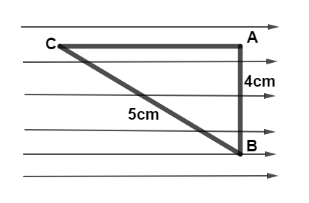
A uniform electric field of $800\,V{m^{ - 1}}$ is acting as shown. Given $AB = 4cm$ $BC = 5cm$. Find potential difference between points (i) $A$ and $B$ (ii) $A$ and $C$ (iii) $B$ and $C$
Answer
 Verified
509.7k+ views
Hint: In electrostatics, electric field is the space around the charge where electric force can be experienced by another charges and potential difference between two points is the difference of electric potential between two points and these two quantities are related mathematically as $dV = - d\vec E.d\vec r$ where $dE,dr$ are the electric field and position magnitudes and having dot product between these two vectors.
Complete step by step answer:
From the given figure, let’s find the length of AC by using Pythagoras theorem we have,
${(BC)^2} = {(AC)^2} + {(AB)^2}$
$\Rightarrow 25 - 16 = {(AC)^2}$
$ \Rightarrow AC = 3cm$
According to the question, the magnitude of the electric field is $E = 800\,V{m^{ - 1}}$.
(i) Point A and B. Since point A and B lie in the same position in electric field direction hence net change in length $dr = 0$ so, the potential difference between point A and B is zero.
(ii) Point A and C. since, Point A and Point C are separated by a distance of $dr = 3cm = 0.03m$ in the direction of electric field hence, using
$dV = - d\vec E.d\vec r$
$\Rightarrow dV = - 800 \times 0.03$
$\therefore dV = - 24V$
Hence, potential difference between point A and C is $dV = - 24V$.
(iii) Point B and C. since point B and C are separated by a distance of $dr = 5cm = 0.05m$ in the direction of electric field hence using,
$dV = - d\vec E.d\vec r$
$\Rightarrow dV = - 800 \times 0.05$
$\therefore dV = - 40V$
Hence, potential difference between point B and C is $dV = - 40V$.
Note: It should be remembered that, negative sign of potential difference shows that it decreases with the increasing in electric field direction and basic unit of conversion are used as $1\,cm = 0.01\,m$ remember, always find the distance between two points in the direction of electric field in order to find the potential difference across them.
Complete step by step answer:
From the given figure, let’s find the length of AC by using Pythagoras theorem we have,
${(BC)^2} = {(AC)^2} + {(AB)^2}$
$\Rightarrow 25 - 16 = {(AC)^2}$
$ \Rightarrow AC = 3cm$
According to the question, the magnitude of the electric field is $E = 800\,V{m^{ - 1}}$.
(i) Point A and B. Since point A and B lie in the same position in electric field direction hence net change in length $dr = 0$ so, the potential difference between point A and B is zero.
(ii) Point A and C. since, Point A and Point C are separated by a distance of $dr = 3cm = 0.03m$ in the direction of electric field hence, using
$dV = - d\vec E.d\vec r$
$\Rightarrow dV = - 800 \times 0.03$
$\therefore dV = - 24V$
Hence, potential difference between point A and C is $dV = - 24V$.
(iii) Point B and C. since point B and C are separated by a distance of $dr = 5cm = 0.05m$ in the direction of electric field hence using,
$dV = - d\vec E.d\vec r$
$\Rightarrow dV = - 800 \times 0.05$
$\therefore dV = - 40V$
Hence, potential difference between point B and C is $dV = - 40V$.
Note: It should be remembered that, negative sign of potential difference shows that it decreases with the increasing in electric field direction and basic unit of conversion are used as $1\,cm = 0.01\,m$ remember, always find the distance between two points in the direction of electric field in order to find the potential difference across them.
Recently Updated Pages
Master Class 12 Economics: Engaging Questions & Answers for Success

Master Class 12 Physics: Engaging Questions & Answers for Success
Master Class 12 English: Engaging Questions & Answers for Success
Master Class 12 Social Science: Engaging Questions & Answers for Success
Master Class 12 Maths: Engaging Questions & Answers for Success
Master Class 12 Business Studies: Engaging Questions & Answers for Success
Trending doubts
Which are the Top 10 Largest Countries of the World?
What are the major means of transport Explain each class 12 social science CBSE
Draw a labelled sketch of the human eye class 12 physics CBSE
Why cannot DNA pass through cell membranes class 12 biology CBSE
Differentiate between insitu conservation and exsitu class 12 biology CBSE
Draw a neat and well labeled diagram of TS of ovary class 12 biology CBSE