




A uniform electric field of 400 V/m is directed at 45∘ above the x-axis as shown in the figure. The potential difference
\[{{\text{V}}_{\text{A}}}-{{\text{V}}_{\text{B}}}~\] is given by:
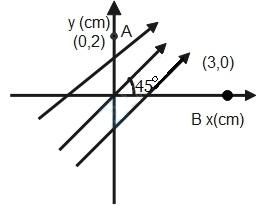
\[\begin{align}
& \text{A}.0 \\
& \text{B}.4V \\
& \text{C}.6.4V \\
& \text{D}\text{.2}\text{.8}V \\
\end{align}\]
Answer
 Verified
571.5k+ views
Hint: The electric field is a unit vector. Firstly, the vector for the electric field is always expressed in terms of the vectors of sine and cosine angles. Then, the potential difference is expressed in terms of force and distance. By integrating the equations and substituting the limits, we will get the corresponding potential difference.
Complete answer:
Let E be the electric field
F be the force
\[F=400~V/m\]
The electric field vector makes an angle of x with the horizontal.
\[x={{45}^{0}}\]
The horizontal component of force is
\[F\cos x\]
Similarly,
The vertical component of force is
\[F\sin x\]
In general,
The unit vector,
\[\hat{r}=\cos x\hat{i}+\sin x\hat{j}\]----(1)
Let this be equation (1)
Let the electric field vector be
\[\overrightarrow{E}\]
The electric field vector is given as,
\[\overrightarrow{E}=F\cos x\widehat{i}+F\sin x\widehat{j}\] ----(2)
Let this be equation (2)
Substitute the value of F and x in equation (2)
We get,
\[\overrightarrow{E}=400\cos 45\widehat{i}+400\sin 45\widehat{j}\]---(3)
Let this be equation (3)
The value of
\[\cos 45=\dfrac{1}{\sqrt{2}}\]----(4)
Let this be equation (4)
Similarly,
The value of
\[\sin 45=\dfrac{1}{\sqrt{2}}\] ---(5)
Let this be equation (5)
Substituting the equations (4) and (5) in equation (3)
We get,
\[\overrightarrow{E}=400(\dfrac{1}{\sqrt{2}}\widehat{)i}+400(\dfrac{1}{\sqrt{2}})\widehat{j}\] ---(6)
Let this be equation (6)
\[\overrightarrow{E}=200\sqrt{2}\widehat{i}+200\sqrt{2}\widehat{j}\]---(7)
Let this be equation (7)
\[V=-\int{\overrightarrow{F.}}\overrightarrow{dr}\]---(8)
Let this be equation (8)
\[V=-\int{200\sqrt{2}}(\widehat{i}+\widehat{j})(dx\widehat{i}+dy\widehat{j})\] ---(9)
Let this be equation (9)
\[V=-200\sqrt{2}\int{{}}(dx+dy)\]---(10)
Let this be equation (10)
\[V={{V}_{B}}-{{V}_{A}}\] ---(11)
Let this be equation (11)
Equating equations (10) and (11),
We get
\[{{V}_{B}}-{{V}_{A}}=-200\sqrt{2}\int{{}}(dx+dy)\] ---(12)
Let this be equation (12)
\[{{V}_{B}}-{{V}_{A}}=-200\sqrt{2}[\int{dx}+\int{dy}]\] ---(13)
Let this be equation (13)
Applying the limits at x and y,
We get,
\[{{V}_{B}}-{{V}_{A}}=-200\sqrt{2}[\int_{0}^{3}{dx}+\int_{2}^{0}{dy}]\] ---(14)
Let this be equation (14)
\[{{V}_{B}}-{{V}_{A}}=-200\sqrt{2}[(3-0)+(0-2)]\]
\[{{V}_{B}}-{{V}_{A}}=-200\sqrt{2}(3-2)\]
\[{{V}_{B}}-{{V}_{A}}=-200\sqrt{2}\]---(15)
Let this be equation (15)
Taking the negative on both the sides,
We get,
\[{{V}_{A}}-{{V}_{B}}=200\sqrt{2}\] ---(16)
Let this be equation (16)
Therefore,
\[{{V}_{A}}-{{V}_{B}}=200\sqrt{2}\dfrac{Vcm}{m}\]---(17)
Let this be equation (17)
We know that
\[1m=100cm\] ---(18)
Let this be equation (18)
Substituting equation (18) in equation (17),we get,
\[{{V}_{A}}-{{V}_{B}}=200\sqrt{2}\dfrac{Vcm}{100cm}\]
Cancelling cm, we get
\[{{V}_{A}}-{{V}_{B}}=200\sqrt{2}\dfrac{V}{100}\]
\[{{V}_{A}}-{{V}_{B}}=2\sqrt{2}V\]
\[{{V}_{A}}-{{V}_{B}}=2.8V\]
Therefore, the correct answer is \[\text{D}.2.8V\]
Note:
Electric field is always expressed as a vector quantity. If the angle of inclination of the force with the horizontal changes, the corresponding electric field vector also changes. It is also important to note that the conversion of values play a vital role in calculations. So, don’t forget to convert the ‘m’ to ‘cm’. Otherwise, the answer will be wrong.
Complete answer:
Let E be the electric field
F be the force
\[F=400~V/m\]
The electric field vector makes an angle of x with the horizontal.
\[x={{45}^{0}}\]
The horizontal component of force is
\[F\cos x\]
Similarly,
The vertical component of force is
\[F\sin x\]
In general,
The unit vector,
\[\hat{r}=\cos x\hat{i}+\sin x\hat{j}\]----(1)
Let this be equation (1)
Let the electric field vector be
\[\overrightarrow{E}\]
The electric field vector is given as,
\[\overrightarrow{E}=F\cos x\widehat{i}+F\sin x\widehat{j}\] ----(2)
Let this be equation (2)
Substitute the value of F and x in equation (2)
We get,
\[\overrightarrow{E}=400\cos 45\widehat{i}+400\sin 45\widehat{j}\]---(3)
Let this be equation (3)
The value of
\[\cos 45=\dfrac{1}{\sqrt{2}}\]----(4)
Let this be equation (4)
Similarly,
The value of
\[\sin 45=\dfrac{1}{\sqrt{2}}\] ---(5)
Let this be equation (5)
Substituting the equations (4) and (5) in equation (3)
We get,
\[\overrightarrow{E}=400(\dfrac{1}{\sqrt{2}}\widehat{)i}+400(\dfrac{1}{\sqrt{2}})\widehat{j}\] ---(6)
Let this be equation (6)
\[\overrightarrow{E}=200\sqrt{2}\widehat{i}+200\sqrt{2}\widehat{j}\]---(7)
Let this be equation (7)
\[V=-\int{\overrightarrow{F.}}\overrightarrow{dr}\]---(8)
Let this be equation (8)
\[V=-\int{200\sqrt{2}}(\widehat{i}+\widehat{j})(dx\widehat{i}+dy\widehat{j})\] ---(9)
Let this be equation (9)
\[V=-200\sqrt{2}\int{{}}(dx+dy)\]---(10)
Let this be equation (10)
\[V={{V}_{B}}-{{V}_{A}}\] ---(11)
Let this be equation (11)
Equating equations (10) and (11),
We get
\[{{V}_{B}}-{{V}_{A}}=-200\sqrt{2}\int{{}}(dx+dy)\] ---(12)
Let this be equation (12)
\[{{V}_{B}}-{{V}_{A}}=-200\sqrt{2}[\int{dx}+\int{dy}]\] ---(13)
Let this be equation (13)
Applying the limits at x and y,
We get,
\[{{V}_{B}}-{{V}_{A}}=-200\sqrt{2}[\int_{0}^{3}{dx}+\int_{2}^{0}{dy}]\] ---(14)
Let this be equation (14)
\[{{V}_{B}}-{{V}_{A}}=-200\sqrt{2}[(3-0)+(0-2)]\]
\[{{V}_{B}}-{{V}_{A}}=-200\sqrt{2}(3-2)\]
\[{{V}_{B}}-{{V}_{A}}=-200\sqrt{2}\]---(15)
Let this be equation (15)
Taking the negative on both the sides,
We get,
\[{{V}_{A}}-{{V}_{B}}=200\sqrt{2}\] ---(16)
Let this be equation (16)
Therefore,
\[{{V}_{A}}-{{V}_{B}}=200\sqrt{2}\dfrac{Vcm}{m}\]---(17)
Let this be equation (17)
We know that
\[1m=100cm\] ---(18)
Let this be equation (18)
Substituting equation (18) in equation (17),we get,
\[{{V}_{A}}-{{V}_{B}}=200\sqrt{2}\dfrac{Vcm}{100cm}\]
Cancelling cm, we get
\[{{V}_{A}}-{{V}_{B}}=200\sqrt{2}\dfrac{V}{100}\]
\[{{V}_{A}}-{{V}_{B}}=2\sqrt{2}V\]
\[{{V}_{A}}-{{V}_{B}}=2.8V\]
Therefore, the correct answer is \[\text{D}.2.8V\]
Note:
Electric field is always expressed as a vector quantity. If the angle of inclination of the force with the horizontal changes, the corresponding electric field vector also changes. It is also important to note that the conversion of values play a vital role in calculations. So, don’t forget to convert the ‘m’ to ‘cm’. Otherwise, the answer will be wrong.
Recently Updated Pages
Master Class 12 Economics: Engaging Questions & Answers for Success

Master Class 12 English: Engaging Questions & Answers for Success
Master Class 12 Social Science: Engaging Questions & Answers for Success
Master Class 12 Maths: Engaging Questions & Answers for Success
Master Class 12 Physics: Engaging Questions & Answers for Success
Master Class 12 Business Studies: Engaging Questions & Answers for Success
Trending doubts
Which are the Top 10 Largest Countries of the World?
Draw a labelled sketch of the human eye class 12 physics CBSE
Differentiate between homogeneous and heterogeneous class 12 chemistry CBSE
Why is the cell called the structural and functional class 12 biology CBSE
Draw ray diagrams each showing i myopic eye and ii class 12 physics CBSE
Which is the correct genotypic ratio of mendel dihybrid class 12 biology CBSE