




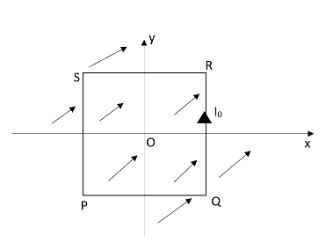
A uniform, constant magnetic field B directed at an angle of $45{}^\circ $ to the x-axis in the x-y plane. PQRS is a rigid, square wire frame carrying a steady current ${{I}_{0}}$, with its centre at the origin O. At time $t=0$, the frame is at rest in the position shown in figure, with its sides parallel to the x- and y-axes. Each side of the frame is of mass $M$ and length $L$. If the angle by which the frame rotates under the action of this torque in a short interval of time $\Delta t$, and the axis about which this rotation occurs is $\theta =\dfrac{3}{X} \& \dfrac{{{I}_{0}}B}{M}\Delta {{t}^{2}}$. Find X? Given, moment of inertia of the frame about an axis through its centre perpendicular to its plane is $\left(\dfrac{4}{3} \right)M{{L}^{2}}$.
$\begin{align}
& A.\dfrac{3}{7}\dfrac{{{I}_{0}}B}{M}\Delta {{t}^{2}} \\
& B.\dfrac{3}{4}\dfrac{{{I}_{0}}B}{M}\Delta {{t}^{2}} \\
& C.\dfrac{3}{2}\dfrac{{{I}_{0}}B}{M}\Delta {{t}^{2}} \\
& D.\dfrac{3}{5}\dfrac{{{I}_{0}}B}{M}\Delta {{t}^{2}} \\
\end{align}$
Answer
 Verified
600.9k+ views
Hint: This question is solved using the perpendicular axes theorem. The perpendicular axis theorem says that a planar lamina is having a moment of inertia about an axis which is perpendicular to the plane of the lamina will be equivalent to the sum of the moments of inertia of the lamina around the two axes at the right angles to each other where the perpendicular axis passes through it. Here the equations of circular motion will be valid.
Complete answer:
The moment of inertia of the frame about QS using the theorem of perpendicular axis,
${{I}_{QS}}=\dfrac{1}{2}{{I}_{Z}}=\dfrac{1}{2}\left( \dfrac{4}{3}M{{L}^{2}} \right)=\dfrac{2}{3}M{{L}^{2}}$
As we all know, the angular acceleration is given as,
$\tau =I\alpha $
Rearranging the equation will give,
$\alpha =\dfrac{\tau }{I}$
Where $\tau $ be the torque and $I$be the moment of inertia.
$\alpha =\dfrac{\tau }{I}=\dfrac{3{{I}_{0}}{{L}^{2}}B}{2{{L}^{2}}M}$
Simplifying this equation will give the angular acceleration,
$\alpha =\dfrac{3{{I}_{0}}B}{2M}$
As we can see here the value of angular acceleration is constant. Therefore the equations of circular motion is applicable here.
Hence we can write that,
$\theta ={{\omega }_{0}}t+\dfrac{1}{2}\alpha {{t}^{2}}$
Where ${{\omega }_{0}}=0$.
Thus the angular acceleration will be,
$\theta =\dfrac{1}{2}\alpha {{t}^{2}}$
Substituting the value of angular acceleration in it,
$\theta =\dfrac{1}{2}\left( \dfrac{3{{I}_{0}}B}{2M} \right){{\left( \Delta t \right)}^{2}}=\dfrac{3}{4}\dfrac{{{I}_{0}}B}{M}\Delta {{t}^{2}}$
So, the correct answer is “Option B”.
Note:
Angular acceleration is defined as the variation in angular velocity divided by the time taken. There are two kinds of angular velocity. One is known as spin angular velocity and the other is known as orbital angular velocity.
Complete answer:
The moment of inertia of the frame about QS using the theorem of perpendicular axis,
${{I}_{QS}}=\dfrac{1}{2}{{I}_{Z}}=\dfrac{1}{2}\left( \dfrac{4}{3}M{{L}^{2}} \right)=\dfrac{2}{3}M{{L}^{2}}$
As we all know, the angular acceleration is given as,
$\tau =I\alpha $
Rearranging the equation will give,
$\alpha =\dfrac{\tau }{I}$
Where $\tau $ be the torque and $I$be the moment of inertia.
$\alpha =\dfrac{\tau }{I}=\dfrac{3{{I}_{0}}{{L}^{2}}B}{2{{L}^{2}}M}$
Simplifying this equation will give the angular acceleration,
$\alpha =\dfrac{3{{I}_{0}}B}{2M}$
As we can see here the value of angular acceleration is constant. Therefore the equations of circular motion is applicable here.
Hence we can write that,
$\theta ={{\omega }_{0}}t+\dfrac{1}{2}\alpha {{t}^{2}}$
Where ${{\omega }_{0}}=0$.
Thus the angular acceleration will be,
$\theta =\dfrac{1}{2}\alpha {{t}^{2}}$
Substituting the value of angular acceleration in it,
$\theta =\dfrac{1}{2}\left( \dfrac{3{{I}_{0}}B}{2M} \right){{\left( \Delta t \right)}^{2}}=\dfrac{3}{4}\dfrac{{{I}_{0}}B}{M}\Delta {{t}^{2}}$
So, the correct answer is “Option B”.
Note:
Angular acceleration is defined as the variation in angular velocity divided by the time taken. There are two kinds of angular velocity. One is known as spin angular velocity and the other is known as orbital angular velocity.
Recently Updated Pages
Master Class 12 Social Science: Engaging Questions & Answers for Success

Master Class 12 Physics: Engaging Questions & Answers for Success
Master Class 12 Maths: Engaging Questions & Answers for Success
Master Class 12 Economics: Engaging Questions & Answers for Success
Master Class 12 Chemistry: Engaging Questions & Answers for Success
Master Class 12 Business Studies: Engaging Questions & Answers for Success
Trending doubts
Which are the Top 10 Largest Countries of the World?
Draw a labelled sketch of the human eye class 12 physics CBSE
Explain the structure of megasporangium class 12 biology CBSE
What are the major means of transport Explain each class 12 social science CBSE
How many chromosomes are found in human ovum a 46 b class 12 biology CBSE
The diagram of the section of a maize grain is given class 12 biology CBSE