




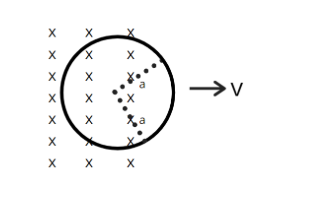
A uniform circular loop of radius a and resistance $R$ is pulled at a constant velocity $v$ out of a region of uniform magnetic field whose magnitude is $B$ . The plane of loop and the velocity are both perpendicular to $B$ . Then the electrical power in the circular loop at the instant when the arc (of circular loop) outside the region of magnetic field subtends an angle $\dfrac{\pi }{3}$ at centre of the loop is
Answer
 Verified
573.6k+ views
Hint: The concept of this question is based on electromagnetic induction and energy consideration and we are aware that lenz's law is consistent with the law of conservation of energy.
Complete step by step solution:
Given that,
Uniform circular loop of radius is = $a$
having resistance is = $R$
constant velocity is=$v$
magnitude of magnetic field is= $B$
and angle subtend is =$\dfrac{\pi }{3}$
We can see in the diagram, the loop is coming out of the magnetic field with a constant velocity $v$
Now calculate rate of change of the magnetic field,
and area enclosed by the magnetic field. So,
Area of circular loop $(A) = \pi {r^2}$
According to question $r = a$ ,
Now area become after putting $r$ as$a$,
Area $(A) = \pi {a^2}$ …………...(1)
\[
= \left[ {\pi {a^2}\left( {\dfrac{{2\theta }}{{2\pi }}} \right) - \dfrac{x}{2}2a\sin \theta } \right] \\
= \pi {a^2} - {a^2}\theta + ax\sin \theta \\
\]
\[ = \pi {a^2} - {a^2}{\cos ^{ - 1}}\left( {\dfrac{x}{a}} \right) + ax\sin \theta \]..............( 2)
Putting $ax\sin \theta $ =$ax\dfrac{{\sqrt {{x^2} - {a^2}} }}{a}$ ……………..( 3)
Putting value of (3) in (2) equation
We get,
$ = \pi {a^2} - {a^2}{\cos ^{ - 1}}\left( {\dfrac{x}{a}} \right) + ax\dfrac{{\sqrt {{x^2} - {a^2}} }}{a} $
Electromotive force given as
$\varepsilon = \dfrac{{d\phi }}{{dt}}$
The rate of change in the magnetic flux passing through the loop is
$\varepsilon = B\dfrac{{dA}}{{dt}}$
Now differentiate the area of loop,
$\dfrac{{dA}}{{dt}} = 0 + \dfrac{{{a^2}}}{{\sqrt {1 - \dfrac{{{x^2}}}{{{a^2}}}} }} \times \dfrac{1}{a}\dfrac{{dx}}{{dt}} + \left[ {\sqrt {{a^2} - {x^2}} - \dfrac{x}{2}\dfrac{{2x}}{{\sqrt {{x^2} - {a^2}} }}} \right]\dfrac{{dx}}{{dt}}$
Now do some basic calculation solve above equation,
As we now, $x = \dfrac{{\sqrt 3 a}}{2}$
We get, $\dfrac{{dA}}{{dt}} = av$ and
For electric power in the circular loop at the instant when the arc outside the region of magnetic field,
$ P = \dfrac{{{\varepsilon ^2}}}{R} \\
P = {B^2} \times \dfrac{1}{R}{\left( {\dfrac{{dA}}{{dt}}} \right)^2} \\
P = \dfrac{{{B^2}{a^2}{v^2}}}{R} \\
$
Hence, Electric power in the circular loop is $P = \dfrac{{{B^2}{a^2}{v^2}}}{R}$
Note:If the magnetic field is increasing, the induced field acts in the opposite direction but in the case we just take positive electromotive force because no opposition component is acting on the system.
Complete step by step solution:
Given that,
Uniform circular loop of radius is = $a$
having resistance is = $R$
constant velocity is=$v$
magnitude of magnetic field is= $B$
and angle subtend is =$\dfrac{\pi }{3}$
We can see in the diagram, the loop is coming out of the magnetic field with a constant velocity $v$
Now calculate rate of change of the magnetic field,
and area enclosed by the magnetic field. So,
Area of circular loop $(A) = \pi {r^2}$
According to question $r = a$ ,
Now area become after putting $r$ as$a$,
Area $(A) = \pi {a^2}$ …………...(1)
\[
= \left[ {\pi {a^2}\left( {\dfrac{{2\theta }}{{2\pi }}} \right) - \dfrac{x}{2}2a\sin \theta } \right] \\
= \pi {a^2} - {a^2}\theta + ax\sin \theta \\
\]
\[ = \pi {a^2} - {a^2}{\cos ^{ - 1}}\left( {\dfrac{x}{a}} \right) + ax\sin \theta \]..............( 2)
Putting $ax\sin \theta $ =$ax\dfrac{{\sqrt {{x^2} - {a^2}} }}{a}$ ……………..( 3)
Putting value of (3) in (2) equation
We get,
$ = \pi {a^2} - {a^2}{\cos ^{ - 1}}\left( {\dfrac{x}{a}} \right) + ax\dfrac{{\sqrt {{x^2} - {a^2}} }}{a} $
Electromotive force given as
$\varepsilon = \dfrac{{d\phi }}{{dt}}$
The rate of change in the magnetic flux passing through the loop is
$\varepsilon = B\dfrac{{dA}}{{dt}}$
Now differentiate the area of loop,
$\dfrac{{dA}}{{dt}} = 0 + \dfrac{{{a^2}}}{{\sqrt {1 - \dfrac{{{x^2}}}{{{a^2}}}} }} \times \dfrac{1}{a}\dfrac{{dx}}{{dt}} + \left[ {\sqrt {{a^2} - {x^2}} - \dfrac{x}{2}\dfrac{{2x}}{{\sqrt {{x^2} - {a^2}} }}} \right]\dfrac{{dx}}{{dt}}$
Now do some basic calculation solve above equation,
As we now, $x = \dfrac{{\sqrt 3 a}}{2}$
We get, $\dfrac{{dA}}{{dt}} = av$ and
For electric power in the circular loop at the instant when the arc outside the region of magnetic field,
$ P = \dfrac{{{\varepsilon ^2}}}{R} \\
P = {B^2} \times \dfrac{1}{R}{\left( {\dfrac{{dA}}{{dt}}} \right)^2} \\
P = \dfrac{{{B^2}{a^2}{v^2}}}{R} \\
$
Hence, Electric power in the circular loop is $P = \dfrac{{{B^2}{a^2}{v^2}}}{R}$
Note:If the magnetic field is increasing, the induced field acts in the opposite direction but in the case we just take positive electromotive force because no opposition component is acting on the system.
Recently Updated Pages
Master Class 12 Economics: Engaging Questions & Answers for Success

Master Class 12 Physics: Engaging Questions & Answers for Success
Master Class 12 English: Engaging Questions & Answers for Success
Master Class 12 Social Science: Engaging Questions & Answers for Success
Master Class 12 Maths: Engaging Questions & Answers for Success
Master Class 12 Business Studies: Engaging Questions & Answers for Success
Trending doubts
Which are the Top 10 Largest Countries of the World?
What are the major means of transport Explain each class 12 social science CBSE
Draw a labelled sketch of the human eye class 12 physics CBSE
Why cannot DNA pass through cell membranes class 12 biology CBSE
Differentiate between insitu conservation and exsitu class 12 biology CBSE
Draw a neat and well labeled diagram of TS of ovary class 12 biology CBSE