




A tuning fork P of unknown frequency gives 7 beats in 2 seconds with another tuning fork Q. When Q runs towards a wall with a speed of 5m/s it gives 5 beats per second with its echo. On loading P with wax, it gives 5 beats per second with Q. What is the frequency of P (in Hz)? Assume speed of sound = 332 m/s.
Answer
 Verified
619.2k+ views
Hint: First we need to obtain the relation between initial frequencies and beat frequency. The relative movement of Q and the echo gives rise to the doppler effect. By applying the appropriate condition for the doppler effect, we get the frequency of Q. Now, after understanding the loading of P and its significance, we can have the value of P.
Formula used:
$\beta = |{f_1} - {f_2}|$
$f' = {f_0}\left( {\dfrac{{v \pm {v_o}}}{{v \pm {v_s}}}} \right)$
Complete answer:
The beat frequency ($\beta $) is the no. of beats per unit time. It is given by
$\beta = |{f_1} - {f_2}|$
Where ${f_1}$ and ${f_2}$ are the given frequencies.
Let the unknown frequency of P and Q be ${f_P}$ and ${f_Q}$ respectively. Applying the beats formula, we have
$\eqalign{
& {\beta _1} = \dfrac{7}{2} \cr
& \Rightarrow |{f_P} - {f_Q}| = 3.5Hz \cr} $
It is mentioned in the question that, when Q runs towards a wall with a speed of 5m/s it gives 5 beats per second with its echo, as shown in the figure
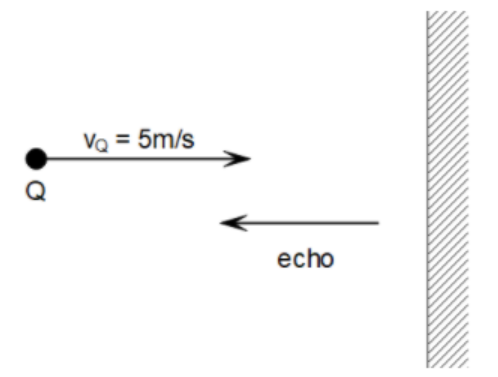
This leads to a Doppler effect. The general formula for the Doppler effect is given by
$f' = {f_0}\left( {\dfrac{{v \pm {v_o}}}{{v \pm {v_s}}}} \right)$
Here,
$f'$ is the observed frequency
${f_0}$ is the emitted frequency
$v$ is the velocity of sound in the medium
${v_o}$ is the velocity of the object
${v_s}$ is the velocity of the source.
In the first case, the source (Q) is said to be moving with velocity ${v_Q}$ , and the object (wall) is said to be stationary. So, the Doppler’s equation for this condition is given as
$f{'_Q} = {f_Q}\left[ {\dfrac{v}{{v - {v_Q}}}} \right]$
Where
$f{'_Q}$ is the observed frequency due to Q
${f_Q}$is the emitted frequency
$v$ is the velocity of sound in air
${v_Q}$ is the velocity of Q
Similarly, in the next case the echo itself acts as a stationary source and the Q acts as a moving object. But here the emitted frequency will be the observed frequency of the previous condition. So, the emitted frequency due to the echo $f{'_E}$ is given by
$\eqalign{
& f{'_E} = f{'_Q}\left( {\dfrac{{v + {v_Q}}}{v}} \right) \cr
& \Rightarrow f{'_E} = {f_Q}\left( {\dfrac{v}{{v - {v_Q}}}} \right) \times \left( {\dfrac{{v + {v_Q}}}{v}} \right) \cr
& \Rightarrow f{'_E} = {f_Q}\left( {\dfrac{{v + {v_Q}}}{{v - {v_Q}}}} \right) \cr} $
It is mentioned in the question that, as Q runs towards the wall with a speed of 5m/s it gives 5 beats per second with its echo. Using this condition and the equations obtained above, we have
$\eqalign{
& {\beta _2} = |f{'_Q} - f{'_E}| = 5Hz \cr
& \Rightarrow |f{'_Q} - f{'_E}| = 5Hz \cr
& \Rightarrow \left| {{f_Q}\left( {\dfrac{{v + {v_Q}}}{{v - {v_Q}}}} \right) - {f_Q}\left( {\dfrac{v}{{v - {v_Q}}}} \right)} \right| = 5Hz \cr
& \Rightarrow \left| {{f_Q}\left( {\dfrac{{{v_Q}}}{{v - {v_Q}}}} \right)} \right| = 5Hz \cr
& \Rightarrow \left| {{f_Q}\left( {\dfrac{5}{{332 - 5}}} \right)} \right| = 5Hz \cr
& \Rightarrow {f_Q} = 327Hz \cr} $
It is given that loading is done on P, this indicates the decrease in the frequency of P. Now, if you observe, the beat frequency has increased from 3.5Hz to 5Hz, we can say that this is due to a decrease in the frequency of P. This essentially concludes that ${f_P} < {f_Q}$.
So, the initial beat frequency ${\beta _1}$ can be resolved by removing the modulus as follows
$\eqalign{
& {\beta _1} = |{f_P} - {f_Q}| = 3.5Hz \cr
& \Rightarrow {f_Q} - {f_P} = 3.5Hz \cr
& \Rightarrow {f_P} = 327Hz - 3.5Hz = 323.5Hz \cr
& \therefore {f_P} = 323.5Hz \cr} $
Therefore, the frequency of P is 323.5Hz.
Note:
One must remember that loading of any tuning fork decreases its frequency. Contrary to this, the filing of a tuning fork increases its frequency. It is because of the change in the inertia of the tuning fork which is a property of mass. As the tuning fork is loaded with wax, inertia increases resulting in decrease of frequency. Incase of filing, the inertia decreases, so the frequency increases.
The echo will have the same speed as a sound.
The beats frequency has the same units as frequency.
Formula used:
$\beta = |{f_1} - {f_2}|$
$f' = {f_0}\left( {\dfrac{{v \pm {v_o}}}{{v \pm {v_s}}}} \right)$
Complete answer:
The beat frequency ($\beta $) is the no. of beats per unit time. It is given by
$\beta = |{f_1} - {f_2}|$
Where ${f_1}$ and ${f_2}$ are the given frequencies.
Let the unknown frequency of P and Q be ${f_P}$ and ${f_Q}$ respectively. Applying the beats formula, we have
$\eqalign{
& {\beta _1} = \dfrac{7}{2} \cr
& \Rightarrow |{f_P} - {f_Q}| = 3.5Hz \cr} $
It is mentioned in the question that, when Q runs towards a wall with a speed of 5m/s it gives 5 beats per second with its echo, as shown in the figure
This leads to a Doppler effect. The general formula for the Doppler effect is given by
$f' = {f_0}\left( {\dfrac{{v \pm {v_o}}}{{v \pm {v_s}}}} \right)$
Here,
$f'$ is the observed frequency
${f_0}$ is the emitted frequency
$v$ is the velocity of sound in the medium
${v_o}$ is the velocity of the object
${v_s}$ is the velocity of the source.
In the first case, the source (Q) is said to be moving with velocity ${v_Q}$ , and the object (wall) is said to be stationary. So, the Doppler’s equation for this condition is given as
$f{'_Q} = {f_Q}\left[ {\dfrac{v}{{v - {v_Q}}}} \right]$
Where
$f{'_Q}$ is the observed frequency due to Q
${f_Q}$is the emitted frequency
$v$ is the velocity of sound in air
${v_Q}$ is the velocity of Q
Similarly, in the next case the echo itself acts as a stationary source and the Q acts as a moving object. But here the emitted frequency will be the observed frequency of the previous condition. So, the emitted frequency due to the echo $f{'_E}$ is given by
$\eqalign{
& f{'_E} = f{'_Q}\left( {\dfrac{{v + {v_Q}}}{v}} \right) \cr
& \Rightarrow f{'_E} = {f_Q}\left( {\dfrac{v}{{v - {v_Q}}}} \right) \times \left( {\dfrac{{v + {v_Q}}}{v}} \right) \cr
& \Rightarrow f{'_E} = {f_Q}\left( {\dfrac{{v + {v_Q}}}{{v - {v_Q}}}} \right) \cr} $
It is mentioned in the question that, as Q runs towards the wall with a speed of 5m/s it gives 5 beats per second with its echo. Using this condition and the equations obtained above, we have
$\eqalign{
& {\beta _2} = |f{'_Q} - f{'_E}| = 5Hz \cr
& \Rightarrow |f{'_Q} - f{'_E}| = 5Hz \cr
& \Rightarrow \left| {{f_Q}\left( {\dfrac{{v + {v_Q}}}{{v - {v_Q}}}} \right) - {f_Q}\left( {\dfrac{v}{{v - {v_Q}}}} \right)} \right| = 5Hz \cr
& \Rightarrow \left| {{f_Q}\left( {\dfrac{{{v_Q}}}{{v - {v_Q}}}} \right)} \right| = 5Hz \cr
& \Rightarrow \left| {{f_Q}\left( {\dfrac{5}{{332 - 5}}} \right)} \right| = 5Hz \cr
& \Rightarrow {f_Q} = 327Hz \cr} $
It is given that loading is done on P, this indicates the decrease in the frequency of P. Now, if you observe, the beat frequency has increased from 3.5Hz to 5Hz, we can say that this is due to a decrease in the frequency of P. This essentially concludes that ${f_P} < {f_Q}$.
So, the initial beat frequency ${\beta _1}$ can be resolved by removing the modulus as follows
$\eqalign{
& {\beta _1} = |{f_P} - {f_Q}| = 3.5Hz \cr
& \Rightarrow {f_Q} - {f_P} = 3.5Hz \cr
& \Rightarrow {f_P} = 327Hz - 3.5Hz = 323.5Hz \cr
& \therefore {f_P} = 323.5Hz \cr} $
Therefore, the frequency of P is 323.5Hz.
Note:
One must remember that loading of any tuning fork decreases its frequency. Contrary to this, the filing of a tuning fork increases its frequency. It is because of the change in the inertia of the tuning fork which is a property of mass. As the tuning fork is loaded with wax, inertia increases resulting in decrease of frequency. Incase of filing, the inertia decreases, so the frequency increases.
The echo will have the same speed as a sound.
The beats frequency has the same units as frequency.
Recently Updated Pages
Master Class 12 Economics: Engaging Questions & Answers for Success

Master Class 12 English: Engaging Questions & Answers for Success
Master Class 12 Social Science: Engaging Questions & Answers for Success
Master Class 12 Maths: Engaging Questions & Answers for Success
Master Class 12 Physics: Engaging Questions & Answers for Success
Master Class 12 Business Studies: Engaging Questions & Answers for Success
Trending doubts
Which are the Top 10 Largest Countries of the World?
Draw a labelled sketch of the human eye class 12 physics CBSE
Differentiate between homogeneous and heterogeneous class 12 chemistry CBSE
Why is the cell called the structural and functional class 12 biology CBSE
Draw ray diagrams each showing i myopic eye and ii class 12 physics CBSE
Which is the correct genotypic ratio of mendel dihybrid class 12 biology CBSE