




A triangle by the line $y = 0,{\text{ }}y = x{\text{ and }}x = 4$revolves about the $x$-axis. Find the volume of the solid of revolution.
Answer
 Verified
617.4k+ views
Hint: - Draw the triangle using the given conditions first . Now, since this triangle is revolving around $x$-axis use the formula of volume of solid of revolution around $x$-axis that is $\int\limits_0^x {\pi {y^2}dx} $.
Complete step-by-step answer:
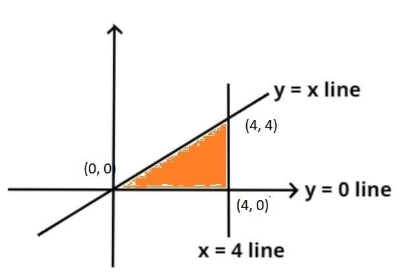
The pictorial representation of the lines $y = 0,{\text{ }}y = x{\text{ and }}x = 4$ is shown above.
Now it is given that$y = x$, so when $y = 0$
$ \Rightarrow x = 0$
Now, when $x = 4$
$ \Rightarrow y = x = 4$
So the intersection point is $\left( {4,4} \right)$
Now, as we know that volume\[\left( V \right)\] of solid of revolution around $x$-axis is $\int\limits_0^x {\pi {y^2}dx} $
Now as we see integration is about x-axis so we have to put the integration limits of x.
So, the integration limit is from 0 to 4 because $x$is from 0 to 4.
$ \Rightarrow V = \int\limits_0^4 {\pi {y^2}dx} $
Now put $y = x$
$ \Rightarrow V = \int\limits_0^4 {\pi {x^2}dx} $
As, you know integration of$\int {{x^n}dx = \dfrac{{{x^{n + 1}}}}{{n + 1}}} + c$, where c is some arbitrary integration constant, so use this basic property of integration we have,
$ \Rightarrow V = \pi \left[ {\dfrac{{{x^3}}}{3}} \right]_0^4$
Now, apply integration limit
$ \Rightarrow V = \pi \left[ {\dfrac{{{4^3}}}{3} - 0} \right] = \dfrac{{64\pi }}{3}$
So, this is the required volume of the solid of revolution.
Note: - In such types of questions the key concept we have to remember is that always remember the formula of solid of revolution around $x$-axis, and the required volume is the revolution of shaded region around $x$-axis, then simplify the integration using some basic formula which is stated above, we will get the required answer.
Complete step-by-step answer:
The pictorial representation of the lines $y = 0,{\text{ }}y = x{\text{ and }}x = 4$ is shown above.
Now it is given that$y = x$, so when $y = 0$
$ \Rightarrow x = 0$
Now, when $x = 4$
$ \Rightarrow y = x = 4$
So the intersection point is $\left( {4,4} \right)$
Now, as we know that volume\[\left( V \right)\] of solid of revolution around $x$-axis is $\int\limits_0^x {\pi {y^2}dx} $
Now as we see integration is about x-axis so we have to put the integration limits of x.
So, the integration limit is from 0 to 4 because $x$is from 0 to 4.
$ \Rightarrow V = \int\limits_0^4 {\pi {y^2}dx} $
Now put $y = x$
$ \Rightarrow V = \int\limits_0^4 {\pi {x^2}dx} $
As, you know integration of$\int {{x^n}dx = \dfrac{{{x^{n + 1}}}}{{n + 1}}} + c$, where c is some arbitrary integration constant, so use this basic property of integration we have,
$ \Rightarrow V = \pi \left[ {\dfrac{{{x^3}}}{3}} \right]_0^4$
Now, apply integration limit
$ \Rightarrow V = \pi \left[ {\dfrac{{{4^3}}}{3} - 0} \right] = \dfrac{{64\pi }}{3}$
So, this is the required volume of the solid of revolution.
Note: - In such types of questions the key concept we have to remember is that always remember the formula of solid of revolution around $x$-axis, and the required volume is the revolution of shaded region around $x$-axis, then simplify the integration using some basic formula which is stated above, we will get the required answer.
Recently Updated Pages
Master Class 12 Economics: Engaging Questions & Answers for Success

Master Class 12 Physics: Engaging Questions & Answers for Success
Master Class 12 English: Engaging Questions & Answers for Success
Master Class 12 Social Science: Engaging Questions & Answers for Success
Master Class 12 Maths: Engaging Questions & Answers for Success
Master Class 12 Business Studies: Engaging Questions & Answers for Success
Trending doubts
Which are the Top 10 Largest Countries of the World?
What are the major means of transport Explain each class 12 social science CBSE
Draw a labelled sketch of the human eye class 12 physics CBSE
Why cannot DNA pass through cell membranes class 12 biology CBSE
Differentiate between insitu conservation and exsitu class 12 biology CBSE
Draw a neat and well labeled diagram of TS of ovary class 12 biology CBSE