




A trapezium is inscribed in the parabola \[{y^2} = 4x\], such that its diagonals pass through the point \[\left( {1,0} \right)\] and each has length \[\dfrac{{25}}{4}\]. If the area of the trapezium be \[P\], then \[4P\] is equal to
Answer
 Verified
596.1k+ views
Hint:
Here, we will first draw a figure to show the given condition. We will then find the focal chord and the coordinates of the trapezium. Using this we will find the sides and the height of the trapezium. Then we will substitute these values in the formula of area of trapezium and hence, find the required value of \[4P\].
Formula Used:
Area of trapezium \[ABCD = \dfrac{1}{2} \times \] sum of parallel sides \[ \times \] height
Complete step by step solution:
First we will draw a parabola \[{y^2} = 4x\] which opens toward the positive side of the \[x\] axis.
Now, since, the trapezium is inscribed in this parabola, we will draw a trapezium such that its corners touch the parabola.
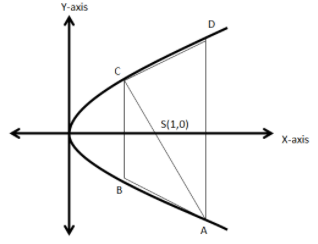
Now, let the focus of the trapezium be \[S\left( {1,0} \right)\] through which the diagonals of the trapezium passes and are of the length\[\dfrac{{25}}{4}\].
Now, let \[AS = x\] and, diagonal \[AC = \dfrac{{25}}{4}\]. Now we can write diagonal AC as a sum of AS and SC. So,
\[AS + SC = AC\]…………………………….\[\left( 1 \right)\]
Substituting \[AS = x\] and \[AC = \dfrac{{25}}{4}\] in the above equation, we get
\[ \Rightarrow x + SC = \dfrac{{25}}{4}\]
Subtracting \[x\] from both the sides, we get
\[ \Rightarrow SC = \dfrac{{25}}{4} - x\]
Now taking reciprocal of equation \[\left( 1 \right)\], we can write it as:
\[\dfrac{1}{{AS}} + \dfrac{1}{{SC}} = \dfrac{1}{{AC}}\]……………………….\[\left( 2 \right)\]
Substituting \[SC = \dfrac{{25}}{4} - x\], \[AS = x\] and \[AC = 1\] in equation \[\left( 2 \right)\], we get
\[ \Rightarrow \dfrac{1}{x} + \dfrac{1}{{\left( {\dfrac{{25}}{4} - x} \right)}} = \dfrac{1}{1}\]
Taking LCM on left hand side of the above equation, we get,
\[ \Rightarrow \dfrac{{\left( {\dfrac{{25}}{4} - x + x} \right)}}{{x\left( {\dfrac{{25}}{4} - x} \right)}} = 1\]
On cross multiplication, we get
\[ \Rightarrow \dfrac{{25}}{4} = \dfrac{{25}}{4}x - {x^2}\]
Taking LCM on RHS, we get
\[ \Rightarrow \dfrac{{25}}{4} = \dfrac{{25x - 4{x^2}}}{4}\]
\[ \Rightarrow 25 = 25x - 4{x^2}\]
Rewriting the above equation, we get
\[ \Rightarrow 4{x^2} - 25x + 25 = 0\]
The above equation is a quadratic equation, so we will factorize the equation to get the value of \[x\].
Now, splitting the middle term, we get
\[ \Rightarrow 4{x^2} - 20x - 5x + 25 = 0\]
\[ \Rightarrow 4x\left( {x - 5} \right) - 5\left( {x - 5} \right) = 0\]
Factoring out the common term, we get
\[ \Rightarrow \left( {4x - 5} \right)\left( {x - 5} \right) = 0\]
Applying zero product property, we get
\[ \Rightarrow \left( {4x - 5} \right) = 0\] or \[\left( {x - 5} \right) = 0\]
Hence,
\[x = \dfrac{5}{4}\] or \[x = 5\]
Now, since \[AC\] is the focal chord, hence, we can write,
\[AS = x = \left( {1 + {t^2}} \right)\]………………………..\[\left( 3 \right)\]
Now, substituting \[x = \dfrac{5}{4}\] in the above equation, we get
\[ \Rightarrow \dfrac{5}{4} = \left( {1 + {t^2}} \right)\]
Subtracting 1 from both sides, we get
\[ \Rightarrow \dfrac{5}{4} - 1 = {t^2}\]
\[ \Rightarrow \dfrac{1}{4} = {t^2}\]
Rewriting the above equation, we get
\[ \Rightarrow {\left( {\dfrac{1}{2}} \right)^2} = {t^2}\]
Taking square root on both sides, we get
\[ \Rightarrow t = \pm \dfrac{1}{2}\]
Substituting \[x = 5\] in equation \[\left( 3 \right)\], we get
\[ \Rightarrow 5 = \left( {1 + {t^2}} \right)\]
Subtracting 1 from both sides, we get
\[\begin{array}{l} \Rightarrow {t^2} = 4\\ \Rightarrow {t^2} = {\left( 2 \right)^2}\end{array}\]
Taking square root on both sides, we get
\[ \Rightarrow t = \pm 2\]
Now, we will find the coordinates of the trapezium \[ABCD\]
Substituting \[a = 1\] and \[t = \pm \dfrac{1}{2}\] in the coordinates of the trapezium \[ABCD\], we get
Coordinates of \[A\left( {a{t^2},2at} \right) = \left( {1 \times \dfrac{1}{4},2 \times 1 \times \dfrac{1}{2}} \right) = A\left( {\dfrac{1}{4},1} \right)\],
Coordinates of \[D\left( {a{t^2},2at} \right) = \left( {1 \times \dfrac{1}{4},2 \times 1 \times \dfrac{{ - 1}}{2}} \right) = A\left( {\dfrac{1}{4}, - 1} \right)\]
Coordinates of \[B\left( {\dfrac{a}{{{t^2}}},\dfrac{{2a}}{t}} \right) = \left( {\dfrac{1}{{\dfrac{1}{4}}},\dfrac{{2 \times 1}}{{\dfrac{1}{2}}}} \right) = \left( {4,4} \right)\]
Coordinates of \[C\left( {\dfrac{a}{{{t^2}}},\dfrac{{2a}}{t}} \right) = \left( {\dfrac{1}{{\dfrac{1}{4}}},\dfrac{{2 \times 1}}{{\dfrac{{ - 1}}{2}}}} \right) = \left( {4, - 4} \right)\]
Now, by distance formula, \[\sqrt {{{\left( {{x_2} - {x_1}} \right)}^2} + {{\left( {{y_2} - {y_1}} \right)}^2}} \], we get
Distance of \[AD = \sqrt {{{\left( {\dfrac{1}{4} - \dfrac{1}{4}} \right)}^2} + {{\left( { - 1 - 1} \right)}^2}} = \sqrt 4 = 2{\rm{ units}}\]
Distance of \[BC = \sqrt {{{\left( {4 - 4} \right)}^2} + {{\left( { - 4 - 4} \right)}^2}} = \sqrt {64} = 8{\rm{ units}}\]
$\therefore $ Height of the trapezium or Distance between the lines \[AD\] and \[BC = 4 - \dfrac{1}{4} = \dfrac{{15}}{4}{\rm{ units}}\]
Now, according to the question, the area of the trapezium is \[P\]
As we know,
Area of trapezium \[ABCD = \dfrac{1}{2} \times \]sum of parallel sides\[ \times \]height
\[ \Rightarrow P = \dfrac{1}{2}\left( {2 + 8} \right)\left( {\dfrac{{15}}{4}} \right)\]
Adding the terms in the bracket, we get
\[ \Rightarrow P = \dfrac{1}{2} \times 10 \times \left( {\dfrac{{15}}{4}} \right) = 5 \times \dfrac{{15}}{4}\]
Multiplying the terms, we get
\[ \Rightarrow P = \dfrac{{75}}{4}\]
$\therefore 4P=4\times \dfrac{75}{4}=75$ square units.
Therefore, if the area of the trapezium is \[P\], then \[4P\] is equal to 75 square units.
Note:
A parabola is a curve having a focus and a directrix, such that each point on parabola is at equal distance from them. Whereas, a trapezium is a quadrilateral which has one pair of its opposite sides parallel. Now, in this question, a trapezium is inscribed in a parabola. Hence, we will draw the largest possible trapezium which can be drawn inside a parabola to solve this question.
Here, we will first draw a figure to show the given condition. We will then find the focal chord and the coordinates of the trapezium. Using this we will find the sides and the height of the trapezium. Then we will substitute these values in the formula of area of trapezium and hence, find the required value of \[4P\].
Formula Used:
Area of trapezium \[ABCD = \dfrac{1}{2} \times \] sum of parallel sides \[ \times \] height
Complete step by step solution:
First we will draw a parabola \[{y^2} = 4x\] which opens toward the positive side of the \[x\] axis.
Now, since, the trapezium is inscribed in this parabola, we will draw a trapezium such that its corners touch the parabola.
Now, let the focus of the trapezium be \[S\left( {1,0} \right)\] through which the diagonals of the trapezium passes and are of the length\[\dfrac{{25}}{4}\].
Now, let \[AS = x\] and, diagonal \[AC = \dfrac{{25}}{4}\]. Now we can write diagonal AC as a sum of AS and SC. So,
\[AS + SC = AC\]…………………………….\[\left( 1 \right)\]
Substituting \[AS = x\] and \[AC = \dfrac{{25}}{4}\] in the above equation, we get
\[ \Rightarrow x + SC = \dfrac{{25}}{4}\]
Subtracting \[x\] from both the sides, we get
\[ \Rightarrow SC = \dfrac{{25}}{4} - x\]
Now taking reciprocal of equation \[\left( 1 \right)\], we can write it as:
\[\dfrac{1}{{AS}} + \dfrac{1}{{SC}} = \dfrac{1}{{AC}}\]……………………….\[\left( 2 \right)\]
Substituting \[SC = \dfrac{{25}}{4} - x\], \[AS = x\] and \[AC = 1\] in equation \[\left( 2 \right)\], we get
\[ \Rightarrow \dfrac{1}{x} + \dfrac{1}{{\left( {\dfrac{{25}}{4} - x} \right)}} = \dfrac{1}{1}\]
Taking LCM on left hand side of the above equation, we get,
\[ \Rightarrow \dfrac{{\left( {\dfrac{{25}}{4} - x + x} \right)}}{{x\left( {\dfrac{{25}}{4} - x} \right)}} = 1\]
On cross multiplication, we get
\[ \Rightarrow \dfrac{{25}}{4} = \dfrac{{25}}{4}x - {x^2}\]
Taking LCM on RHS, we get
\[ \Rightarrow \dfrac{{25}}{4} = \dfrac{{25x - 4{x^2}}}{4}\]
\[ \Rightarrow 25 = 25x - 4{x^2}\]
Rewriting the above equation, we get
\[ \Rightarrow 4{x^2} - 25x + 25 = 0\]
The above equation is a quadratic equation, so we will factorize the equation to get the value of \[x\].
Now, splitting the middle term, we get
\[ \Rightarrow 4{x^2} - 20x - 5x + 25 = 0\]
\[ \Rightarrow 4x\left( {x - 5} \right) - 5\left( {x - 5} \right) = 0\]
Factoring out the common term, we get
\[ \Rightarrow \left( {4x - 5} \right)\left( {x - 5} \right) = 0\]
Applying zero product property, we get
\[ \Rightarrow \left( {4x - 5} \right) = 0\] or \[\left( {x - 5} \right) = 0\]
Hence,
\[x = \dfrac{5}{4}\] or \[x = 5\]
Now, since \[AC\] is the focal chord, hence, we can write,
\[AS = x = \left( {1 + {t^2}} \right)\]………………………..\[\left( 3 \right)\]
Now, substituting \[x = \dfrac{5}{4}\] in the above equation, we get
\[ \Rightarrow \dfrac{5}{4} = \left( {1 + {t^2}} \right)\]
Subtracting 1 from both sides, we get
\[ \Rightarrow \dfrac{5}{4} - 1 = {t^2}\]
\[ \Rightarrow \dfrac{1}{4} = {t^2}\]
Rewriting the above equation, we get
\[ \Rightarrow {\left( {\dfrac{1}{2}} \right)^2} = {t^2}\]
Taking square root on both sides, we get
\[ \Rightarrow t = \pm \dfrac{1}{2}\]
Substituting \[x = 5\] in equation \[\left( 3 \right)\], we get
\[ \Rightarrow 5 = \left( {1 + {t^2}} \right)\]
Subtracting 1 from both sides, we get
\[\begin{array}{l} \Rightarrow {t^2} = 4\\ \Rightarrow {t^2} = {\left( 2 \right)^2}\end{array}\]
Taking square root on both sides, we get
\[ \Rightarrow t = \pm 2\]
Now, we will find the coordinates of the trapezium \[ABCD\]
Substituting \[a = 1\] and \[t = \pm \dfrac{1}{2}\] in the coordinates of the trapezium \[ABCD\], we get
Coordinates of \[A\left( {a{t^2},2at} \right) = \left( {1 \times \dfrac{1}{4},2 \times 1 \times \dfrac{1}{2}} \right) = A\left( {\dfrac{1}{4},1} \right)\],
Coordinates of \[D\left( {a{t^2},2at} \right) = \left( {1 \times \dfrac{1}{4},2 \times 1 \times \dfrac{{ - 1}}{2}} \right) = A\left( {\dfrac{1}{4}, - 1} \right)\]
Coordinates of \[B\left( {\dfrac{a}{{{t^2}}},\dfrac{{2a}}{t}} \right) = \left( {\dfrac{1}{{\dfrac{1}{4}}},\dfrac{{2 \times 1}}{{\dfrac{1}{2}}}} \right) = \left( {4,4} \right)\]
Coordinates of \[C\left( {\dfrac{a}{{{t^2}}},\dfrac{{2a}}{t}} \right) = \left( {\dfrac{1}{{\dfrac{1}{4}}},\dfrac{{2 \times 1}}{{\dfrac{{ - 1}}{2}}}} \right) = \left( {4, - 4} \right)\]
Now, by distance formula, \[\sqrt {{{\left( {{x_2} - {x_1}} \right)}^2} + {{\left( {{y_2} - {y_1}} \right)}^2}} \], we get
Distance of \[AD = \sqrt {{{\left( {\dfrac{1}{4} - \dfrac{1}{4}} \right)}^2} + {{\left( { - 1 - 1} \right)}^2}} = \sqrt 4 = 2{\rm{ units}}\]
Distance of \[BC = \sqrt {{{\left( {4 - 4} \right)}^2} + {{\left( { - 4 - 4} \right)}^2}} = \sqrt {64} = 8{\rm{ units}}\]
$\therefore $ Height of the trapezium or Distance between the lines \[AD\] and \[BC = 4 - \dfrac{1}{4} = \dfrac{{15}}{4}{\rm{ units}}\]
Now, according to the question, the area of the trapezium is \[P\]
As we know,
Area of trapezium \[ABCD = \dfrac{1}{2} \times \]sum of parallel sides\[ \times \]height
\[ \Rightarrow P = \dfrac{1}{2}\left( {2 + 8} \right)\left( {\dfrac{{15}}{4}} \right)\]
Adding the terms in the bracket, we get
\[ \Rightarrow P = \dfrac{1}{2} \times 10 \times \left( {\dfrac{{15}}{4}} \right) = 5 \times \dfrac{{15}}{4}\]
Multiplying the terms, we get
\[ \Rightarrow P = \dfrac{{75}}{4}\]
$\therefore 4P=4\times \dfrac{75}{4}=75$ square units.
Therefore, if the area of the trapezium is \[P\], then \[4P\] is equal to 75 square units.
Note:
A parabola is a curve having a focus and a directrix, such that each point on parabola is at equal distance from them. Whereas, a trapezium is a quadrilateral which has one pair of its opposite sides parallel. Now, in this question, a trapezium is inscribed in a parabola. Hence, we will draw the largest possible trapezium which can be drawn inside a parabola to solve this question.
Recently Updated Pages
Master Class 9 General Knowledge: Engaging Questions & Answers for Success

Master Class 9 Maths: Engaging Questions & Answers for Success
Master Class 9 Science: Engaging Questions & Answers for Success
Master Class 9 English: Engaging Questions & Answers for Success
Master Class 9 Social Science: Engaging Questions & Answers for Success
Class 9 Question and Answer - Your Ultimate Solutions Guide
Trending doubts
Which are the Top 10 Largest Countries of the World?
The total number of vertebrae in man is a30 b31 c32 class 12 biology CBSE
Draw a labelled sketch of the human eye class 12 physics CBSE
The number of cranial nerves in a frog is A 10 pairs class 12 biology CBSE
Differentiate between homogeneous and heterogeneous class 12 chemistry CBSE
Differentiate between Pyramid of energy and pyramid class 12 biology CBSE