




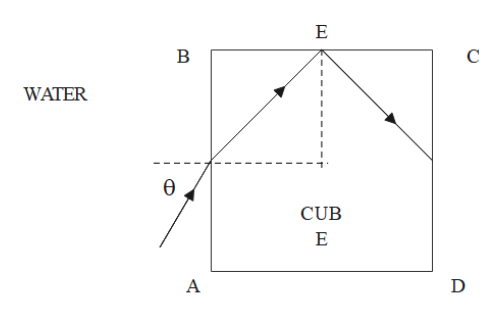
A transparent cube of side d, made of a material of refractive index ${{\mu }_{2}}$, is immersed in a liquid of refractive index ${{\mu }_{1}}({{\mu }_{1}}<{{\mu }_{2}})$. A ray is incident on the face ab at an angle $\theta $ (shown in the figure). Total internal reflection takes place at point E on the face BC. The $\theta $ must satisfy:
$\begin{align}
& a)\theta <{{\sin }^{-1}}(\dfrac{{{\mu }_{2}}}{{{\mu }_{1}}}) \\
& b)\theta <{{\sin }^{-1}}\sqrt{\dfrac{{{\mu }_{2}}^{2}}{{{\mu }_{1}}^{2}}-1} \\
& c)\theta >{{\sin }^{-1}}\dfrac{{{\mu }_{1}}}{{{\mu }_{2}}} \\
& d)\theta <{{\sin }^{-1}}\dfrac{{{\mu }_{2}}}{{{\mu }_{1}}} \\
\end{align}$
Answer
 Verified
620.4k+ views
Hint: Find the critical angle in terms of the refractive indices of the two media. Apply the condition of total internal reflection for the above point E. After finding the angle of incidence, we know total internal reflection occurs only if the angle of incidence is greater than the critical angle.
Formulas used:
$\begin{align}
& \sin c=\dfrac{{{\mu }_{1}}}{{{\mu }_{2}}} \\
& {{\mu }_{1}}\sin \theta ={{\mu }_{2}}\sin ({{90}^{0}}-C) \\
\end{align}$
Complete answer:
Let the critical angle for the ray travelling from liquid into the cube be c. Now, the critical angle can be defined as,
$\sin c=\dfrac{{{\mu }_{1}}}{{{\mu }_{2}}}$
Applying snell's law condition,
We get,
$\begin{align}
& \\
& {{\mu }_{1}}\sin \theta ={{\mu }_{2}}\sin ({{90}^{0}}-C) \\
& \sin \theta =\dfrac{{{\mu }_{2}}\sqrt{1-\dfrac{{{\mu }_{1}}^{2}}{{{\mu }_{2}}^{2}}}}{{{\mu }_{1}}} \\
& \theta ={{\sin }^{-1}}\sqrt{\dfrac{{{\mu }_{2}}^{2}}{{{\mu }_{1}}^{2}}-1} \\
\end{align}$
Now, for total internal reflection to occur,
$\theta <{{\sin }^{-1}}\sqrt{\dfrac{{{\mu }_{2}}^{2}}{{{\mu }_{1}}^{2}}-1}$
Therefore, the correct option is option b.
Additional information:
There are two conditions required for a ray for total internal reflection to occur, one is, light must be travelling from denser medium to rarer medium like glass to air, the next condition is the angle of incidence must be greater than the critical angle. Critical angle is defined as the angle of incidence that provides an angle of refraction of ninety degrees. Usually, for the water boundary, the critical angle is forty-eight degrees approximately. Critical angle is found using the snell's law where the angle of refraction must be taken as ninety degrees. Brewster’s angle is the angle of incidence at which light with a particular polarization is perfectly transmitted through a transparent dielectric surface, with no reflection. Light rays bend away from the normal if they are travelling from denser medium to rarer medium. Light rays tend to move closer to the normal when they are moving from rarer medium to denser medium.
Note:
For total internal reflection to occur, the angle of incidence must be greater than or equal to the critical angle. Also, total internal reflection occurs only when ray is traveling from denser medium to rarer medium but not in the reverse. If the incident angle is less than critical angle, it partly reflects and partly gets refracted.
Formulas used:
$\begin{align}
& \sin c=\dfrac{{{\mu }_{1}}}{{{\mu }_{2}}} \\
& {{\mu }_{1}}\sin \theta ={{\mu }_{2}}\sin ({{90}^{0}}-C) \\
\end{align}$
Complete answer:
Let the critical angle for the ray travelling from liquid into the cube be c. Now, the critical angle can be defined as,
$\sin c=\dfrac{{{\mu }_{1}}}{{{\mu }_{2}}}$
Applying snell's law condition,
We get,
$\begin{align}
& \\
& {{\mu }_{1}}\sin \theta ={{\mu }_{2}}\sin ({{90}^{0}}-C) \\
& \sin \theta =\dfrac{{{\mu }_{2}}\sqrt{1-\dfrac{{{\mu }_{1}}^{2}}{{{\mu }_{2}}^{2}}}}{{{\mu }_{1}}} \\
& \theta ={{\sin }^{-1}}\sqrt{\dfrac{{{\mu }_{2}}^{2}}{{{\mu }_{1}}^{2}}-1} \\
\end{align}$
Now, for total internal reflection to occur,
$\theta <{{\sin }^{-1}}\sqrt{\dfrac{{{\mu }_{2}}^{2}}{{{\mu }_{1}}^{2}}-1}$
Therefore, the correct option is option b.
Additional information:
There are two conditions required for a ray for total internal reflection to occur, one is, light must be travelling from denser medium to rarer medium like glass to air, the next condition is the angle of incidence must be greater than the critical angle. Critical angle is defined as the angle of incidence that provides an angle of refraction of ninety degrees. Usually, for the water boundary, the critical angle is forty-eight degrees approximately. Critical angle is found using the snell's law where the angle of refraction must be taken as ninety degrees. Brewster’s angle is the angle of incidence at which light with a particular polarization is perfectly transmitted through a transparent dielectric surface, with no reflection. Light rays bend away from the normal if they are travelling from denser medium to rarer medium. Light rays tend to move closer to the normal when they are moving from rarer medium to denser medium.
Note:
For total internal reflection to occur, the angle of incidence must be greater than or equal to the critical angle. Also, total internal reflection occurs only when ray is traveling from denser medium to rarer medium but not in the reverse. If the incident angle is less than critical angle, it partly reflects and partly gets refracted.
Recently Updated Pages
Master Class 12 Economics: Engaging Questions & Answers for Success

Master Class 12 English: Engaging Questions & Answers for Success
Master Class 12 Social Science: Engaging Questions & Answers for Success
Master Class 12 Maths: Engaging Questions & Answers for Success
Master Class 12 Physics: Engaging Questions & Answers for Success
Master Class 12 Business Studies: Engaging Questions & Answers for Success
Trending doubts
Which are the Top 10 Largest Countries of the World?
Draw a labelled sketch of the human eye class 12 physics CBSE
Differentiate between homogeneous and heterogeneous class 12 chemistry CBSE
Why is the cell called the structural and functional class 12 biology CBSE
Draw ray diagrams each showing i myopic eye and ii class 12 physics CBSE
Which is the correct genotypic ratio of mendel dihybrid class 12 biology CBSE