




A transistor has a base current of 1 mA and emitter current of 100 mA. The current transfer ratio will be
A. 0.9
B. 0.99
C. 1.1
D. 10.1
Answer
 Verified
653.7k+ views
Hint: We have been given the emitter current also known as input current and the base current in this question and asked to calculate the current transfer ratio. We know that, current transfer ratio is the ratio of output current over the input current. Therefore, we will be calculating the output current also known as collector current using the given values. We will then use this to calculate the current transfer ratio.
Formula used:
\[{{I}_{e}}={{I}_{c}}+{{I}_{b}}\]
Where,
\[{{I}_{c}}\] = output current or collector current
\[{{I}_{e}}\] = emitter current or input current
\[{{I}_{b}}\] = base current
\[\dfrac{{{I}_{c}}}{{{I}_{e}}}\] for the ratio.
Complete answer:
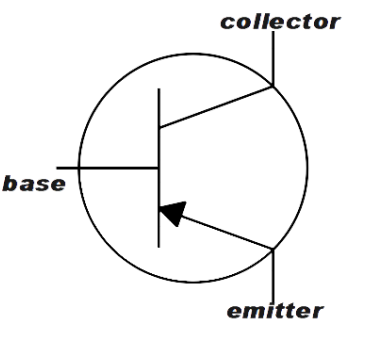
A transistor is a semiconductor device that is used to amplify the current or switch the electric power to on or off. A transistor has three terminals namely, the collector terminal, base terminal and the emitter terminal as shown in the figure. The collector current in a transistor is the amplified output current. While the emitter current is the addition of base current and the collector current.
Therefore, we can say that
\[{{I}_{e}}={{I}_{c}}+{{I}_{b}}\]
We have been given the value of emitter current = 100 mA and the base current = 1 mA
Therefore, solving for collector current
\[{{I}_{c}}={{I}_{e}}-{{I}_{b}}\]
After substituting the values,
We get,
\[{{I}_{c}}=100-1\]
Therefore,
\[{{I}_{c}}\] = 99 mA …………. (1)
Now, taking the ratio of \[\dfrac{{{I}_{c}}}{{{I}_{e}}}\] to calculate the current transfer ratio.
We get,
\[\dfrac{{{I}_{c}}}{{{I}_{e}}}\] = \[\dfrac{99}{100}\] …………….. (from equation 1)
Therefore,
\[\dfrac{{{I}_{c}}}{{{I}_{e}}}\] = 0.99
So, the correct answer is “Option B”.
Note:
The collector terminal of a transistor is positive lead while the emitter terminal is the negative lead. The base terminal is the lead responsible for the activation of the transistor. The name transistor is kind of an acronym for transfer resistor. It means that resistance is transferred in channels of the transistor. That is also the working principle of the transistor.
Formula used:
\[{{I}_{e}}={{I}_{c}}+{{I}_{b}}\]
Where,
\[{{I}_{c}}\] = output current or collector current
\[{{I}_{e}}\] = emitter current or input current
\[{{I}_{b}}\] = base current
\[\dfrac{{{I}_{c}}}{{{I}_{e}}}\] for the ratio.
Complete answer:
A transistor is a semiconductor device that is used to amplify the current or switch the electric power to on or off. A transistor has three terminals namely, the collector terminal, base terminal and the emitter terminal as shown in the figure. The collector current in a transistor is the amplified output current. While the emitter current is the addition of base current and the collector current.
Therefore, we can say that
\[{{I}_{e}}={{I}_{c}}+{{I}_{b}}\]
We have been given the value of emitter current = 100 mA and the base current = 1 mA
Therefore, solving for collector current
\[{{I}_{c}}={{I}_{e}}-{{I}_{b}}\]
After substituting the values,
We get,
\[{{I}_{c}}=100-1\]
Therefore,
\[{{I}_{c}}\] = 99 mA …………. (1)
Now, taking the ratio of \[\dfrac{{{I}_{c}}}{{{I}_{e}}}\] to calculate the current transfer ratio.
We get,
\[\dfrac{{{I}_{c}}}{{{I}_{e}}}\] = \[\dfrac{99}{100}\] …………….. (from equation 1)
Therefore,
\[\dfrac{{{I}_{c}}}{{{I}_{e}}}\] = 0.99
So, the correct answer is “Option B”.
Note:
The collector terminal of a transistor is positive lead while the emitter terminal is the negative lead. The base terminal is the lead responsible for the activation of the transistor. The name transistor is kind of an acronym for transfer resistor. It means that resistance is transferred in channels of the transistor. That is also the working principle of the transistor.
Recently Updated Pages
Which of the following graphs shows the variation of class 12 physics CBSE

Draw a labelled diagram of the human male reproductive class 12 biology CBSE
Describe the experiment to compare the emf of two cells class 12 physics CBSE
What is standard hydrogen electrode
What is conventional current and electric current class 12 physics CBSE
2Bromopentane is treated with an alcoholic KOH solution class 12 chemistry CBSE
Trending doubts
Draw a labelled sketch of the human eye class 12 physics CBSE
Which are the Top 10 Largest Countries of the World?
Differentiate between homogeneous and heterogeneous class 12 chemistry CBSE
Draw ray diagrams each showing i myopic eye and ii class 12 physics CBSE
Which is the correct genotypic ratio of mendel dihybrid class 12 biology CBSE
What is the Full Form of PVC, PET, HDPE, LDPE, PP and PS ?