




A train is running at $20\,m/s$ on a railway line with a radius of curvature 40,000 meters. The distance between the two rails is 1.5 meters. For safe running of train the elevation of outer rail over the inner rail is
A. $2 \cdot 0\,mm$
B. $1 \cdot 75\,mm$
C. $1 \cdot 50\,mm$
D. $1 \cdot 25\,mm$
Answer
 Verified
584.4k+ views
Hint:We know the concept of banking of roads when there is a curved path. Same concept is used here in order to provide a safe turn. The formula for finding the angle of elevation is
$\tan \,\theta = \dfrac{{{v^2}}}{{rg}}$
Where v is a velocity and g is acceleration due to gravity and r is the radius of curvature.
Tan of an angle can also be found by taking the ratio of opposite side to adjacent side.
$\tan \theta = \dfrac{{{\text{opposite}}\,{\text{side}}}}{{{\text{adjacent}}\,{\text{side}}}}$
Here, opposite side will be the elevation h and adjacent side is the width of the rail d. From this we can calculate the height of elevation.
Complete step-by-step solution:
It is given that the velocity of the train is $v = 20\,m/s$
The radius of curvature of the path is given as $r = 40000\,m$
The distance between the two rails is given as $d = 1.5\,m$
We need to find the elevation of the outer rail with respect to the inner rail for safe running of the train.
We know the concept of banking of roads in curved paths. The roads are made in such a way that the outer edge is made at an elevation with respect to the inner edge. This is a safety measure. By doing this necessary centripetal force for taking a safe turn can be provided. Similarly, for the safe turning of trains the rails are also constructed such that the outer rail will be at a higher level than the inner rail where the curved path is present.
In such cases the tan of angle of elevation is found out by the formula
$\tan \,\theta = \dfrac{{{v^2}}}{{rg}}$
Where v is a velocity and g is acceleration due to gravity and r is the radius of curvature.
By substituting the values we get $\tan \theta $ as
$\tan \,\theta = \dfrac{{{{\left( {20\,m/s} \right)}^2}}}{{40000\,m \times 10\,m/{s^2}}}$
$\therefore \tan \theta = 1 \times {10^{ - 3}}$
Tan of an angle can also be found by taking the ratio of opposite side to adjacent side.
$\tan \theta = \dfrac{{{\text{opposite}}\,{\text{side}}}}{{{\text{adjacent}}\,{\text{side}}}}$
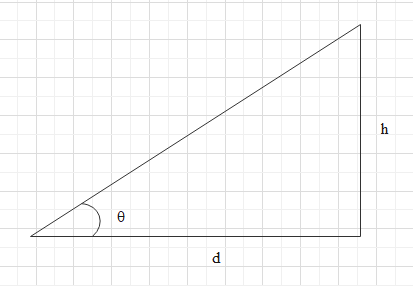
Here, opposite side will be the elevation h and adjacent side is the width of the rail d.
$\tan \theta = \dfrac{h}{d}$
By substituting the value of width of rail in this equation we get
$\tan \theta = \dfrac{h}{{1 \cdot 5}}$
$ \Rightarrow h = 1 \cdot 5\tan \,\theta $
$ \Rightarrow h = 1 \cdot 5 \times {10^{ - 3}}\,m$
$\therefore h = 1.5\,mm$
This is the elevation of the outer rail .
So the correct answer is option C.
Note:- Here we considered the angle of banking without friction. In the absence of friction
$\tan \,\theta = \dfrac{{{v^2}}}{{rg}}$ Where v is a velocity and g is acceleration due to gravity and r is the radius of curvature.
If friction is involved then the angle of banking with friction is given by the formula
$\dfrac{{\tan \,\theta + \mu }}{{1 - \mu \tan \theta }} = \dfrac{{{v^2}}}{{rg}}$
Where $\mu $ represents the coefficient of friction.
$\tan \,\theta = \dfrac{{{v^2}}}{{rg}}$
Where v is a velocity and g is acceleration due to gravity and r is the radius of curvature.
Tan of an angle can also be found by taking the ratio of opposite side to adjacent side.
$\tan \theta = \dfrac{{{\text{opposite}}\,{\text{side}}}}{{{\text{adjacent}}\,{\text{side}}}}$
Here, opposite side will be the elevation h and adjacent side is the width of the rail d. From this we can calculate the height of elevation.
Complete step-by-step solution:
It is given that the velocity of the train is $v = 20\,m/s$
The radius of curvature of the path is given as $r = 40000\,m$
The distance between the two rails is given as $d = 1.5\,m$
We need to find the elevation of the outer rail with respect to the inner rail for safe running of the train.
We know the concept of banking of roads in curved paths. The roads are made in such a way that the outer edge is made at an elevation with respect to the inner edge. This is a safety measure. By doing this necessary centripetal force for taking a safe turn can be provided. Similarly, for the safe turning of trains the rails are also constructed such that the outer rail will be at a higher level than the inner rail where the curved path is present.
In such cases the tan of angle of elevation is found out by the formula
$\tan \,\theta = \dfrac{{{v^2}}}{{rg}}$
Where v is a velocity and g is acceleration due to gravity and r is the radius of curvature.
By substituting the values we get $\tan \theta $ as
$\tan \,\theta = \dfrac{{{{\left( {20\,m/s} \right)}^2}}}{{40000\,m \times 10\,m/{s^2}}}$
$\therefore \tan \theta = 1 \times {10^{ - 3}}$
Tan of an angle can also be found by taking the ratio of opposite side to adjacent side.
$\tan \theta = \dfrac{{{\text{opposite}}\,{\text{side}}}}{{{\text{adjacent}}\,{\text{side}}}}$
Here, opposite side will be the elevation h and adjacent side is the width of the rail d.
$\tan \theta = \dfrac{h}{d}$
By substituting the value of width of rail in this equation we get
$\tan \theta = \dfrac{h}{{1 \cdot 5}}$
$ \Rightarrow h = 1 \cdot 5\tan \,\theta $
$ \Rightarrow h = 1 \cdot 5 \times {10^{ - 3}}\,m$
$\therefore h = 1.5\,mm$
This is the elevation of the outer rail .
So the correct answer is option C.
Note:- Here we considered the angle of banking without friction. In the absence of friction
$\tan \,\theta = \dfrac{{{v^2}}}{{rg}}$ Where v is a velocity and g is acceleration due to gravity and r is the radius of curvature.
If friction is involved then the angle of banking with friction is given by the formula
$\dfrac{{\tan \,\theta + \mu }}{{1 - \mu \tan \theta }} = \dfrac{{{v^2}}}{{rg}}$
Where $\mu $ represents the coefficient of friction.
Recently Updated Pages
Master Class 12 Economics: Engaging Questions & Answers for Success

Master Class 12 Physics: Engaging Questions & Answers for Success
Master Class 12 English: Engaging Questions & Answers for Success
Master Class 12 Social Science: Engaging Questions & Answers for Success
Master Class 12 Maths: Engaging Questions & Answers for Success
Master Class 12 Business Studies: Engaging Questions & Answers for Success
Trending doubts
Which are the Top 10 Largest Countries of the World?
What are the major means of transport Explain each class 12 social science CBSE
Draw a labelled sketch of the human eye class 12 physics CBSE
Why cannot DNA pass through cell membranes class 12 biology CBSE
Differentiate between insitu conservation and exsitu class 12 biology CBSE
Draw a neat and well labeled diagram of TS of ovary class 12 biology CBSE