




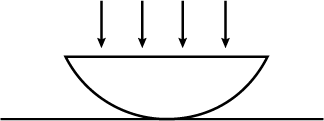
A thin slice is cut out of a glass cylinder along a plane parallel to its axis. The slice is placed on a flat glass plate as shown. What will be the observed interference fringes from this combination?
Answer
 Verified
471.3k+ views
Hint: Since the surface of the cylinder meets the glass plate along with the parallel line to the cylinder’s axis. The wedge shape increases on both the sides of the respected line. Locus of equal path difference is the lines running parallel to the axis of the cylinder. Hence, straight fringes are obtained.
Complete answer:
When a cylinder is placed on a glass plate with its curved surface touching the plane surface, a thin film is formed between the curved surface of the cylinder and the glass plate. The glass plate will touch the slice of the cylinder in a straight line parallel to the axis of the cylinder, and the thickness of the film increases as we move away from this straight line. The loci of all points having the same thickness are straight lines. Thus straight line fringes will appear in this combination. The fringe spacing will decrease as we go outwards.
Newton's rings are said to be a phenomenon in which an interference pattern is created by the light's reflection between two surfaces. The rings of Newton's are formed as a result of interference which is between the light waves that are reflected from the top and bottom surfaces of the air film formed between the lens and glass sheet.
The phenomenon of the formation of rings of Newton's can be explained on the basis of the theory of wave of light that is:
An air film which is of varying thickness is formed between the lens and the sheet of glass.
Note:
Circular rings (also called Newton's rings) are observed in interference pattern when a plano-convex lens of large focal length is placed with its convex surface in contact with a plane glass plate because the locus of equal path difference in this case is a circle.
Complete answer:
When a cylinder is placed on a glass plate with its curved surface touching the plane surface, a thin film is formed between the curved surface of the cylinder and the glass plate. The glass plate will touch the slice of the cylinder in a straight line parallel to the axis of the cylinder, and the thickness of the film increases as we move away from this straight line. The loci of all points having the same thickness are straight lines. Thus straight line fringes will appear in this combination. The fringe spacing will decrease as we go outwards.
Newton's rings are said to be a phenomenon in which an interference pattern is created by the light's reflection between two surfaces. The rings of Newton's are formed as a result of interference which is between the light waves that are reflected from the top and bottom surfaces of the air film formed between the lens and glass sheet.
The phenomenon of the formation of rings of Newton's can be explained on the basis of the theory of wave of light that is:
An air film which is of varying thickness is formed between the lens and the sheet of glass.
Note:
Circular rings (also called Newton's rings) are observed in interference pattern when a plano-convex lens of large focal length is placed with its convex surface in contact with a plane glass plate because the locus of equal path difference in this case is a circle.
Recently Updated Pages
Master Class 12 Economics: Engaging Questions & Answers for Success

Master Class 12 Physics: Engaging Questions & Answers for Success
Master Class 12 English: Engaging Questions & Answers for Success
Master Class 12 Social Science: Engaging Questions & Answers for Success
Master Class 12 Maths: Engaging Questions & Answers for Success
Master Class 12 Business Studies: Engaging Questions & Answers for Success
Trending doubts
Which are the Top 10 Largest Countries of the World?
What are the major means of transport Explain each class 12 social science CBSE
Draw a labelled sketch of the human eye class 12 physics CBSE
Why cannot DNA pass through cell membranes class 12 biology CBSE
Differentiate between insitu conservation and exsitu class 12 biology CBSE
Draw a neat and well labeled diagram of TS of ovary class 12 biology CBSE