




A thin Plano-convex lens acts like a concave mirror of focal length $0.2m$ when silvered from its plane surface. The refractive index of the material of the lens is $1.5$. The radius of curvature of the convex surface of the lens will be:
$\begin{align}
& \text{A}\text{. }0.1m \\
& \text{B}\text{. }0.75m \\
& \text{C}\text{. }0.4m \\
& \text{D}\text{. }0.2m \\
\end{align}$
Answer
 Verified
589.6k+ views
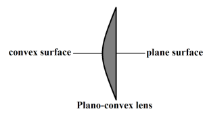
Hint: In a Plano-convex lens, one surface is curved outwards, that is, the convex surface, and the other surface is flat. The focal length of a Plano-convex lens can be determined using lens maker formula. The focal length of a plane or flat surface is infinity.
Formula used:
Lens maker formula:
$\dfrac{1}{f}=\left( \mu -1 \right)\left( \dfrac{1}{{{R}_{1}}}-\dfrac{1}{{{R}_{2}}} \right)$
Complete step by step answer:
Plano-convex lens is a type of lens that is plane on one side and convex on the other. Plano-convex lenses have one positive convex face and a flat or plane face on the opposite side of the lens. These lens elements focus parallel light rays into a focal point that is positive and forms a real image that can be projected on a screen or manipulated by spatial filters.
We are given that a thin Plano-convex lens acts like a concave mirror of focal length $0.2m$ when it is silvered from its plane surface,
Focal length Plano-convex lens, $f=0.2m=20cm$
Refractive index of material of lens (behaving like concave mirror), $\mu =1.5$
Using combinational lens formula, we have,
$\dfrac{1}{{{f}_{1}}}=\dfrac{2}{f}+\dfrac{1}{{{f}_{m}}}$
Where,
${{f}_{1}}$is the focal length of combination, that is, Plano-convex lens
$f$ is the focal length of convex surface of lens
${{f}_{m}}$ is the focal length of mirror surface
We have,
${{f}_{m}}=\infty $, because focal length of plane surface is infinite
$\dfrac{1}{{{f}_{1}}}=\dfrac{2}{f}+\dfrac{1}{{{f}_{m}}}$
Putting values of${{f}_{1}}$and ${{f}_{m}}$
$\begin{align}
& \dfrac{1}{{{f}_{1}}}=\dfrac{2}{f} \\
& f=2{{f}_{1}} \\
& f=2\times 20=40cm \\
\end{align}$
Using lens maker formula,
$\dfrac{1}{f}=\left( \mu -1 \right)\left( \dfrac{1}{{{R}_{1}}}-\dfrac{1}{{{R}_{2}}} \right)$
Putting values,
$\begin{align}
& f=40cm \\
& \mu =1.5 \\
& {{R}_{2}}=\infty \\
\end{align}$
We get,
$\begin{align}
& \dfrac{1}{40}=\left( 1.5-1 \right)\left( \dfrac{1}{{{R}_{1}}}-\dfrac{1}{\infty } \right) \\
& \dfrac{1}{40}=\dfrac{1}{2{{R}_{1}}} \\
& {{R}_{1}}=20cm \\
\end{align}$
The radius of curvature of the convex surface of the lens is $20cm$ or $0.2m$
Hence, the correct option is D.
Note:
A Plano-convex lens is a combination of two different types of surfaces, one flat and the other one being curved outwards. The focal length of a plane surface is always infinity. It can be assumed as a spherical surface of infinite radius of curvature. Since the radius of curvature of the plane surface is infinity, thus its focal length is also infinity. The focal length of a Plano-convex lens is determined using lens maker formula.
Formula used:
Lens maker formula:
$\dfrac{1}{f}=\left( \mu -1 \right)\left( \dfrac{1}{{{R}_{1}}}-\dfrac{1}{{{R}_{2}}} \right)$
Complete step by step answer:
Plano-convex lens is a type of lens that is plane on one side and convex on the other. Plano-convex lenses have one positive convex face and a flat or plane face on the opposite side of the lens. These lens elements focus parallel light rays into a focal point that is positive and forms a real image that can be projected on a screen or manipulated by spatial filters.
We are given that a thin Plano-convex lens acts like a concave mirror of focal length $0.2m$ when it is silvered from its plane surface,
Focal length Plano-convex lens, $f=0.2m=20cm$
Refractive index of material of lens (behaving like concave mirror), $\mu =1.5$
Using combinational lens formula, we have,
$\dfrac{1}{{{f}_{1}}}=\dfrac{2}{f}+\dfrac{1}{{{f}_{m}}}$
Where,
${{f}_{1}}$is the focal length of combination, that is, Plano-convex lens
$f$ is the focal length of convex surface of lens
${{f}_{m}}$ is the focal length of mirror surface
We have,
${{f}_{m}}=\infty $, because focal length of plane surface is infinite
$\dfrac{1}{{{f}_{1}}}=\dfrac{2}{f}+\dfrac{1}{{{f}_{m}}}$
Putting values of${{f}_{1}}$and ${{f}_{m}}$
$\begin{align}
& \dfrac{1}{{{f}_{1}}}=\dfrac{2}{f} \\
& f=2{{f}_{1}} \\
& f=2\times 20=40cm \\
\end{align}$
Using lens maker formula,
$\dfrac{1}{f}=\left( \mu -1 \right)\left( \dfrac{1}{{{R}_{1}}}-\dfrac{1}{{{R}_{2}}} \right)$
Putting values,
$\begin{align}
& f=40cm \\
& \mu =1.5 \\
& {{R}_{2}}=\infty \\
\end{align}$
We get,
$\begin{align}
& \dfrac{1}{40}=\left( 1.5-1 \right)\left( \dfrac{1}{{{R}_{1}}}-\dfrac{1}{\infty } \right) \\
& \dfrac{1}{40}=\dfrac{1}{2{{R}_{1}}} \\
& {{R}_{1}}=20cm \\
\end{align}$
The radius of curvature of the convex surface of the lens is $20cm$ or $0.2m$
Hence, the correct option is D.
Note:
A Plano-convex lens is a combination of two different types of surfaces, one flat and the other one being curved outwards. The focal length of a plane surface is always infinity. It can be assumed as a spherical surface of infinite radius of curvature. Since the radius of curvature of the plane surface is infinity, thus its focal length is also infinity. The focal length of a Plano-convex lens is determined using lens maker formula.
Recently Updated Pages
Explain the structure of megasporangium class 12 biology CBSE

Why is chloroform kept in dark coloured bottles class 12 chemistry CBSE
Derive the balancing condition of a Wheatstone bri class 12 physics CBSE
Draw VI characteristics of a pn junction diode Explain class 12 physics CBSE
Is it possible to carry pride in ones language too class 12 english CBSE
In a population at Hardy Weinberg equilibrium the allele class 12 biology CBSE
Trending doubts
Draw a labelled sketch of the human eye class 12 physics CBSE
Which are the Top 10 Largest Countries of the World?
Draw ray diagrams each showing i myopic eye and ii class 12 physics CBSE
Which is the correct genotypic ratio of mendel dihybrid class 12 biology CBSE
Differentiate between homogeneous and heterogeneous class 12 chemistry CBSE
Which animal never drinks water in its entire life class 12 biology CBSE