




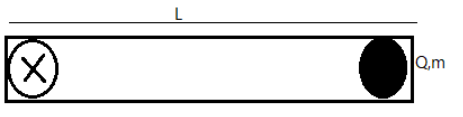
A thin homogeneous stick of mass $m$ and length $L$ may rotate in the vertical plane around a horizontal axle pivoted at one end of the stick. A small bar of mass $m$ and charge $Q$ is attached to the opposite end of this stick. The whole system is placed in a constant horizontal electric field of magnitude $E=\dfrac{mg}{2Q}$. The stick is held horizontally at the beginning. The acceleration of the small bar at the instant of releasing the stick is:
\[\begin{align}
& A.\dfrac{3g}{2} \\
& B.\dfrac{3g}{4} \\
& C.\dfrac{9g}{8} \\
& D.none \\
\end{align}\]
Answer
 Verified
584.7k+ views
Hint: Here the work done in by the charge and the rotation of the rod results in the torque due to the rotating rod. For the system to remain in equilibrium the torque on the system is equal to the work done on the system.
Formula: $\tau=WD$
Complete answer:
Let us consider a stick to be a rod of mass $m$ and length $L$ , then $I$will be the moment of inertia of the rod when rotated by an angular velocity $\omega$. Since the system is a combination of a spherical charge and a rod then $I=\dfrac{mL^{2}}{3}+mL^{2}=\dfrac{4mL^{2}}{3}$.
We know that the force on the charge due to gravity is given as $F=mg$, then the work done is given as $WD_{1}=mgL$
Similarly, the work done on the rod is given as $WD_{2}=mg\dfrac{L}{2}$ as the force acts on the centre of mass of the rod, which lies at a distance $\dfrac{L}{2}$
Due to rotation, the system experience a torque $\tau=I\omega$
Then the torque on the system is equal to the work done on the system.
$\tau=WD$
Then, substituting the values we get $\dfrac{4mL^{2}\omega}{3}=\dfrac{mgL}{2} +mgL$
$\implies \dfrac{2mL^{2}\omega}{3}=\dfrac{3mgL}{2}$
$\implies \dfrac{2L\omega}{3}=\dfrac{3g}{2}$
$\implies \omega=\dfrac{9g}{4L}$
We know that $v=\omega L$, where $v$ is the linear velocity.
Then $v=\dfrac{9g}{4L}\times l=\dfrac{9g}{8}$
Then the linear acceleration at the instant of releasing the stick is $\dfrac{9g}{8}$
Hence the answer is \[C.\dfrac{9g}{8}\] .
Note:
The electric field is an extra data, which we didn’t use in the sum. Here, the force due to the charge doesn’t contribute to the torque, as the force due to the charge acts in a different direction as compared to the direction of the torque. Only the work done in rotating the rod and charge is taken into account.
Formula: $\tau=WD$
Complete answer:
Let us consider a stick to be a rod of mass $m$ and length $L$ , then $I$will be the moment of inertia of the rod when rotated by an angular velocity $\omega$. Since the system is a combination of a spherical charge and a rod then $I=\dfrac{mL^{2}}{3}+mL^{2}=\dfrac{4mL^{2}}{3}$.
We know that the force on the charge due to gravity is given as $F=mg$, then the work done is given as $WD_{1}=mgL$
Similarly, the work done on the rod is given as $WD_{2}=mg\dfrac{L}{2}$ as the force acts on the centre of mass of the rod, which lies at a distance $\dfrac{L}{2}$
Due to rotation, the system experience a torque $\tau=I\omega$
Then the torque on the system is equal to the work done on the system.
$\tau=WD$
Then, substituting the values we get $\dfrac{4mL^{2}\omega}{3}=\dfrac{mgL}{2} +mgL$
$\implies \dfrac{2mL^{2}\omega}{3}=\dfrac{3mgL}{2}$
$\implies \dfrac{2L\omega}{3}=\dfrac{3g}{2}$
$\implies \omega=\dfrac{9g}{4L}$
We know that $v=\omega L$, where $v$ is the linear velocity.
Then $v=\dfrac{9g}{4L}\times l=\dfrac{9g}{8}$
Then the linear acceleration at the instant of releasing the stick is $\dfrac{9g}{8}$
Hence the answer is \[C.\dfrac{9g}{8}\] .
Note:
The electric field is an extra data, which we didn’t use in the sum. Here, the force due to the charge doesn’t contribute to the torque, as the force due to the charge acts in a different direction as compared to the direction of the torque. Only the work done in rotating the rod and charge is taken into account.
Recently Updated Pages
Master Class 12 Economics: Engaging Questions & Answers for Success

Master Class 12 Physics: Engaging Questions & Answers for Success
Master Class 12 English: Engaging Questions & Answers for Success
Master Class 12 Social Science: Engaging Questions & Answers for Success
Master Class 12 Maths: Engaging Questions & Answers for Success
Master Class 12 Business Studies: Engaging Questions & Answers for Success
Trending doubts
Which are the Top 10 Largest Countries of the World?
What are the major means of transport Explain each class 12 social science CBSE
Draw a labelled sketch of the human eye class 12 physics CBSE
Why cannot DNA pass through cell membranes class 12 biology CBSE
Differentiate between insitu conservation and exsitu class 12 biology CBSE
Draw a neat and well labeled diagram of TS of ovary class 12 biology CBSE