




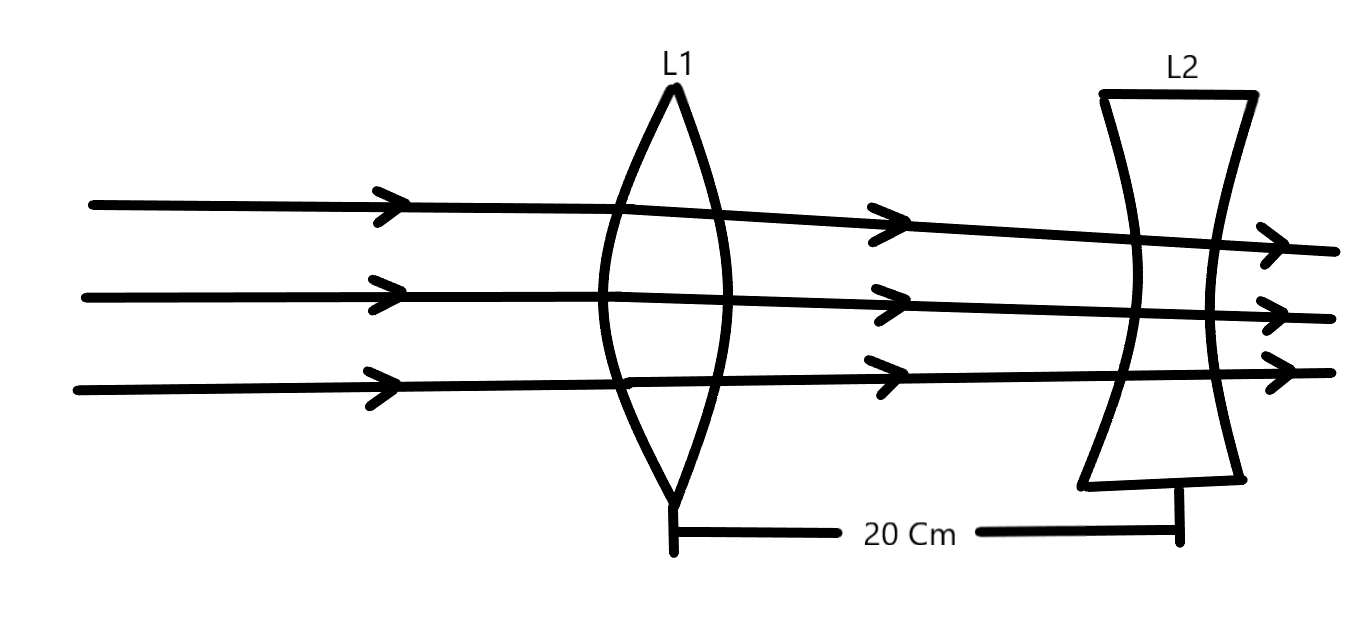
A thin convex lens (${L_1}$) of focal length 80cm and a thin concave lens (${L_2}$ ) of focal length f are kept coaxially, 20cm apart as shown in figure. When a narrow and parallel beam of light is incident on the convex lens, the beam emerging from the concave lens is also a parallel beam. Find f.
Answer
 Verified
623.1k+ views
Hint: In a convex lens, when the light passes through it the light rays bends towards each other whereas in a concave lens when the light passes through it the light gets spread out. Moreover the curve of the convex lens is towards the inside and the curve of the concave lens is towards the outside.
Complete answer:
The term convex lens is also known as ‘Converging lens’ or positive lens. Whereas the term concave lens is also known as ‘Diverging lens’ or negative lens. For long sightedness or hypermetropia the convex lens is used and for short sightedness or myopia the concave lens is used.
According to this question:
After refraction the parallel rays through the convex lens will converge at focus. This means that the convex lens will focus at 80cm.
So, we know that
$
\dfrac{1}{f} = \dfrac{1}{v} - \dfrac{1}{u} \\
\dfrac{1}{f} = \dfrac{1}{\infty } - \dfrac{1}{{60}} \\
$
So, we get f= -60cm
The focal length of the concave lens is 60cm.
Concave lens or diverging lens, means that it spreads out light rays that have been refracted through it. A convex lens is thinner from its centre than its edges, and is used to correct short-sightedness or we can say myopia.
Note: There are some examples of convex lens i-e telescope, the human eye, microscope, etc. however there are some examples of concave lenses also i-e lights, flashlight, laser, binocular etc. A lens is a piece of transparent glass substance which is either curved from inside or either curved from outside.
Complete answer:
The term convex lens is also known as ‘Converging lens’ or positive lens. Whereas the term concave lens is also known as ‘Diverging lens’ or negative lens. For long sightedness or hypermetropia the convex lens is used and for short sightedness or myopia the concave lens is used.
According to this question:
After refraction the parallel rays through the convex lens will converge at focus. This means that the convex lens will focus at 80cm.
So, we know that
$
\dfrac{1}{f} = \dfrac{1}{v} - \dfrac{1}{u} \\
\dfrac{1}{f} = \dfrac{1}{\infty } - \dfrac{1}{{60}} \\
$
So, we get f= -60cm
The focal length of the concave lens is 60cm.
Concave lens or diverging lens, means that it spreads out light rays that have been refracted through it. A convex lens is thinner from its centre than its edges, and is used to correct short-sightedness or we can say myopia.
Note: There are some examples of convex lens i-e telescope, the human eye, microscope, etc. however there are some examples of concave lenses also i-e lights, flashlight, laser, binocular etc. A lens is a piece of transparent glass substance which is either curved from inside or either curved from outside.
Recently Updated Pages
Master Class 12 Business Studies: Engaging Questions & Answers for Success

Master Class 12 Biology: Engaging Questions & Answers for Success
Master Class 12 Chemistry: Engaging Questions & Answers for Success
Class 12 Question and Answer - Your Ultimate Solutions Guide
Master Class 11 Social Science: Engaging Questions & Answers for Success
Master Class 11 English: Engaging Questions & Answers for Success
Trending doubts
Which is more stable and why class 12 chemistry CBSE
Which are the Top 10 Largest Countries of the World?
Draw a labelled sketch of the human eye class 12 physics CBSE
Differentiate between homogeneous and heterogeneous class 12 chemistry CBSE
What are the major means of transport Explain each class 12 social science CBSE
Sulphuric acid is known as the king of acids State class 12 chemistry CBSE