




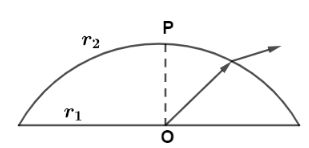
A thick plane convex lens made of crown glass (Refractive index $1.5$ ) has thickness of $3\,cm$ at its center, The radius of curvature of lens is $5cm$ . An ink made at the center of its plane face, when viewed normally through the curved face, appears to be at distance $x$ from the curved face. Then x is equal to
A. $2\,cm$
B. $2.1\,cm$
C. $2.3\,cm$
D. $2.5\,cm$
Answer
 Verified
508.5k+ views
Hint: In order to solve this question we need to understand convex lens, refractive index and light behavior upon entering in another medium. So a convex lens is a type of lens having thicker edges than center, these lenses are converging in nature as it converges parallel beam falling on it on a point known as focal point of lens. Refractive index of medium is the ratio of sine of incident angle to the sine of refracted angle. Whenever a light enters in some medium its speed gets slower and it gets refracted at medium. Same phenomena happens when we visualize the ink mark at the center of convex lens light coming from ink refracted and we see an apparent position of ink.
Complete step by step answer:
The lens equations is written as,
$\dfrac{{{\mu _2}}}{v} - \dfrac{{{\mu _1}}}{u} = \dfrac{{{\mu _2} - {\mu _1}}}{R}$
Here ${\mu _2}$ is the refractive index of that medium into which light transfers.According to given problem ${\mu _2} = 1$ (refractive index of air). And ${\mu _1}$ is the refractive index of that medium from which light passes. According to the given problem ${\mu _1} = 1.5$.
Also $v$ is image distance. According to the given problem $v = x$.And $u$ is the object distance from the center. According to the given problem $u = - 3\,cm$.Also $R$ is the radius of a convex lens. According to the given problem $R = - 5\,cm$.Putting values we get
$\dfrac{1}{x} - \dfrac{{1.5}}{{( - 3)}} = \dfrac{{(1 - 1.5)}}{{( - 5)}}$
$\Rightarrow \dfrac{1}{x} + 0.5 = 0.1$
$\Rightarrow \dfrac{1}{x} = 0.1 - 0.5 = - 0.4$
$\therefore x = - \dfrac{1}{{0.4}} = - 2.5\,cm$
So the correct option is D.
Note:It should be remembered that negative sign in image distance, object distance and radius implies that these distances are measured in opposite directions. We can only see the apparent position of ink rather than the actual position because of refraction at the interface. Also light first falls on ink then from ink it is reflected by and then light enters in our eye by undergoing refraction.
Complete step by step answer:
The lens equations is written as,
$\dfrac{{{\mu _2}}}{v} - \dfrac{{{\mu _1}}}{u} = \dfrac{{{\mu _2} - {\mu _1}}}{R}$
Here ${\mu _2}$ is the refractive index of that medium into which light transfers.According to given problem ${\mu _2} = 1$ (refractive index of air). And ${\mu _1}$ is the refractive index of that medium from which light passes. According to the given problem ${\mu _1} = 1.5$.
Also $v$ is image distance. According to the given problem $v = x$.And $u$ is the object distance from the center. According to the given problem $u = - 3\,cm$.Also $R$ is the radius of a convex lens. According to the given problem $R = - 5\,cm$.Putting values we get
$\dfrac{1}{x} - \dfrac{{1.5}}{{( - 3)}} = \dfrac{{(1 - 1.5)}}{{( - 5)}}$
$\Rightarrow \dfrac{1}{x} + 0.5 = 0.1$
$\Rightarrow \dfrac{1}{x} = 0.1 - 0.5 = - 0.4$
$\therefore x = - \dfrac{1}{{0.4}} = - 2.5\,cm$
So the correct option is D.
Note:It should be remembered that negative sign in image distance, object distance and radius implies that these distances are measured in opposite directions. We can only see the apparent position of ink rather than the actual position because of refraction at the interface. Also light first falls on ink then from ink it is reflected by and then light enters in our eye by undergoing refraction.
Recently Updated Pages
Master Class 12 Economics: Engaging Questions & Answers for Success

Master Class 12 Physics: Engaging Questions & Answers for Success
Master Class 12 English: Engaging Questions & Answers for Success
Master Class 12 Social Science: Engaging Questions & Answers for Success
Master Class 12 Maths: Engaging Questions & Answers for Success
Master Class 12 Business Studies: Engaging Questions & Answers for Success
Trending doubts
Which are the Top 10 Largest Countries of the World?
What are the major means of transport Explain each class 12 social science CBSE
Draw a labelled sketch of the human eye class 12 physics CBSE
Why cannot DNA pass through cell membranes class 12 biology CBSE
Differentiate between insitu conservation and exsitu class 12 biology CBSE
Draw a neat and well labeled diagram of TS of ovary class 12 biology CBSE