




A tetrahedron has 4 faces and 6 edges. How many vertices does it have?
(a). 2
(b). 4
(c). 6
(d). 8
Answer
 Verified
633.6k+ views
Hint: We have a tetrahedron that has four faces and 6 edges. We have to find the number of vertices. Use the Euler’s polyhedron formula, \[V-E+F=2\] , where V is the number of vertices, e is the number of edges and F is the number of faces. Now, solve further and the value of V, which is the number of vertices.
Complete step-by-step answer:
According to the question, it is given that a tetrahedron has 4 faces and 6 edges. We are required to find the exact number of vertices of the tetrahedron.
We know that tetrahedron is a form of a polyhedron. So, we can apply Euler’s polyhedron formula here.
According to Euler’s polyhedron formula, we have
\[V-E+F=2\] …………….(1)
, where V is the number of vertices, e is the number of edges and F is the number of faces.
In a tetrahedron,
Number of faces = 4 ……………………(2)
Number of edges = 6 …………………..(3)
From equation (1), equation (2) and equation (3), we get
\[\begin{align}
& V-E+F=2 \\
& \Rightarrow V-6+4=2 \\
\end{align}\]
On solving, we get
\[\begin{align}
& \Rightarrow V=2+2 \\
& \Rightarrow V=4 \\
\end{align}\]
Hence, the number of vertices is 4.
Therefore, option (B) is the correct one.
Note: One can also solve this question with the help of a figure of tetrahedron. We have the point E,F, and G in the vertical plane and point H coming out of the plane EFG.
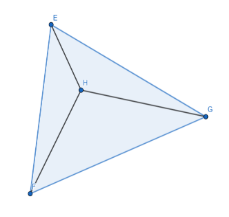
In this figure, we have plane EFG, EHF, EHG, and FHG as the face of the tetrahedron and EF, EG, EH, FG, FH, and GH as the edges of the tetrahedron. Points E, F, G, and H are the vertices of the tetrahedron.
Hence, the number of vertices is 4.
But don’t proceed with this approach because it is very difficult to imagine the figure if the given polyhedron is octahedron or something else complex.
Complete step-by-step answer:
According to the question, it is given that a tetrahedron has 4 faces and 6 edges. We are required to find the exact number of vertices of the tetrahedron.
We know that tetrahedron is a form of a polyhedron. So, we can apply Euler’s polyhedron formula here.
According to Euler’s polyhedron formula, we have
\[V-E+F=2\] …………….(1)
, where V is the number of vertices, e is the number of edges and F is the number of faces.
In a tetrahedron,
Number of faces = 4 ……………………(2)
Number of edges = 6 …………………..(3)
From equation (1), equation (2) and equation (3), we get
\[\begin{align}
& V-E+F=2 \\
& \Rightarrow V-6+4=2 \\
\end{align}\]
On solving, we get
\[\begin{align}
& \Rightarrow V=2+2 \\
& \Rightarrow V=4 \\
\end{align}\]
Hence, the number of vertices is 4.
Therefore, option (B) is the correct one.
Note: One can also solve this question with the help of a figure of tetrahedron. We have the point E,F, and G in the vertical plane and point H coming out of the plane EFG.
In this figure, we have plane EFG, EHF, EHG, and FHG as the face of the tetrahedron and EF, EG, EH, FG, FH, and GH as the edges of the tetrahedron. Points E, F, G, and H are the vertices of the tetrahedron.
Hence, the number of vertices is 4.
But don’t proceed with this approach because it is very difficult to imagine the figure if the given polyhedron is octahedron or something else complex.
Recently Updated Pages
Master Class 11 Social Science: Engaging Questions & Answers for Success

Master Class 11 Chemistry: Engaging Questions & Answers for Success
Master Class 12 Business Studies: Engaging Questions & Answers for Success
Master Class 12 Chemistry: Engaging Questions & Answers for Success
Master Class 12 Biology: Engaging Questions & Answers for Success
Class 12 Question and Answer - Your Ultimate Solutions Guide
Trending doubts
What is the situation called when no party gets the class 9 social science CBSE
Find the sum of series 1 + 2 + 3 + 4 + 5 + + 100 class 9 maths CBSE
Fill the blanks with the suitable prepositions 1 The class 9 english CBSE
Difference Between Plant Cell and Animal Cell
What is pollution? How many types of pollution? Define it
Name 10 Living and Non living things class 9 biology CBSE