




What is a test cross? Give examples.
Answer
 Verified
594.1k+ views
Hint: Various types of crosses are done between organisms to determine their genotype and find individuals with a completely new genotype. These types of crosses are essential for scientific research as they help in knowing the genotype of each and every plant.
Complete answer :
In a test cross, a dominant phenotype organism is crossed with the homozygous recessive genotype organism in order to determine whether the dominant phenotype organism has homozygous dominant and heterozygous genotypes. Hence test cross is used to determine the zygosity of an organism with unknown genotype. This cross was first introduced by Gregor Mendel, father of genetics.
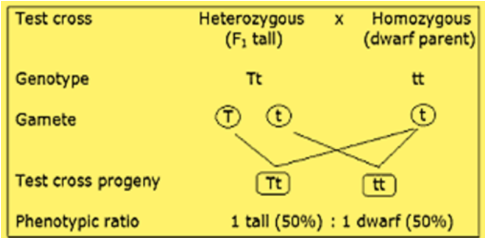
Consider the following example in plants: Suppose you have a tall and dwarf plant and tall characteristic (T) is dominant to dwarf(t). The dwarf plant must be homozygous for the recessive allele, but the genotype of the tall plant is unknown. It could be either TT or Tt. A testcross will decide the organism's genotype. The unknown genotype can be ascertained by examining the phenotypes of the resulting progeny. If crossing the unknown dominant phenotype (TT or Tt genotype) individual with the recessive phenotype individual produces only dominant phenotypes, then the plant with unknown genotype is homozygous dominant. If any recessive phenotypic plants emerge from the cross, then the unknown individual must possess the recessive allele, and have the heterozygous genotype.
Notes: In backcross, the F1 generation is crossbred with one of the parents or genetically identical individuals to the parent. A test cross is a type of back cross is the unknown dominant phenotypic generation is F1 progeny. But a backcross is not a test cross.
Complete answer :
In a test cross, a dominant phenotype organism is crossed with the homozygous recessive genotype organism in order to determine whether the dominant phenotype organism has homozygous dominant and heterozygous genotypes. Hence test cross is used to determine the zygosity of an organism with unknown genotype. This cross was first introduced by Gregor Mendel, father of genetics.
Consider the following example in plants: Suppose you have a tall and dwarf plant and tall characteristic (T) is dominant to dwarf(t). The dwarf plant must be homozygous for the recessive allele, but the genotype of the tall plant is unknown. It could be either TT or Tt. A testcross will decide the organism's genotype. The unknown genotype can be ascertained by examining the phenotypes of the resulting progeny. If crossing the unknown dominant phenotype (TT or Tt genotype) individual with the recessive phenotype individual produces only dominant phenotypes, then the plant with unknown genotype is homozygous dominant. If any recessive phenotypic plants emerge from the cross, then the unknown individual must possess the recessive allele, and have the heterozygous genotype.
Notes: In backcross, the F1 generation is crossbred with one of the parents or genetically identical individuals to the parent. A test cross is a type of back cross is the unknown dominant phenotypic generation is F1 progeny. But a backcross is not a test cross.
Recently Updated Pages
What is BLO What is the full form of BLO class 8 social science CBSE

Explain the Treaty of Vienna of 1815 class 10 social science CBSE
10 examples of friction in our daily life
Draw a diagram of nephron and explain its structur class 11 biology CBSE
Write structures of the following compounds i 2 Chloro3methylpentane class 11 chemistry CBSE
A Paragraph on Pollution in about 100-150 Words
Trending doubts
Draw a labelled sketch of the human eye class 12 physics CBSE
Which are the Top 10 Largest Countries of the World?
Differentiate between homogeneous and heterogeneous class 12 chemistry CBSE
Draw ray diagrams each showing i myopic eye and ii class 12 physics CBSE
Which is the correct genotypic ratio of mendel dihybrid class 12 biology CBSE
What is the Full Form of PVC, PET, HDPE, LDPE, PP and PS ?