




A tent is in the shape of a cylinder surmounted by a conical top. If the height and diameter of the cylindrical tap are 2.1 m and 4 m respectively, and the slant height of the top is 2.8 m, find the area of the canvas used for making the tent. Also find the cost of the canvas of the tent at the rate of Rs. 500 per square meter. (Note that the base of the tent will not be covered with canvas.) (Use $\pi =\dfrac{22}{7}$).
Answer
 Verified
651.3k+ views
Hint: Use the formulae “Curved surface area of Cylinder = $2\pi rh$” and “Curved surface area of conical shape = $\pi rl$” and add them, then put the given data to get the total curved surface area which is your area of total canvas required. Multiply the area of canvas by 500 to get the total cost of canvas required.
Complete step-by-step answer:
To solve the given question we will first draw a diagram with given conditions for better understanding, therefore,
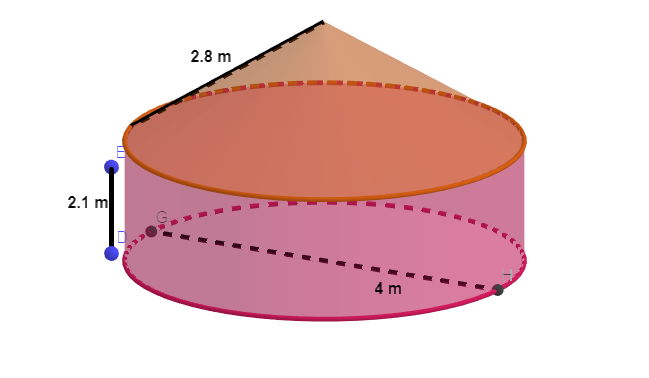
As we have our figure therefore we will write the given data, therefore,
Diameter of Cylinder = 4 m
Therefore radius of cylinder = r = $\dfrac{Diameter}{2}$ = $\dfrac{4}{2}$ = 2 m
As we know that the conical part is placed exactly on the cylindrical part therefore it will also have same radius as cylinder therefore,
Therefore radius of cylinder = radius of conical part = r= 2 m …………………………………… (1)
Height of the cylinder = h = 2.1 m ……………………………………………………………………….. (2)
Slant height of the Conical shape = l = 2.8 m ………………………………………………………. (3)
The rate of canvas per \[{{m}^{2}}\] = Rs. 500 …………………………………………………………………….. (4)
As we have given that the canvas required to the tent does not include the base of the tent, therefore the total canvas required will be the total curved surface area of the cylinder as well as conical shape.
Therefore we can write the formula for total canvas required as,
Area of canvas used = Curved surface area of Cylinder + Curved surface area of conical shape
To proceed further in the solution we should know the formulae of curved surface area given below,
Formulae:
Curved surface area of Cylinder = $2\pi rh$
Curved surface area of conical shape = $\pi rl$
If we use above formulae in the area of canvas required then we will get,
Therefore, Area of canvas required = $2\pi rh$ + $\pi rl$
If we take $\pi r$ common from the above equation we will get,
Therefore, Area of canvas required = \[\pi r\left( 2h+l \right)\]
If we put the values of equation (1), equation (2) and equation (3) in the above equation we will get,
Therefore, Area of canvas required = \[\pi \left( 2 \right)\left[ 2\left( 2.1 \right)+\left( 2.8 \right) \right]\]
If we put $\pi =\dfrac{22}{7}$ in the above equation we will get,
Therefore, Area of canvas required = \[\dfrac{22}{7}\times \left( 2 \right)\left[ 2\left( 2.1 \right)+\left( 2.8 \right) \right]\]
Further simplification in the above equation will give,
Therefore, Area of canvas required = \[\dfrac{44}{7}\left[ 4.2+2.8 \right]\]
If we perform addition in the above equation we will get,
Therefore, Area of canvas required = \[\dfrac{44}{7}\times 7\]
Therefore, Area of canvas required = 44 \[{{m}^{2}}\] …………………………………………… (5)
As we have given the rate of canvas per \[{{m}^{2}}\] = Rs. 500
Therefore if we multiply the equation (5) by 500 we will get the total cost of canvas required therefore we will get,
Total cost of canvas = Area of canvas required \[\times \] 500
If we put the value of equation (5) in the above equation we will get,
Therefore, Total cost of canvas = 44\[\times \] 500
Further simplification n the above equation will give,
Therefore, Total cost of canvas = Rs. 20000 ………………………………………………….. (6)
From equation (5) and equation (6) we can write,
Therefore the given tent will require a canvas having area equal to 44 \[{{m}^{2}}\] and its cost will be equal to Rs. 22000.
Note: Students may not read the complete question and will also add the area of base i.e. \[\pi {{r}^{2}}\] and will get a wrong answer. Therefore read the question carefully to avoid the silly mistake told earlier.
Complete step-by-step answer:
To solve the given question we will first draw a diagram with given conditions for better understanding, therefore,
As we have our figure therefore we will write the given data, therefore,
Diameter of Cylinder = 4 m
Therefore radius of cylinder = r = $\dfrac{Diameter}{2}$ = $\dfrac{4}{2}$ = 2 m
As we know that the conical part is placed exactly on the cylindrical part therefore it will also have same radius as cylinder therefore,
Therefore radius of cylinder = radius of conical part = r= 2 m …………………………………… (1)
Height of the cylinder = h = 2.1 m ……………………………………………………………………….. (2)
Slant height of the Conical shape = l = 2.8 m ………………………………………………………. (3)
The rate of canvas per \[{{m}^{2}}\] = Rs. 500 …………………………………………………………………….. (4)
As we have given that the canvas required to the tent does not include the base of the tent, therefore the total canvas required will be the total curved surface area of the cylinder as well as conical shape.
Therefore we can write the formula for total canvas required as,
Area of canvas used = Curved surface area of Cylinder + Curved surface area of conical shape
To proceed further in the solution we should know the formulae of curved surface area given below,
Formulae:
Curved surface area of Cylinder = $2\pi rh$
Curved surface area of conical shape = $\pi rl$
If we use above formulae in the area of canvas required then we will get,
Therefore, Area of canvas required = $2\pi rh$ + $\pi rl$
If we take $\pi r$ common from the above equation we will get,
Therefore, Area of canvas required = \[\pi r\left( 2h+l \right)\]
If we put the values of equation (1), equation (2) and equation (3) in the above equation we will get,
Therefore, Area of canvas required = \[\pi \left( 2 \right)\left[ 2\left( 2.1 \right)+\left( 2.8 \right) \right]\]
If we put $\pi =\dfrac{22}{7}$ in the above equation we will get,
Therefore, Area of canvas required = \[\dfrac{22}{7}\times \left( 2 \right)\left[ 2\left( 2.1 \right)+\left( 2.8 \right) \right]\]
Further simplification in the above equation will give,
Therefore, Area of canvas required = \[\dfrac{44}{7}\left[ 4.2+2.8 \right]\]
If we perform addition in the above equation we will get,
Therefore, Area of canvas required = \[\dfrac{44}{7}\times 7\]
Therefore, Area of canvas required = 44 \[{{m}^{2}}\] …………………………………………… (5)
As we have given the rate of canvas per \[{{m}^{2}}\] = Rs. 500
Therefore if we multiply the equation (5) by 500 we will get the total cost of canvas required therefore we will get,
Total cost of canvas = Area of canvas required \[\times \] 500
If we put the value of equation (5) in the above equation we will get,
Therefore, Total cost of canvas = 44\[\times \] 500
Further simplification n the above equation will give,
Therefore, Total cost of canvas = Rs. 20000 ………………………………………………….. (6)
From equation (5) and equation (6) we can write,
Therefore the given tent will require a canvas having area equal to 44 \[{{m}^{2}}\] and its cost will be equal to Rs. 22000.
Note: Students may not read the complete question and will also add the area of base i.e. \[\pi {{r}^{2}}\] and will get a wrong answer. Therefore read the question carefully to avoid the silly mistake told earlier.
Recently Updated Pages
Master Class 12 Business Studies: Engaging Questions & Answers for Success

Master Class 12 Chemistry: Engaging Questions & Answers for Success
Master Class 12 Biology: Engaging Questions & Answers for Success
Class 12 Question and Answer - Your Ultimate Solutions Guide
Master Class 11 English: Engaging Questions & Answers for Success
Master Class 11 Social Science: Engaging Questions & Answers for Success
Trending doubts
Which are the Top 10 Largest Countries of the World?
Draw a labelled sketch of the human eye class 12 physics CBSE
Differentiate between homogeneous and heterogeneous class 12 chemistry CBSE
In order to find out the different types of gametes class 12 biology NEET_UG
Why is the cell called the structural and functional class 12 biology CBSE
Draw ray diagrams each showing i myopic eye and ii class 12 physics CBSE