




A telescope has an objective lens of a focal length of 200 cm and an eyepiece with a focal length of 2 cm. If this telescope is used to see a 50 meter tall building at a distance of 2 km, what is the height of the image of the building formed by the objective lens?
A. 5 cm
B. 10 cm
C. 1 cm
D. 2 cm
Answer
 Verified
561.9k+ views
Hint: The magnification of the lens is image distance by the object distance. And, the magnification of the lens is image height by the object height. We will equate these equations as the LHS is the same, and then, will substitute the values to find the value of the height of the image of the building.
Formula used:
\[m=\dfrac{I}{O}\]
\[m=\dfrac{v}{u}\]
Complete answer:
From the given information we have the data as follows.
A telescope has an objective lens of a focal length of 200 cm and an eyepiece with a focal length of 2 cm. This telescope is used to see a 50 meter tall building at a distance of 2 km.
\[\begin{align}
& u=2\,km=2\times {{10}^{3}}m \\
& v=200\,cm=2\,m \\
& O=50\,m \\
\end{align}\]
The ray diagram representing the given situation is as follows.
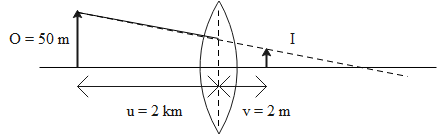
Consider the formula of the magnification of the lens.
\[m=\dfrac{I}{O}\]…… (1)
Where I is the image distance and O is the object distance.
\[m=\dfrac{v}{u}\]…… (2)
Where v is the image height and u is the object height.
Equate the equations (1) and (2), as, the LHS of both the equations are the same, that is, the magnification.
\[\dfrac{I}{O}=\dfrac{v}{u}\]
Substitute the values in the above equation.
\[\dfrac{I}{50}=\dfrac{2}{2\times {{10}^{3}}}\]
Continue further computation.
\[\begin{align}
& I=50\times \dfrac{2}{2\times {{10}^{3}}} \\
& \Rightarrow I=0.05\,m \\
& \therefore I=5\,cm \\
\end{align}\]
\[\therefore \]The height of the image of the building formed by the objective lens is 5 cm.
Thus, option (A) is correct.
Note:
The magnification of the lens: if the magnification of the lens is greater than one, then, the image is magnified, if the magnification of the lens is equal to one, then, the image is of the same size as that of the object and if the magnification of the lens is less than one, then, the image is diminished.
Formula used:
\[m=\dfrac{I}{O}\]
\[m=\dfrac{v}{u}\]
Complete answer:
From the given information we have the data as follows.
A telescope has an objective lens of a focal length of 200 cm and an eyepiece with a focal length of 2 cm. This telescope is used to see a 50 meter tall building at a distance of 2 km.
\[\begin{align}
& u=2\,km=2\times {{10}^{3}}m \\
& v=200\,cm=2\,m \\
& O=50\,m \\
\end{align}\]
The ray diagram representing the given situation is as follows.
Consider the formula of the magnification of the lens.
\[m=\dfrac{I}{O}\]…… (1)
Where I is the image distance and O is the object distance.
\[m=\dfrac{v}{u}\]…… (2)
Where v is the image height and u is the object height.
Equate the equations (1) and (2), as, the LHS of both the equations are the same, that is, the magnification.
\[\dfrac{I}{O}=\dfrac{v}{u}\]
Substitute the values in the above equation.
\[\dfrac{I}{50}=\dfrac{2}{2\times {{10}^{3}}}\]
Continue further computation.
\[\begin{align}
& I=50\times \dfrac{2}{2\times {{10}^{3}}} \\
& \Rightarrow I=0.05\,m \\
& \therefore I=5\,cm \\
\end{align}\]
\[\therefore \]The height of the image of the building formed by the objective lens is 5 cm.
Thus, option (A) is correct.
Note:
The magnification of the lens: if the magnification of the lens is greater than one, then, the image is magnified, if the magnification of the lens is equal to one, then, the image is of the same size as that of the object and if the magnification of the lens is less than one, then, the image is diminished.
Recently Updated Pages
Master Class 12 Business Studies: Engaging Questions & Answers for Success

Master Class 12 Biology: Engaging Questions & Answers for Success
Master Class 12 Chemistry: Engaging Questions & Answers for Success
Class 12 Question and Answer - Your Ultimate Solutions Guide
Master Class 11 Social Science: Engaging Questions & Answers for Success
Master Class 11 English: Engaging Questions & Answers for Success
Trending doubts
Which is more stable and why class 12 chemistry CBSE
Which are the Top 10 Largest Countries of the World?
Draw a labelled sketch of the human eye class 12 physics CBSE
Differentiate between homogeneous and heterogeneous class 12 chemistry CBSE
What are the major means of transport Explain each class 12 social science CBSE
Sulphuric acid is known as the king of acids State class 12 chemistry CBSE