




A teacher focused the slide under a compound microscope. Which student identified it correctly?
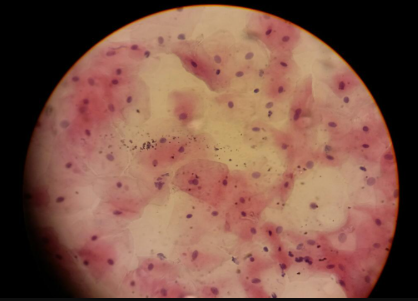
A. Sheela identified it as cheek cells
B. Madhu identified it as squamous epithelium
C. Balaji identified it as parenchyma
D. Shanti identified it as onion peel
Answer
 Verified
581.7k+ views
Hint: All organisms are made up of cells or groups of cells. A group of cells in which cells are similar in structure, function and origin is called tissue. Structure and function of cells in a tissue may vary but the origin of each cell in a tissue is always the same.
On the basis of structure and function tissues are of four types namely- epithelial tissue, connective tissue, muscular tissue and nervous tissue. These tissues are found in animals. In plants, tissues are also present but these are different from animal tissues. The major plant tissues are namely- meristematic tissues, simple permanent tissues and complex permanent tissues.
Complete answer:
The epithelial tissue is the first originated tissue during embryonic development. Epithelial tissue has two surfaces, one facing either the body fluid or outside environment and other is attached to the underlying tissue. Thus, it provides covering and lining to the surface.
Epithelial tissue is divided into simple epithelial tissues and compound epithelial tissues. Simple epithelial tissues are further divided into simple squamous, simple cuboidal, simple columnar and pseudo stratified epithelial tissues. Compound epithelial tissues are further divided into transitional epithelial and stratified epithelial tissues.
Epithelial tissue with a single layer of flat scale like cells with irregular boundaries is known as simple squamous epithelial tissue. The characteristic feature of squamous epithelial tissue is that they do not have any intercellular space. Thus, the flat cells are tightly packed with nuclei present at the centre of the cell. Human cheek cells are loosely packed along with mucous glands. Similarly, in plant cells parenchyma (simple permanent tissue) contains loosely arranged cells.
Since onion contains plant cells, its cells possess a thick cell wall, a large vacuole for storage and a peripheral nucleus.
Thus, the given diagram is of squamous epithelial tissue as cells are flat and tightly packed with rounded nuclei near the centre.
Hence, the correct answer is option (B).
Note: Epithelial tissue is the only tissue which grows upon another tissue (connective tissue). Epithelial tissue is devoid of any blood circulation due to the lack of any intercellular spaces. Lymph vessels and capillaries are also unable to pierce the tissue due to the compactly packed cells. Hence, cells depend for their nutrition on the underlying connective tissue. A thin, non living and acellular basement membrane is present between epithelium and connective tissue. Basement membrane is highly permeable.
On the basis of structure and function tissues are of four types namely- epithelial tissue, connective tissue, muscular tissue and nervous tissue. These tissues are found in animals. In plants, tissues are also present but these are different from animal tissues. The major plant tissues are namely- meristematic tissues, simple permanent tissues and complex permanent tissues.
Complete answer:
The epithelial tissue is the first originated tissue during embryonic development. Epithelial tissue has two surfaces, one facing either the body fluid or outside environment and other is attached to the underlying tissue. Thus, it provides covering and lining to the surface.
Epithelial tissue is divided into simple epithelial tissues and compound epithelial tissues. Simple epithelial tissues are further divided into simple squamous, simple cuboidal, simple columnar and pseudo stratified epithelial tissues. Compound epithelial tissues are further divided into transitional epithelial and stratified epithelial tissues.
Epithelial tissue with a single layer of flat scale like cells with irregular boundaries is known as simple squamous epithelial tissue. The characteristic feature of squamous epithelial tissue is that they do not have any intercellular space. Thus, the flat cells are tightly packed with nuclei present at the centre of the cell. Human cheek cells are loosely packed along with mucous glands. Similarly, in plant cells parenchyma (simple permanent tissue) contains loosely arranged cells.
Since onion contains plant cells, its cells possess a thick cell wall, a large vacuole for storage and a peripheral nucleus.
Thus, the given diagram is of squamous epithelial tissue as cells are flat and tightly packed with rounded nuclei near the centre.
Hence, the correct answer is option (B).
Note: Epithelial tissue is the only tissue which grows upon another tissue (connective tissue). Epithelial tissue is devoid of any blood circulation due to the lack of any intercellular spaces. Lymph vessels and capillaries are also unable to pierce the tissue due to the compactly packed cells. Hence, cells depend for their nutrition on the underlying connective tissue. A thin, non living and acellular basement membrane is present between epithelium and connective tissue. Basement membrane is highly permeable.
Recently Updated Pages
Three beakers labelled as A B and C each containing 25 mL of water were taken A small amount of NaOH anhydrous CuSO4 and NaCl were added to the beakers A B and C respectively It was observed that there was an increase in the temperature of the solutions contained in beakers A and B whereas in case of beaker C the temperature of the solution falls Which one of the following statements isarecorrect i In beakers A and B exothermic process has occurred ii In beakers A and B endothermic process has occurred iii In beaker C exothermic process has occurred iv In beaker C endothermic process has occurred

Master Class 11 Social Science: Engaging Questions & Answers for Success
Master Class 11 Physics: Engaging Questions & Answers for Success
Master Class 11 Maths: Engaging Questions & Answers for Success
Master Class 11 Economics: Engaging Questions & Answers for Success
Master Class 11 Computer Science: Engaging Questions & Answers for Success
Three beakers labelled as A B and C each containing 25 mL of water were taken A small amount of NaOH anhydrous CuSO4 and NaCl were added to the beakers A B and C respectively It was observed that there was an increase in the temperature of the solutions contained in beakers A and B whereas in case of beaker C the temperature of the solution falls Which one of the following statements isarecorrect i In beakers A and B exothermic process has occurred ii In beakers A and B endothermic process has occurred iii In beaker C exothermic process has occurred iv In beaker C endothermic process has occurred
Master Class 11 Social Science: Engaging Questions & Answers for Success
Master Class 11 Physics: Engaging Questions & Answers for Success
Trending doubts
One Metric ton is equal to kg A 10000 B 1000 C 100 class 11 physics CBSE
There are 720 permutations of the digits 1 2 3 4 5 class 11 maths CBSE
State and prove Bernoullis theorem class 11 physics CBSE
Draw a diagram of a plant cell and label at least eight class 11 biology CBSE
Difference Between Prokaryotic Cells and Eukaryotic Cells
1 Quintal is equal to a 110 kg b 10 kg c 100kg d 1000 class 11 physics CBSE