




A tangent to the hyperbola \[\dfrac{{{x^2}}}{4} - \dfrac{{{y^2}}}{2} = 1\] meets \[x\]-axis at P and \[y\]-axis at Q. Lines PR and QR are drawn such that OPRQ is a rectangle (where O is the origin). Then R lies on:
A) \[\dfrac{2}{{{x^2}}} - \dfrac{4}{{{y^2}}} = 1\]
B) \[\dfrac{4}{{{x^2}}} - \dfrac{2}{{{y^2}}} = 1\]
C) \[\dfrac{4}{{{x^2}}} + \dfrac{2}{{{y^2}}} = 1\]
D) \[\dfrac{2}{{{x^2}}} + \dfrac{4}{{{y^2}}} = 1\]
Answer
 Verified
626.4k+ views
Hint:
Here, we will first compare the given tangent equation of hyperbola to the general form and will find the value of the transverse and conjugate axis. We will then substitute these values in the equation of tangent to the Hyperbola and simplify it to get a new equation. We will use the condition given in the question to find the coordinate axis. We will then substitute the coordinates in the midpoint formula and simplify it further to get the required answer.
Formula Used:
We will use the following formula:
1) Equation of tangent to the Hyperbola is given by \[y = mx \pm \sqrt {{a^2}{m^2} - {b^2}} \] where \[a,b\] are the transverse axis and conjugate axis.
2) Midpoint is given by the formula \[M = \left( {\dfrac{{{x_1} + {x_2}}}{2},\dfrac{{{y_1} + {y_2}}}{2}} \right)\] where \[\left( {{x_1},{y_1}} \right)\] and \[\left( {{x_2},{y_2}} \right)\] are the coordinates of the line.
Complete step by step solution:
We are given that equation of the hyperbola \[\dfrac{{{x^2}}}{4} - \dfrac{{{y^2}}}{2} = 1\].
So, the given equation of hyperbola is a transverse axis on the \[x\]-axis which is of the form \[\dfrac{{{x^2}}}{{{a^2}}} - \dfrac{{{y^2}}}{{{b^2}}} = 1\].
Comparing the given equation of hyperbola with the standard equation of hyperbola, we get
\[{a^2} = 4\]
\[{b^2} = 2\]
Now we will find the equation of the tangent to the Hyperbola \[\dfrac{{{x^2}}}{4} - \dfrac{{{y^2}}}{2} = 1\].
Substituting \[{a^2} = 4\] and \[{b^2} = 2\] in the formula \[y = mx \pm \sqrt {{a^2}{m^2} - {b^2}} \], we get
\[ \Rightarrow y = mx \pm \sqrt {4{m^2} - 2} \] ………………………………………………………..\[(1)\]
Since the tangent meets the hyperbola meets \[x\]-axis at P, we have y-coordinate as 0.
Substituting \[y = 0\] in the equation \[(1)\], we get
\[ \Rightarrow 0 = mx \pm \sqrt {4{m^2} - 2} \]
Rewriting the equation, we get
\[ \Rightarrow mx = \mp \sqrt {4{m^2} - 2} \]
Dividing by \[m\] on both the sides, we get
\[ \Rightarrow x = \dfrac{{ \mp \sqrt {4{m^2} - 2} }}{m}\]
So, the coordinate of P is \[\left( {\dfrac{{ \mp \sqrt {4{m^2} - 2} }}{m},0} \right)\].
Since the tangent meets the hyperbola meets \[y\]-axis at Q, we have x-coordinate as 0.
Substituting \[x = 0\] in the equation\[(1)\], we get
\[ \Rightarrow y = m(0) \pm \sqrt {4{m^2} - 2} \]
Rewriting the equation, we get
\[ \Rightarrow y = \pm \sqrt {4{m^2} - 2} \]
So, the coordinate of Q is \[\left( {0, \pm \sqrt {4{m^2} - 2} } \right)\]
Let the point R be \[R(h,k)\].
We are given that lines PR and QR are drawn such that OPRQ is a rectangle where O is the origin.
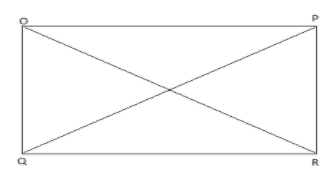
We know that in a rectangle, the midpoints of the diagonal are equal.
So, by using the midpoint formula \[M = \left( {\dfrac{{{x_1} + {x_2}}}{2},\dfrac{{{y_1} + {y_2}}}{2}} \right)\] for the diagonals \[O\left( {0,0} \right)\] and \[R\left( {h,k} \right)\] as well as \[P\left( {\dfrac{{ \mp \sqrt {4{m^2} - 2} }}{m},0} \right)\] and \[Q\left( {0, \pm \sqrt {4{m^2} - 2} } \right)\].
\[ \Rightarrow \] Midpoint of OR\[ = \] Midpoint of PQ
\[ \Rightarrow \left( {\dfrac{{0 + h}}{2},\dfrac{{0 + k}}{2}} \right) = \left( {\dfrac{{ - \sqrt {4{m^2} - 2} + 0}}{{2m}},\dfrac{{0 + \sqrt {4{m^2} - 2} }}{2}} \right)\]
\[ \Rightarrow \left( {\dfrac{h}{2},\dfrac{k}{2}} \right) = \left( {\dfrac{{ - \sqrt {4{m^2} - 2} }}{{2m}},\dfrac{{\sqrt {4{m^2} - 2} }}{2}} \right)\]
Equating the co-ordinates, we get
\[ \Rightarrow \dfrac{h}{2} = \dfrac{{ - \sqrt {4{m^2} - 2} }}{{2m}}\] and \[\dfrac{k}{2} = \dfrac{{\sqrt {4{m^2} - 2} }}{2}\]
\[ \Rightarrow \dfrac{h}{2} = \dfrac{{ - \sqrt {4{m^2} - 2} }}{{2m}}\] and \[k = \sqrt {4{m^2} - 2} \]
Substituting \[k = \sqrt {4{m^2} - 2} \] in \[h = \dfrac{{ - \sqrt {4{m^2} - 2} }}{m}\], we get
\[h = \dfrac{{ - k}}{m}\]
Now, we find the value of \[m\].
\[ \Rightarrow m = \dfrac{{ - k}}{h}\]
Substituting the value of \[m = \dfrac{{ - k}}{h}\] in \[k = \sqrt {4{m^2} - 2} \], we get
\[ \Rightarrow k = \sqrt {4{{\left( {\dfrac{{ - k}}{h}} \right)}^2} - 2} \]
Now, simplifying the expression, we get
\[ \Rightarrow k = \sqrt {4\left( {\dfrac{{{k^2}}}{{{h^2}}}} \right) - 2} \]
By cross-multiplication, we get
\[ \Rightarrow k = \sqrt {\dfrac{{4{k^2} - 2{h^2}}}{{{h^2}}}} \]
Squaring on both the sides, we get
\[ \Rightarrow {k^2} = \dfrac{{4{k^2} - 2{h^2}}}{{{h^2}}}\]
Rewriting the equation, we get
\[ \Rightarrow {k^2}{h^2} = 4{k^2} - 2{h^2}\]
Dividing by \[{k^2}{h^2}\] on both the sides, we get
\[ \Rightarrow \dfrac{{{k^2}{h^2}}}{{{k^2}{h^2}}} = \dfrac{{4{k^2}}}{{{k^2}{h^2}}} - \dfrac{{2{h^2}}}{{{k^2}{h^2}}}\]
\[ \Rightarrow 1 = \dfrac{4}{{{h^2}}} - \dfrac{2}{{{k^2}}}\]
So, by replacing \[\left( {h,k} \right)\] by \[\left( {x,y} \right)\], we get
\[ \Rightarrow \dfrac{4}{{{x^2}}} - \dfrac{2}{{{y^2}}} = 1\]
Therefore, \[R\] lies on \[\dfrac{4}{{{x^2}}} - \dfrac{2}{{{y^2}}} = 1\].
Hence, option B is the correct option.
Note:
We have to be clear that the given equation is the equation of the hyperbola and not the equation of the tangent to the hyperbola. It is not necessary to find the point of R. But we need to find the equation of the line where the point R lies. The transverse axis is the axis that passes through both vertices and foci, and the conjugate axis is the axis perpendicular to the transverse axis.
Here, we will first compare the given tangent equation of hyperbola to the general form and will find the value of the transverse and conjugate axis. We will then substitute these values in the equation of tangent to the Hyperbola and simplify it to get a new equation. We will use the condition given in the question to find the coordinate axis. We will then substitute the coordinates in the midpoint formula and simplify it further to get the required answer.
Formula Used:
We will use the following formula:
1) Equation of tangent to the Hyperbola is given by \[y = mx \pm \sqrt {{a^2}{m^2} - {b^2}} \] where \[a,b\] are the transverse axis and conjugate axis.
2) Midpoint is given by the formula \[M = \left( {\dfrac{{{x_1} + {x_2}}}{2},\dfrac{{{y_1} + {y_2}}}{2}} \right)\] where \[\left( {{x_1},{y_1}} \right)\] and \[\left( {{x_2},{y_2}} \right)\] are the coordinates of the line.
Complete step by step solution:
We are given that equation of the hyperbola \[\dfrac{{{x^2}}}{4} - \dfrac{{{y^2}}}{2} = 1\].
So, the given equation of hyperbola is a transverse axis on the \[x\]-axis which is of the form \[\dfrac{{{x^2}}}{{{a^2}}} - \dfrac{{{y^2}}}{{{b^2}}} = 1\].
Comparing the given equation of hyperbola with the standard equation of hyperbola, we get
\[{a^2} = 4\]
\[{b^2} = 2\]
Now we will find the equation of the tangent to the Hyperbola \[\dfrac{{{x^2}}}{4} - \dfrac{{{y^2}}}{2} = 1\].
Substituting \[{a^2} = 4\] and \[{b^2} = 2\] in the formula \[y = mx \pm \sqrt {{a^2}{m^2} - {b^2}} \], we get
\[ \Rightarrow y = mx \pm \sqrt {4{m^2} - 2} \] ………………………………………………………..\[(1)\]
Since the tangent meets the hyperbola meets \[x\]-axis at P, we have y-coordinate as 0.
Substituting \[y = 0\] in the equation \[(1)\], we get
\[ \Rightarrow 0 = mx \pm \sqrt {4{m^2} - 2} \]
Rewriting the equation, we get
\[ \Rightarrow mx = \mp \sqrt {4{m^2} - 2} \]
Dividing by \[m\] on both the sides, we get
\[ \Rightarrow x = \dfrac{{ \mp \sqrt {4{m^2} - 2} }}{m}\]
So, the coordinate of P is \[\left( {\dfrac{{ \mp \sqrt {4{m^2} - 2} }}{m},0} \right)\].
Since the tangent meets the hyperbola meets \[y\]-axis at Q, we have x-coordinate as 0.
Substituting \[x = 0\] in the equation\[(1)\], we get
\[ \Rightarrow y = m(0) \pm \sqrt {4{m^2} - 2} \]
Rewriting the equation, we get
\[ \Rightarrow y = \pm \sqrt {4{m^2} - 2} \]
So, the coordinate of Q is \[\left( {0, \pm \sqrt {4{m^2} - 2} } \right)\]
Let the point R be \[R(h,k)\].
We are given that lines PR and QR are drawn such that OPRQ is a rectangle where O is the origin.
We know that in a rectangle, the midpoints of the diagonal are equal.
So, by using the midpoint formula \[M = \left( {\dfrac{{{x_1} + {x_2}}}{2},\dfrac{{{y_1} + {y_2}}}{2}} \right)\] for the diagonals \[O\left( {0,0} \right)\] and \[R\left( {h,k} \right)\] as well as \[P\left( {\dfrac{{ \mp \sqrt {4{m^2} - 2} }}{m},0} \right)\] and \[Q\left( {0, \pm \sqrt {4{m^2} - 2} } \right)\].
\[ \Rightarrow \] Midpoint of OR\[ = \] Midpoint of PQ
\[ \Rightarrow \left( {\dfrac{{0 + h}}{2},\dfrac{{0 + k}}{2}} \right) = \left( {\dfrac{{ - \sqrt {4{m^2} - 2} + 0}}{{2m}},\dfrac{{0 + \sqrt {4{m^2} - 2} }}{2}} \right)\]
\[ \Rightarrow \left( {\dfrac{h}{2},\dfrac{k}{2}} \right) = \left( {\dfrac{{ - \sqrt {4{m^2} - 2} }}{{2m}},\dfrac{{\sqrt {4{m^2} - 2} }}{2}} \right)\]
Equating the co-ordinates, we get
\[ \Rightarrow \dfrac{h}{2} = \dfrac{{ - \sqrt {4{m^2} - 2} }}{{2m}}\] and \[\dfrac{k}{2} = \dfrac{{\sqrt {4{m^2} - 2} }}{2}\]
\[ \Rightarrow \dfrac{h}{2} = \dfrac{{ - \sqrt {4{m^2} - 2} }}{{2m}}\] and \[k = \sqrt {4{m^2} - 2} \]
Substituting \[k = \sqrt {4{m^2} - 2} \] in \[h = \dfrac{{ - \sqrt {4{m^2} - 2} }}{m}\], we get
\[h = \dfrac{{ - k}}{m}\]
Now, we find the value of \[m\].
\[ \Rightarrow m = \dfrac{{ - k}}{h}\]
Substituting the value of \[m = \dfrac{{ - k}}{h}\] in \[k = \sqrt {4{m^2} - 2} \], we get
\[ \Rightarrow k = \sqrt {4{{\left( {\dfrac{{ - k}}{h}} \right)}^2} - 2} \]
Now, simplifying the expression, we get
\[ \Rightarrow k = \sqrt {4\left( {\dfrac{{{k^2}}}{{{h^2}}}} \right) - 2} \]
By cross-multiplication, we get
\[ \Rightarrow k = \sqrt {\dfrac{{4{k^2} - 2{h^2}}}{{{h^2}}}} \]
Squaring on both the sides, we get
\[ \Rightarrow {k^2} = \dfrac{{4{k^2} - 2{h^2}}}{{{h^2}}}\]
Rewriting the equation, we get
\[ \Rightarrow {k^2}{h^2} = 4{k^2} - 2{h^2}\]
Dividing by \[{k^2}{h^2}\] on both the sides, we get
\[ \Rightarrow \dfrac{{{k^2}{h^2}}}{{{k^2}{h^2}}} = \dfrac{{4{k^2}}}{{{k^2}{h^2}}} - \dfrac{{2{h^2}}}{{{k^2}{h^2}}}\]
\[ \Rightarrow 1 = \dfrac{4}{{{h^2}}} - \dfrac{2}{{{k^2}}}\]
So, by replacing \[\left( {h,k} \right)\] by \[\left( {x,y} \right)\], we get
\[ \Rightarrow \dfrac{4}{{{x^2}}} - \dfrac{2}{{{y^2}}} = 1\]
Therefore, \[R\] lies on \[\dfrac{4}{{{x^2}}} - \dfrac{2}{{{y^2}}} = 1\].
Hence, option B is the correct option.
Note:
We have to be clear that the given equation is the equation of the hyperbola and not the equation of the tangent to the hyperbola. It is not necessary to find the point of R. But we need to find the equation of the line where the point R lies. The transverse axis is the axis that passes through both vertices and foci, and the conjugate axis is the axis perpendicular to the transverse axis.
Recently Updated Pages
Master Class 12 Economics: Engaging Questions & Answers for Success

Master Class 12 Social Science: Engaging Questions & Answers for Success
Master Class 12 English: Engaging Questions & Answers for Success
Master Class 12 Maths: Engaging Questions & Answers for Success
Master Class 12 Physics: Engaging Questions & Answers for Success
Master Class 12 Biology: Engaging Questions & Answers for Success
Trending doubts
Draw a labelled sketch of the human eye class 12 physics CBSE
Which are the Top 10 Largest Countries of the World?
Draw ray diagrams each showing i myopic eye and ii class 12 physics CBSE
Which is the correct genotypic ratio of mendel dihybrid class 12 biology CBSE
Differentiate between homogeneous and heterogeneous class 12 chemistry CBSE
Which animal never drinks water in its entire life class 12 biology CBSE