




A system of three polarizers ${{P}_{1}},{{P}_{2,}}{{P}_{3}}$ is set up such that the pass axis of ${{P}_{3}}$ is crossed with respect to that of${{P}_{1}}$. The pass axis of ${{P}_{2}}$ is inclined at ${{60}^{o}}$ to the pass axis of ${{P}_{3}}$when a beam of unpolarized light of intensity ${{I}_{O}}$ is incident on ${{P}_{1}}$the in of light transmitted by three polarized I. the ratio $\left( \dfrac{{{I}_{o}}}{I} \right)$ equals (nearly):
$\begin{align}
& A.16.00 \\
& B.1.80 \\
& C.5.33 \\
& D.10.67 \\
\end{align}$
Answer
 Verified
599.7k+ views
Hint: According to the malu’s law the intensity of the plane polarized light passing through a second polarized (also called as analyzers) is directly proportional to cosine of angle between axes of two polarizers when an unpolarized light is incident on a polarizer the intensity of light transmitted will always be half of the incident light.
Complete answer:
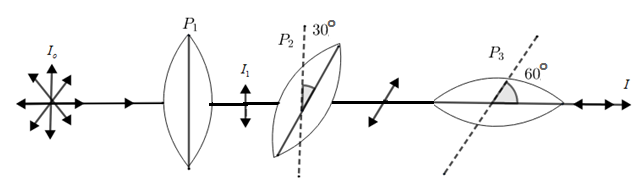
Given that intensity of light falling on polarizers ${{P}_{1}}$ and ${{I}_{O}}$. The intensity of light coming out from polarizer ${{P}_{3}}$ is I. so we have to find out ratio $\left( \dfrac{{{I}_{o}}}{I} \right)$ i.e. ratio of intensity of incident light to intensity of transmitted light from the polarizer ${{P}_{3}}$. Also given that the incident light is unpolarized i.e. electric field in the incident light varies in all directions.
When this unpolarized light is incident on polarized ${{P}_{1}}$, the transmitted light through ${{P}_{1}}$ will be linearly polarized in which plane of vibration will in the plane of axis of polarizer. Therefore, the intensity of light that is transmitted through ${{P}_{1}}$ will be half of the intensity of incident light.
Let ${{I}_{1}}$ be the intensity of light that is transmitted through ${{P}_{1}}$
$\therefore {{I}_{1}}=\dfrac{{{I}_{o}}}{2}$
This light will fall on the polarizer ${{P}_{2}}$
Given that the pass axis of ${{P}_{3}}$is crossed with the respect to that of ${{P}_{1}}$
Therefore the angle between the axis of polarizer ${{P}_{1}}$ and polarizer ${{P}_{3}}$ is ${{90}^{o}}$ also, the pass axis of ${{P}_{2}}$ is inclined at ${{60}^{o}}$ to the pass axis of ${{P}_{3}}$ therefore the angle between ${{P}_{2}}\text{ and }{{P}_{3}}$ is. Thus the angle between axes of polarizer ${{P}_{1}}$ and ${{P}_{2}}$ will be ${{30}^{o}}$. Let ${{I}_{2}}$ be the intensity of light transmitted through polarized ${{P}_{2}}$
Therefore according to Malus law
$\begin{align}
& {{I}_{2}}={{I}_{1}}{{\cos }^{2}}{{30}^{o}} \\
& =\dfrac{{{I}_{o}}}{2}\times \dfrac{3}{4} \\
& {{I}_{2}}=\dfrac{3}{8}{{I}_{o}} \\
\end{align}$
Similarly the intensity of light that is transmitted through polarizer ${{P}_{3}}$ is
$\begin{align}
& I={{I}_{2}}{{\cos }^{2}}{{60}^{o}} \\
& \dfrac{3}{8}{{I}_{o}}\times \dfrac{1}{4} \\
& I=\dfrac{3}{32}{{I}_{o}} \\
& \therefore \dfrac{{{I}_{o}}}{I}=\dfrac{32}{3} \\
& \dfrac{{{I}_{o}}}{I}=10.67 \\
\end{align}$
Thus, the ratio $\left( \dfrac{{{I}_{o}}}{I} \right)$ equals 10.67. Therefore the correct option is (D).
So, the correct answer is “Option d”.
Note:
Malu’s law helps to understand the polarization properties of light. This law gives the relation between intensity of light fall on a polarizer and the intensity of light transmitted through a same polarizer. Carefully take the angle students may get confused when plane polarized light is incident on a polarizer. In that case you have to consider the angle between the plane of polarization of incident light and the axis of the polarizer.
Complete answer:
Given that intensity of light falling on polarizers ${{P}_{1}}$ and ${{I}_{O}}$. The intensity of light coming out from polarizer ${{P}_{3}}$ is I. so we have to find out ratio $\left( \dfrac{{{I}_{o}}}{I} \right)$ i.e. ratio of intensity of incident light to intensity of transmitted light from the polarizer ${{P}_{3}}$. Also given that the incident light is unpolarized i.e. electric field in the incident light varies in all directions.
When this unpolarized light is incident on polarized ${{P}_{1}}$, the transmitted light through ${{P}_{1}}$ will be linearly polarized in which plane of vibration will in the plane of axis of polarizer. Therefore, the intensity of light that is transmitted through ${{P}_{1}}$ will be half of the intensity of incident light.
Let ${{I}_{1}}$ be the intensity of light that is transmitted through ${{P}_{1}}$
$\therefore {{I}_{1}}=\dfrac{{{I}_{o}}}{2}$
This light will fall on the polarizer ${{P}_{2}}$
Given that the pass axis of ${{P}_{3}}$is crossed with the respect to that of ${{P}_{1}}$
Therefore the angle between the axis of polarizer ${{P}_{1}}$ and polarizer ${{P}_{3}}$ is ${{90}^{o}}$ also, the pass axis of ${{P}_{2}}$ is inclined at ${{60}^{o}}$ to the pass axis of ${{P}_{3}}$ therefore the angle between ${{P}_{2}}\text{ and }{{P}_{3}}$ is. Thus the angle between axes of polarizer ${{P}_{1}}$ and ${{P}_{2}}$ will be ${{30}^{o}}$. Let ${{I}_{2}}$ be the intensity of light transmitted through polarized ${{P}_{2}}$
Therefore according to Malus law
$\begin{align}
& {{I}_{2}}={{I}_{1}}{{\cos }^{2}}{{30}^{o}} \\
& =\dfrac{{{I}_{o}}}{2}\times \dfrac{3}{4} \\
& {{I}_{2}}=\dfrac{3}{8}{{I}_{o}} \\
\end{align}$
Similarly the intensity of light that is transmitted through polarizer ${{P}_{3}}$ is
$\begin{align}
& I={{I}_{2}}{{\cos }^{2}}{{60}^{o}} \\
& \dfrac{3}{8}{{I}_{o}}\times \dfrac{1}{4} \\
& I=\dfrac{3}{32}{{I}_{o}} \\
& \therefore \dfrac{{{I}_{o}}}{I}=\dfrac{32}{3} \\
& \dfrac{{{I}_{o}}}{I}=10.67 \\
\end{align}$
Thus, the ratio $\left( \dfrac{{{I}_{o}}}{I} \right)$ equals 10.67. Therefore the correct option is (D).
So, the correct answer is “Option d”.
Note:
Malu’s law helps to understand the polarization properties of light. This law gives the relation between intensity of light fall on a polarizer and the intensity of light transmitted through a same polarizer. Carefully take the angle students may get confused when plane polarized light is incident on a polarizer. In that case you have to consider the angle between the plane of polarization of incident light and the axis of the polarizer.
Recently Updated Pages
Master Class 12 Economics: Engaging Questions & Answers for Success

Master Class 12 English: Engaging Questions & Answers for Success
Master Class 12 Social Science: Engaging Questions & Answers for Success
Master Class 12 Maths: Engaging Questions & Answers for Success
Master Class 12 Physics: Engaging Questions & Answers for Success
Master Class 9 General Knowledge: Engaging Questions & Answers for Success
Trending doubts
Which are the Top 10 Largest Countries of the World?
Draw a labelled sketch of the human eye class 12 physics CBSE
Differentiate between homogeneous and heterogeneous class 12 chemistry CBSE
Sulphuric acid is known as the king of acids State class 12 chemistry CBSE
Why is the cell called the structural and functional class 12 biology CBSE
Draw ray diagrams each showing i myopic eye and ii class 12 physics CBSE