




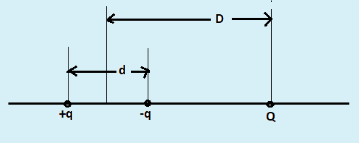
A system of three charges is placed as shown in the figure: if D>>d the potential energy of the system is best given by.
(A). $\dfrac{1}{{4\pi { \in _o}}}\left[ { + \dfrac{{{q^2}}}{d} + \dfrac{{2qQd}}{{{D^2}}}} \right]$
(B). $\dfrac{1}{{4\pi { \in _o}}}\left[ { - \dfrac{{{q^2}}}{d} + \dfrac{{qQd}}{{2{D^2}}}} \right]$
(C). $\dfrac{1}{{4\pi { \in _o}}}\left[ { - \dfrac{{{q^2}}}{d} - \dfrac{{qQd}}{{{D^2}}}} \right]$
(D). $\dfrac{1}{{4\pi { \in _o}}}\left[ { - \dfrac{{{q^2}}}{d} - \dfrac{{qQd}}{{2{D^2}}}} \right]$
Answer
 Verified
631.8k+ views
Hint: First we write the formula for potential energy that is ${U_E}\left( r \right) = \dfrac{1}{{4\pi { \in _o}}}\left[ {\dfrac{{Qq}}{r}} \right]$. Then find the potential energy for bringing each point charge in the presence of other charges. After that Add all the potential energy that is \[{U_Q}\left( r \right) + {U_{ - qQ}}\left( {D - \dfrac{d}{2}} \right) + {U_{ + q - q}}\left( d \right) + {U_{ + qQ}}\left( {D + \dfrac{d}{2}} \right)\] to find the total potential energy of the system.
Formula used - ${U_E}\left( r \right) = \dfrac{1}{{4\pi { \in _o}}}\left[ {\dfrac{{Qq}}{r}} \right]$.
Complete step-by-step solution -
The electric potential energy of a system of point charges is defined as the work required assembling this system of charges by bringing them close together, from an infinite distance. The SI unit of electric potential energy is the joule.
Let us assume the potential energy of a point charge after bringing it from an infinite distance in the presence of another point charge. And the distance between them is r. So using this above definition we get
${U_E}\left( r \right) = \dfrac{1}{{4\pi { \in _o}}}\left[ {\dfrac{{Qq}}{r}} \right]$ --------------------------------------- (1)
Now using equation (1) and the figure provided in the question, first finding the potential energy in bringing the first point charge from infinity. Here as no other charge is present the potential energy will be zero as shown in figure 1.

Figure 1
${U_Q}\left( r \right) = \dfrac{1}{{4\pi { \in _o}}}\left[ {\dfrac{{Q \times 0}}{r}} \right] = 0$------------------------------------- (2)
Now the potential energy in bringing point charge $ - q$ from infinity to a point which is $D - \dfrac{d}{2}$ distance from charge $Q$ as shown in figure 2.
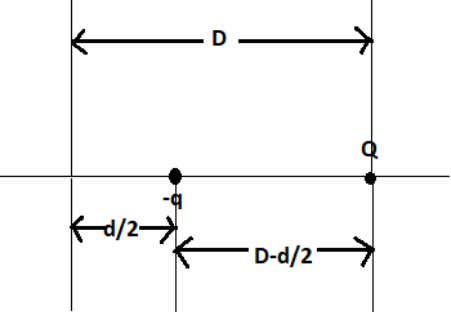
Figure 2
${U_{ - qQ}}\left( {D - \dfrac{d}{2}} \right) = \dfrac{1}{{4\pi { \in _o}}}\left[ {\dfrac{{Q \times \left( { - q} \right)}}{{D - \dfrac{d}{2}}}} \right] = \dfrac{1}{{4\pi { \in _o}}}\left[ {\dfrac{{ - 2Qq}}{{2D - d}}} \right]$------------------ (3)
Now the potential energy in bringing a point charge $ + q$ from infinity to a point which is $D + \dfrac{d}{2}$ distance from $Q$ and $d$ distance from point charge $ - q$ as shown in figure 3
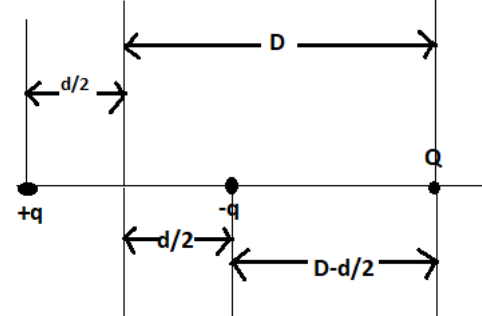
Figure 3
\[{U_{ + q - q}}\left( d \right) + {U_{ + qQ}}\left( {D + \dfrac{d}{2}} \right) = \dfrac{1}{{4\pi { \in _o}}}\left[ {\dfrac{{\left( { + q} \right) \times \left( { - q} \right)}}{d}} \right] + \dfrac{1}{{4\pi { \in _o}}}\left[ {\dfrac{{Q \times \left( { + q} \right)}}{{D + \dfrac{d}{2}}}} \right]\]
\[ = \dfrac{1}{{4\pi { \in _o}}}\left( {\left[ {\dfrac{{\left( { + q} \right) \times \left( { - q} \right)}}{d}} \right] + \left[ {\dfrac{{2Q \times \left( { + q} \right)}}{{2D + d}}} \right]} \right)\]
\[ = \dfrac{1}{{4\pi { \in _o}}}\left( {\dfrac{{ - {q^2}}}{d} + \dfrac{{2Qq}}{{2D + d}}} \right) = \dfrac{q}{{4\pi { \in _o}}}\left( {\dfrac{{ - q}}{d} + \dfrac{{2Q}}{{2D + d}}} \right)\]
Taking LCM we get
\[{U_{ + q - q}}\left( d \right) + {U_{ + qQ}}\left( D \right) = \dfrac{q}{{4\pi { \in _o}}}\left( {\dfrac{{ - q2D - qd + 2Qd}}{{d\left( {2D + d} \right)}}} \right)\]-------------------------- (4)
For the total potential energy add equation (2), (3), and (4)
\[{U_Q}\left( r \right) + {U_{ - qQ}}\left( {D - \dfrac{d}{2}} \right) + {U_{ + q - q}}\left( d \right) + {U_{ + qQ}}\left( {D + \dfrac{d}{2}} \right) = 0 + \dfrac{1}{{4\pi { \in _o}}}\left[ {\dfrac{{ - 2Qq}}{{2D - d}}} \right] + \dfrac{q}{{4\pi { \in _o}}}\left( {\dfrac{{ - q2D - qd + 2Qd}}{{d\left( {2D + d} \right)}}} \right)\]
Taking LCM, we get
\[ = \dfrac{q}{{4\pi { \in _o}}}\left( {\dfrac{{ - q2D - qd + 2Qd}}{{d\left( {2D + d} \right)}} + \dfrac{{ - 2Q}}{{2D - d}}} \right) = \dfrac{q}{{4\pi { \in _o}}}\left( {\dfrac{{ - 4q{D^2} + 2qdD - 2qdD + q{d^2} + 4DQd - 2Q{d^2} - 4DQd - 2Q{d^2}}}{{d\left( {4{D^2} - {d^2}} \right)}}} \right)\]
\[ = \dfrac{q}{{4\pi { \in _o}}}\left( {\dfrac{{ - 4q{D^2} + q{d^2} - 4Q{d^2}}}{{d\left( {4{D^2} - {d^2}} \right)}}} \right) = \dfrac{q}{{4\pi { \in _o}}}\left( {\dfrac{{ - q\left( {4{D^2} - {d^2}} \right) - 4Q{d^2}}}{{d\left( {4{D^2} - {d^2}} \right)}}} \right) = \dfrac{q}{{4\pi { \in _o}}}\left( {\dfrac{{ - q}}{d} - \dfrac{{4Qd}}{{4{D^2} - {d^2}}}} \right)\]
As $D \gg d$ we can write $4{D^2} - {d^{^2}} \approx 4{D^2}$
Hence \[{U_Q}\left( r \right) + {U_{ - qQ}}\left( {D - \dfrac{d}{2}} \right) + {U_{ + q - q}}\left( d \right) + {U_{ + qQ}}\left( {D + \dfrac{d}{2}} \right) = - \dfrac{1}{{4\pi { \in _o}}}\left( {\dfrac{{{q^2}}}{d} + \dfrac{{qQd}}{{{D^2}}}} \right)\]
So option C is correct.
Note: For these types of questions first, recall the formula for potential energy and find individual potential energy for each charge in the presence of other charges. Take care of the sign convention. As potential energy is a scalar quantity we can simply add the individual potential energy to find the total potential energy of the system.
Formula used - ${U_E}\left( r \right) = \dfrac{1}{{4\pi { \in _o}}}\left[ {\dfrac{{Qq}}{r}} \right]$.
Complete step-by-step solution -
The electric potential energy of a system of point charges is defined as the work required assembling this system of charges by bringing them close together, from an infinite distance. The SI unit of electric potential energy is the joule.
Let us assume the potential energy of a point charge after bringing it from an infinite distance in the presence of another point charge. And the distance between them is r. So using this above definition we get
${U_E}\left( r \right) = \dfrac{1}{{4\pi { \in _o}}}\left[ {\dfrac{{Qq}}{r}} \right]$ --------------------------------------- (1)
Now using equation (1) and the figure provided in the question, first finding the potential energy in bringing the first point charge from infinity. Here as no other charge is present the potential energy will be zero as shown in figure 1.
Figure 1
${U_Q}\left( r \right) = \dfrac{1}{{4\pi { \in _o}}}\left[ {\dfrac{{Q \times 0}}{r}} \right] = 0$------------------------------------- (2)
Now the potential energy in bringing point charge $ - q$ from infinity to a point which is $D - \dfrac{d}{2}$ distance from charge $Q$ as shown in figure 2.
Figure 2
${U_{ - qQ}}\left( {D - \dfrac{d}{2}} \right) = \dfrac{1}{{4\pi { \in _o}}}\left[ {\dfrac{{Q \times \left( { - q} \right)}}{{D - \dfrac{d}{2}}}} \right] = \dfrac{1}{{4\pi { \in _o}}}\left[ {\dfrac{{ - 2Qq}}{{2D - d}}} \right]$------------------ (3)
Now the potential energy in bringing a point charge $ + q$ from infinity to a point which is $D + \dfrac{d}{2}$ distance from $Q$ and $d$ distance from point charge $ - q$ as shown in figure 3
Figure 3
\[{U_{ + q - q}}\left( d \right) + {U_{ + qQ}}\left( {D + \dfrac{d}{2}} \right) = \dfrac{1}{{4\pi { \in _o}}}\left[ {\dfrac{{\left( { + q} \right) \times \left( { - q} \right)}}{d}} \right] + \dfrac{1}{{4\pi { \in _o}}}\left[ {\dfrac{{Q \times \left( { + q} \right)}}{{D + \dfrac{d}{2}}}} \right]\]
\[ = \dfrac{1}{{4\pi { \in _o}}}\left( {\left[ {\dfrac{{\left( { + q} \right) \times \left( { - q} \right)}}{d}} \right] + \left[ {\dfrac{{2Q \times \left( { + q} \right)}}{{2D + d}}} \right]} \right)\]
\[ = \dfrac{1}{{4\pi { \in _o}}}\left( {\dfrac{{ - {q^2}}}{d} + \dfrac{{2Qq}}{{2D + d}}} \right) = \dfrac{q}{{4\pi { \in _o}}}\left( {\dfrac{{ - q}}{d} + \dfrac{{2Q}}{{2D + d}}} \right)\]
Taking LCM we get
\[{U_{ + q - q}}\left( d \right) + {U_{ + qQ}}\left( D \right) = \dfrac{q}{{4\pi { \in _o}}}\left( {\dfrac{{ - q2D - qd + 2Qd}}{{d\left( {2D + d} \right)}}} \right)\]-------------------------- (4)
For the total potential energy add equation (2), (3), and (4)
\[{U_Q}\left( r \right) + {U_{ - qQ}}\left( {D - \dfrac{d}{2}} \right) + {U_{ + q - q}}\left( d \right) + {U_{ + qQ}}\left( {D + \dfrac{d}{2}} \right) = 0 + \dfrac{1}{{4\pi { \in _o}}}\left[ {\dfrac{{ - 2Qq}}{{2D - d}}} \right] + \dfrac{q}{{4\pi { \in _o}}}\left( {\dfrac{{ - q2D - qd + 2Qd}}{{d\left( {2D + d} \right)}}} \right)\]
Taking LCM, we get
\[ = \dfrac{q}{{4\pi { \in _o}}}\left( {\dfrac{{ - q2D - qd + 2Qd}}{{d\left( {2D + d} \right)}} + \dfrac{{ - 2Q}}{{2D - d}}} \right) = \dfrac{q}{{4\pi { \in _o}}}\left( {\dfrac{{ - 4q{D^2} + 2qdD - 2qdD + q{d^2} + 4DQd - 2Q{d^2} - 4DQd - 2Q{d^2}}}{{d\left( {4{D^2} - {d^2}} \right)}}} \right)\]
\[ = \dfrac{q}{{4\pi { \in _o}}}\left( {\dfrac{{ - 4q{D^2} + q{d^2} - 4Q{d^2}}}{{d\left( {4{D^2} - {d^2}} \right)}}} \right) = \dfrac{q}{{4\pi { \in _o}}}\left( {\dfrac{{ - q\left( {4{D^2} - {d^2}} \right) - 4Q{d^2}}}{{d\left( {4{D^2} - {d^2}} \right)}}} \right) = \dfrac{q}{{4\pi { \in _o}}}\left( {\dfrac{{ - q}}{d} - \dfrac{{4Qd}}{{4{D^2} - {d^2}}}} \right)\]
As $D \gg d$ we can write $4{D^2} - {d^{^2}} \approx 4{D^2}$
Hence \[{U_Q}\left( r \right) + {U_{ - qQ}}\left( {D - \dfrac{d}{2}} \right) + {U_{ + q - q}}\left( d \right) + {U_{ + qQ}}\left( {D + \dfrac{d}{2}} \right) = - \dfrac{1}{{4\pi { \in _o}}}\left( {\dfrac{{{q^2}}}{d} + \dfrac{{qQd}}{{{D^2}}}} \right)\]
So option C is correct.
Note: For these types of questions first, recall the formula for potential energy and find individual potential energy for each charge in the presence of other charges. Take care of the sign convention. As potential energy is a scalar quantity we can simply add the individual potential energy to find the total potential energy of the system.
Recently Updated Pages
Master Class 12 Business Studies: Engaging Questions & Answers for Success

Master Class 12 Biology: Engaging Questions & Answers for Success
Master Class 12 Chemistry: Engaging Questions & Answers for Success
Class 12 Question and Answer - Your Ultimate Solutions Guide
Master Class 11 Social Science: Engaging Questions & Answers for Success
Master Class 11 English: Engaging Questions & Answers for Success
Trending doubts
Which is more stable and why class 12 chemistry CBSE
Which are the Top 10 Largest Countries of the World?
Draw a labelled sketch of the human eye class 12 physics CBSE
Differentiate between homogeneous and heterogeneous class 12 chemistry CBSE
What are the major means of transport Explain each class 12 social science CBSE
Sulphuric acid is known as the king of acids State class 12 chemistry CBSE