




A swimming pool appears shallower than its actual depth due to
(A) Reflection
(B) Dispersion
(C) Refraction
(D) Scattering
Answer
 Verified
611.4k+ views
Hint: To answer this question, we need to trace the path of the light rays as they travel from the swimming pool into the air. We have to remember that the eyes perceive the light rays entering to be travelling straight.
Complete step by step solution:
Let us consider a swimming pool of depth $h$ as shown in the figure below.
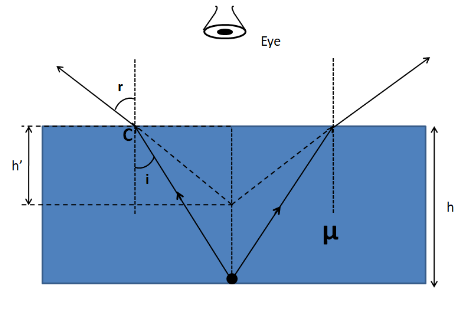
Consider that a human eye is observing a point situated at the bottom of the tank, adjusted for near normal viewing. We can see the rays originating from that point. Now, at point C, the light ray changes its leaves to the water medium, which is optically denser, and enters the air medium, which is optically rarer. We know that when the light travels from an optically denser to the rarer medium, it bends away from the normal, as shown in the above figure. The eye receives these bent rays. But it does not perceive the refraction which has taken place. The eye only perceives the light ray to be a straight ray which is originating from a point situated a little above from the original point. The perceived point can be obtained by joining the bent light rays. The same is the case with all the points situated at the bottom. Thus, the swimming pool appears to be shallower than its actual depth. Therefore, the phenomenon of refraction is the reason for this apparent depth.
Hence, the correct answer is option A.
Note:
We have taken the position of the eye to be near to the normal to the surface of the pool. But that does not mean that this effect does not take place for the other position. In fact this effect is independent of the position of the eye, whether it is normally viewing, or obliquely viewing.
Complete step by step solution:
Let us consider a swimming pool of depth $h$ as shown in the figure below.
Consider that a human eye is observing a point situated at the bottom of the tank, adjusted for near normal viewing. We can see the rays originating from that point. Now, at point C, the light ray changes its leaves to the water medium, which is optically denser, and enters the air medium, which is optically rarer. We know that when the light travels from an optically denser to the rarer medium, it bends away from the normal, as shown in the above figure. The eye receives these bent rays. But it does not perceive the refraction which has taken place. The eye only perceives the light ray to be a straight ray which is originating from a point situated a little above from the original point. The perceived point can be obtained by joining the bent light rays. The same is the case with all the points situated at the bottom. Thus, the swimming pool appears to be shallower than its actual depth. Therefore, the phenomenon of refraction is the reason for this apparent depth.
Hence, the correct answer is option A.
Note:
We have taken the position of the eye to be near to the normal to the surface of the pool. But that does not mean that this effect does not take place for the other position. In fact this effect is independent of the position of the eye, whether it is normally viewing, or obliquely viewing.
Recently Updated Pages
Master Class 12 Business Studies: Engaging Questions & Answers for Success

Master Class 12 Chemistry: Engaging Questions & Answers for Success
Master Class 12 Biology: Engaging Questions & Answers for Success
Class 12 Question and Answer - Your Ultimate Solutions Guide
Master Class 11 English: Engaging Questions & Answers for Success
Master Class 11 Social Science: Engaging Questions & Answers for Success
Trending doubts
Which are the Top 10 Largest Countries of the World?
Draw a labelled sketch of the human eye class 12 physics CBSE
The end of compass needle which points towards north class 12 physics CBSE
Differentiate between homogeneous and heterogeneous class 12 chemistry CBSE
Why is the cell called the structural and functional class 12 biology CBSE
When was the first election held in India a 194748 class 12 sst CBSE