




A student sitting at the back of the classroom cannot read clearly the letters written on the blackboard. What advice will a doctor give to her? Draw a ray diagram for the correction of this defect.
Answer
 Verified
582.9k+ views
Hint:
Here we have to first know what is meant by myopia or short sightedness.
Myopia is a normal state of vision in which we can easily see objects around us, but fuzzy objects further away. It happens when our eye structure allows rays to bend wrongly, reflecting images on our retina rather than in front of our retina.
Complete step by step solution:
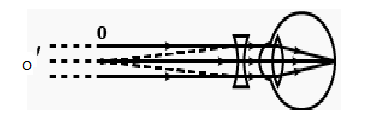
If the eyeball is too lengthy or the cornea is too curvy then myopia occurs. The light entering the eye is not properly centred as a result and distant objects appear distorted.
High myopia is a more serious form of the condition, where the eyeball grows more than it is meant to grow and becomes very long from the front to the back. It can also increase our chance of having other conditions such as detached retina, cataracts and glaucoma in addition to making it hard to see things at a distance.
Near-sightedness is also known as myopia. An individual with myopia can clearly see nearby objects but cannot specifically see distant objects. The far point is closer than infinity for a human with this defect. Such a person can see up to a distance of several metres clearly. The defect of myopia may arise due to excessive eye lens curvature or eyeball elongation. In eyeglasses that correct nearsightedness, concave lenses are used. Placing concave lenses in front of a nearsighted eye decreases the light refraction and the focal length is increased.
Note:Lenses having negative power will extend the focus of a myopic person and give them a good vision. The higher the power of the lens the more far point can be achieved for the eye.
Here we have to first know what is meant by myopia or short sightedness.
Myopia is a normal state of vision in which we can easily see objects around us, but fuzzy objects further away. It happens when our eye structure allows rays to bend wrongly, reflecting images on our retina rather than in front of our retina.
Complete step by step solution:
If the eyeball is too lengthy or the cornea is too curvy then myopia occurs. The light entering the eye is not properly centred as a result and distant objects appear distorted.
High myopia is a more serious form of the condition, where the eyeball grows more than it is meant to grow and becomes very long from the front to the back. It can also increase our chance of having other conditions such as detached retina, cataracts and glaucoma in addition to making it hard to see things at a distance.
Near-sightedness is also known as myopia. An individual with myopia can clearly see nearby objects but cannot specifically see distant objects. The far point is closer than infinity for a human with this defect. Such a person can see up to a distance of several metres clearly. The defect of myopia may arise due to excessive eye lens curvature or eyeball elongation. In eyeglasses that correct nearsightedness, concave lenses are used. Placing concave lenses in front of a nearsighted eye decreases the light refraction and the focal length is increased.
Note:Lenses having negative power will extend the focus of a myopic person and give them a good vision. The higher the power of the lens the more far point can be achieved for the eye.
Recently Updated Pages
Master Class 12 Economics: Engaging Questions & Answers for Success

Master Class 12 Physics: Engaging Questions & Answers for Success
Master Class 12 English: Engaging Questions & Answers for Success
Master Class 12 Social Science: Engaging Questions & Answers for Success
Master Class 12 Maths: Engaging Questions & Answers for Success
Master Class 12 Business Studies: Engaging Questions & Answers for Success
Trending doubts
Why cannot DNA pass through cell membranes class 12 biology CBSE
Draw a neat and well labeled diagram of TS of ovary class 12 biology CBSE
In a human foetus the limbs and digits develop after class 12 biology CBSE
AABbCc genotype forms how many types of gametes a 4 class 12 biology CBSE
Differentiate between homogeneous and heterogeneous class 12 chemistry CBSE
The correct structure of ethylenediaminetetraacetic class 12 chemistry CBSE