




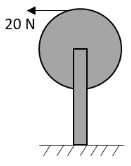
A string is wrapped around the rim of a wheel of moment of inertial \[0.20\,{\text{kg}} \cdot {{\text{m}}^2}\] and radius \[20\,{\text{cm}}\]. The wheel is free to rotate about its axis. Initially the wheel is at rest. The string is now pulled by a force of \[20\,{\text{N}}\]. The angular velocity of the string after 5 seconds will be:
A. \[90\,{\text{rad/s}}\]
B. \[70\,{\text{rad/s}}\]
C. \[95\,{\text{rad/s}}\]
D. \[100\,{\text{rad/s}}\]
Answer
 Verified
579.9k+ views
Hint: Use the formula for torque acting on an object due to a force and torque acting on an object in terms of the moment of inertia and angular acceleration of the object. Also use the kinematic equation for the final angular velocity of an object in terms of angular acceleration. First calculate the angular acceleration of the wheel and then angular velocity of the wheel after 5 seconds.
Formulae used:
The torque \[\tau \] acting on an object due to a force \[F\] is
\[\tau = Fr\] …… (1)
Here, \[r\] is the perpendicular distance between the point of action of the force and centre of torque.
The torque \[\tau \] acting on an object is
\[\tau = I\alpha \] …… (2)
Here, \[I\] is the moment of inertia of the object and \[\alpha \] is angular acceleration of the object.
The kinematic equation for the final angular velocity \[\omega \] of an object in terms of angular acceleration \[\alpha \] is
\[\omega = {\omega _0} + \alpha t\] …… (3)
Here, \[{\omega _0}\] is the initial angular velocity of the object and \[t\] is time.
Complete step by step answer:
We have given that the moment of inertia of the wheel is \[0.20\,{\text{kg}} \cdot {{\text{m}}^2}\] and the radius of the wheel is \[20\,{\text{cm}}\].
\[I = 0.20\,{\text{kg}} \cdot {{\text{m}}^2}\]
\[R = 20\,{\text{cm}}\]
The string wrapped around the rim of the wheel is pulled by a force \[20\,{\text{N}}\].
\[F = 20\,{\text{N}}\]
We have asked to calculate the angular velocity of the wheel after 5 seconds.Let us first calculate the angular acceleration of the wheelSubstitute \[I\alpha \] for \[\tau \] in equation (1).
\[I\alpha = FR\]
\[ \Rightarrow \alpha = \dfrac{{FR}}{I}\]
Substitute \[20\,{\text{N}}\] for \[F\], \[20\,{\text{cm}}\] for \[R\] and \[0.20\,{\text{kg}} \cdot {{\text{m}}^2}\] for \[I\] in the above equation.
\[ \Rightarrow \alpha = \dfrac{{\left( {20\,{\text{N}}} \right)\left( {20\,{\text{cm}}} \right)}}{{0.20\,{\text{kg}} \cdot {{\text{m}}^2}}}\]
\[ \Rightarrow \alpha = \dfrac{{\left( {20\,{\text{N}}} \right)\left( {0.20\,{\text{m}}} \right)}}{{0.20\,{\text{kg}} \cdot {{\text{m}}^2}}}\]
\[ \Rightarrow \alpha = 20\,{\text{rad/}}{{\text{s}}^2}\]
Hence, the angular acceleration of the wheel is \[20\,{\text{rad/}}{{\text{s}}^2}\].
Let us now calculate the velocity of the wheel after 5 seconds.Initially the wheel starts from rest. Hence, the initial angular velocity of the wheel is \[0\,{\text{rad/s}}\].
\[{\omega _0} = 0\,{\text{rad/s}}\]
We can calculate the angular velocity after 5 seconds using equation (3).Substitute \[0\,{\text{rad/s}}\] for \[{\omega _0}\], \[20\,{\text{rad/}}{{\text{s}}^2}\] for \[\alpha \] and \[5\,{\text{s}}\] for \[t\] in equation (3).
\[\omega = \left( {0\,{\text{rad/s}}} \right) + \left( {20\,{\text{rad/}}{{\text{s}}^2}} \right)\left( {5\,{\text{s}}} \right)\]
\[ \therefore \omega = 100\,{\text{rad/s}}\]
Therefore, the angular velocity of the wheel after 5 seconds is \[100\,{\text{rad/s}}\].
Hence, the correct option is D.
Note: The students can also calculate the angular velocity of the wheel after 5 seconds by directly using the formula for the angular acceleration in terms of angular velocity and time as the wheel is initially at rest. But the students should keep in mind that we can directly use the formula for angular acceleration only when the initial velocity of the object is zero, otherwise not.
Formulae used:
The torque \[\tau \] acting on an object due to a force \[F\] is
\[\tau = Fr\] …… (1)
Here, \[r\] is the perpendicular distance between the point of action of the force and centre of torque.
The torque \[\tau \] acting on an object is
\[\tau = I\alpha \] …… (2)
Here, \[I\] is the moment of inertia of the object and \[\alpha \] is angular acceleration of the object.
The kinematic equation for the final angular velocity \[\omega \] of an object in terms of angular acceleration \[\alpha \] is
\[\omega = {\omega _0} + \alpha t\] …… (3)
Here, \[{\omega _0}\] is the initial angular velocity of the object and \[t\] is time.
Complete step by step answer:
We have given that the moment of inertia of the wheel is \[0.20\,{\text{kg}} \cdot {{\text{m}}^2}\] and the radius of the wheel is \[20\,{\text{cm}}\].
\[I = 0.20\,{\text{kg}} \cdot {{\text{m}}^2}\]
\[R = 20\,{\text{cm}}\]
The string wrapped around the rim of the wheel is pulled by a force \[20\,{\text{N}}\].
\[F = 20\,{\text{N}}\]
We have asked to calculate the angular velocity of the wheel after 5 seconds.Let us first calculate the angular acceleration of the wheelSubstitute \[I\alpha \] for \[\tau \] in equation (1).
\[I\alpha = FR\]
\[ \Rightarrow \alpha = \dfrac{{FR}}{I}\]
Substitute \[20\,{\text{N}}\] for \[F\], \[20\,{\text{cm}}\] for \[R\] and \[0.20\,{\text{kg}} \cdot {{\text{m}}^2}\] for \[I\] in the above equation.
\[ \Rightarrow \alpha = \dfrac{{\left( {20\,{\text{N}}} \right)\left( {20\,{\text{cm}}} \right)}}{{0.20\,{\text{kg}} \cdot {{\text{m}}^2}}}\]
\[ \Rightarrow \alpha = \dfrac{{\left( {20\,{\text{N}}} \right)\left( {0.20\,{\text{m}}} \right)}}{{0.20\,{\text{kg}} \cdot {{\text{m}}^2}}}\]
\[ \Rightarrow \alpha = 20\,{\text{rad/}}{{\text{s}}^2}\]
Hence, the angular acceleration of the wheel is \[20\,{\text{rad/}}{{\text{s}}^2}\].
Let us now calculate the velocity of the wheel after 5 seconds.Initially the wheel starts from rest. Hence, the initial angular velocity of the wheel is \[0\,{\text{rad/s}}\].
\[{\omega _0} = 0\,{\text{rad/s}}\]
We can calculate the angular velocity after 5 seconds using equation (3).Substitute \[0\,{\text{rad/s}}\] for \[{\omega _0}\], \[20\,{\text{rad/}}{{\text{s}}^2}\] for \[\alpha \] and \[5\,{\text{s}}\] for \[t\] in equation (3).
\[\omega = \left( {0\,{\text{rad/s}}} \right) + \left( {20\,{\text{rad/}}{{\text{s}}^2}} \right)\left( {5\,{\text{s}}} \right)\]
\[ \therefore \omega = 100\,{\text{rad/s}}\]
Therefore, the angular velocity of the wheel after 5 seconds is \[100\,{\text{rad/s}}\].
Hence, the correct option is D.
Note: The students can also calculate the angular velocity of the wheel after 5 seconds by directly using the formula for the angular acceleration in terms of angular velocity and time as the wheel is initially at rest. But the students should keep in mind that we can directly use the formula for angular acceleration only when the initial velocity of the object is zero, otherwise not.
Recently Updated Pages
Master Class 11 Social Science: Engaging Questions & Answers for Success

Master Class 11 English: Engaging Questions & Answers for Success
Master Class 11 Maths: Engaging Questions & Answers for Success
Master Class 11 Chemistry: Engaging Questions & Answers for Success
Master Class 11 Biology: Engaging Questions & Answers for Success
Master Class 11 Physics: Engaging Questions & Answers for Success
Trending doubts
Differentiate between an exothermic and an endothermic class 11 chemistry CBSE
One Metric ton is equal to kg A 10000 B 1000 C 100 class 11 physics CBSE
Difference Between Prokaryotic Cells and Eukaryotic Cells
There are 720 permutations of the digits 1 2 3 4 5 class 11 maths CBSE
Draw a diagram of a plant cell and label at least eight class 11 biology CBSE
Two of the body parts which do not appear in MRI are class 11 biology CBSE