




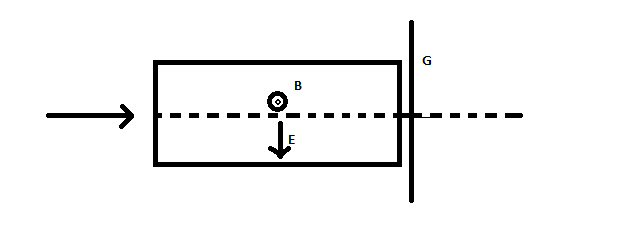
A stream of electrons and protons are directed towards a narrow slit in a screen (see figure). The intervening region has a uniform electric field E (vertically downwards) and a uniform magnetic field B (out of the plane of the figure) as shown. Then:
A. Electron and protons with speed \[\dfrac{{\left| E \right|}}{{\left| B \right|}}\] will pass through the slit.
B. Protons with speed \[\dfrac{{\left| E \right|}}{{\left| B \right|}}\] will pass through the slit, electrons of the same speed will not.
C. Neither electrons nor protons will go through the slit irrespective of their speed.
D. Electrons will always be deflected upwards irrespective of their speed.
Answer
 Verified
657k+ views
When any charged particle of charge q undergoes a magnetic field B and electric field E, the force on the charged particle is given by:
\[\vec F = q\left[ {\vec E + \left( {\vec v \times \vec B} \right)} \right]\]
Where v is the velocity of the charged particle.
Complete step-by-step answer:
1) As the electric field is directed along –ve Y axis then,
\[\vec E = - E\hat y\]
2) As the electric field is directed along z axis then,
\[
\vec B = B\hat z \\
\vec v = v\hat x \\
\]
3) For protons, charge is +q. Then the Lorentz force on it is
\[
{{\vec F}_P} = q\left[ { - E\hat y + (v\hat x \times B\hat z)} \right] \\
{{\vec F}_P} = - q\left[ {E + \left( {vB} \right)} \right]\hat y \\
\]
As the proton will move along the negative Y axis, it can not escape through the slit.
4) For electrons charge is –q. Then the Lorentz force on it is
\[
{{\vec F}_e} = - q\left[ { - E\hat y + (v\hat x \times B\hat z)} \right] \\
{{\vec F}_e} = q\left[ {E + \left( {vB} \right)} \right]\hat y \\
\]
As the electrons will move along the +ve Y direction, it also cannot escape through the slit.
Hence, C. Neither electrons nor protons will go through the slit irrespective of their speed is the correct option.
Note: Students must be aware of the positive or negative charge while using the Lorentz equation. The velocity, electric field and magnetic field are mutually perpendicular. We must use this fact while fixing the direction of the vectors.
\[\vec F = q\left[ {\vec E + \left( {\vec v \times \vec B} \right)} \right]\]
Where v is the velocity of the charged particle.
Complete step-by-step answer:
1) As the electric field is directed along –ve Y axis then,
\[\vec E = - E\hat y\]
2) As the electric field is directed along z axis then,
\[
\vec B = B\hat z \\
\vec v = v\hat x \\
\]
3) For protons, charge is +q. Then the Lorentz force on it is
\[
{{\vec F}_P} = q\left[ { - E\hat y + (v\hat x \times B\hat z)} \right] \\
{{\vec F}_P} = - q\left[ {E + \left( {vB} \right)} \right]\hat y \\
\]
As the proton will move along the negative Y axis, it can not escape through the slit.
4) For electrons charge is –q. Then the Lorentz force on it is
\[
{{\vec F}_e} = - q\left[ { - E\hat y + (v\hat x \times B\hat z)} \right] \\
{{\vec F}_e} = q\left[ {E + \left( {vB} \right)} \right]\hat y \\
\]
As the electrons will move along the +ve Y direction, it also cannot escape through the slit.
Hence, C. Neither electrons nor protons will go through the slit irrespective of their speed is the correct option.
Note: Students must be aware of the positive or negative charge while using the Lorentz equation. The velocity, electric field and magnetic field are mutually perpendicular. We must use this fact while fixing the direction of the vectors.
Recently Updated Pages
Master Class 12 Economics: Engaging Questions & Answers for Success

Master Class 12 Social Science: Engaging Questions & Answers for Success
Master Class 12 English: Engaging Questions & Answers for Success
Master Class 12 Maths: Engaging Questions & Answers for Success
Master Class 12 Physics: Engaging Questions & Answers for Success
Master Class 12 Biology: Engaging Questions & Answers for Success
Trending doubts
Draw a labelled sketch of the human eye class 12 physics CBSE
Which are the Top 10 Largest Countries of the World?
Draw ray diagrams each showing i myopic eye and ii class 12 physics CBSE
Which is the correct genotypic ratio of mendel dihybrid class 12 biology CBSE
Differentiate between homogeneous and heterogeneous class 12 chemistry CBSE
Which animal never drinks water in its entire life class 12 biology CBSE