




A stone is swinging in a horizontal circle of diameter 0.8m at 30rev/min. a distant light causes a shadow of a stone on a nearly wall. The amplitude and period of SHM for the shadow of the stone are
a) 0.4m, 4s
b) 0.2m, 2s
c) 0.4m, 2s
d) 0.8m, 2s
Answer
 Verified
655.5k+ views
Hint: It is given in the question that a stone moves in a circle and the stone is illuminated by a source of light such that its shadow is visible on the wall. On the wall we will see the stone moving to and fro along its fixed length which is equal to the diameter of the circular path and fixed point which is the centre of the circle. The amplitude is the distance from the mean position i.e. the centre of the circle and the time period for the stone will be the time taken for the stone to move to and fro to the same position.
Complete answer:
To begin with let us draw the diagram to visualize the above scenario.
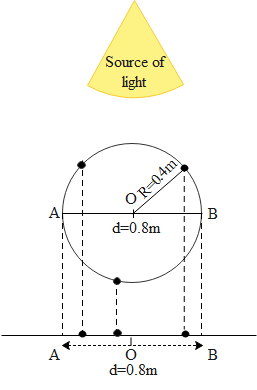
Let us say the stone moves anticlockwise. In the above figure we can see that the stone moves to and fro along the wall AB when it traces a circular path. Hence we can say that the stone will perform SHM. The amplitude of the above SHM is basically the distance from the mean position i.e. the centre of the circle O to that of the extreme positions i.e. either A and B on the wall or the diameter of the circle. This distance is equal to nothing but the radius of the circle. Hence we can say that the amplitude of the above SHM is 0.4m.
The time period is the time taken for the stone to move to and fro from B to A through O and back to B. This is nothing but the time taken for the stone to trace the complete circumference of the stone i.e. given as 30rev/min. Since 1 min equals 60 sec, the time taken for 1 revolution is 2sec.
So, the correct answer is “Option C”.
Note:
It is to be noted that the shadow of the stone on the wall and the stone in the circular path travel with different velocities. This can simply be understood as in the given time i.e. for 1 period of revolution the stone in circular path covers distance of $\pi d$. But in case of the shadow on the wall the stone covers a distance of $2d$.
Complete answer:
To begin with let us draw the diagram to visualize the above scenario.
Let us say the stone moves anticlockwise. In the above figure we can see that the stone moves to and fro along the wall AB when it traces a circular path. Hence we can say that the stone will perform SHM. The amplitude of the above SHM is basically the distance from the mean position i.e. the centre of the circle O to that of the extreme positions i.e. either A and B on the wall or the diameter of the circle. This distance is equal to nothing but the radius of the circle. Hence we can say that the amplitude of the above SHM is 0.4m.
The time period is the time taken for the stone to move to and fro from B to A through O and back to B. This is nothing but the time taken for the stone to trace the complete circumference of the stone i.e. given as 30rev/min. Since 1 min equals 60 sec, the time taken for 1 revolution is 2sec.
So, the correct answer is “Option C”.
Note:
It is to be noted that the shadow of the stone on the wall and the stone in the circular path travel with different velocities. This can simply be understood as in the given time i.e. for 1 period of revolution the stone in circular path covers distance of $\pi d$. But in case of the shadow on the wall the stone covers a distance of $2d$.
Recently Updated Pages
If x a + bt + ct2 where x is in meters and t is in class 11 physics CBSE

A car covers the first half distance between two places class 11 physics CBSE
The resultant of two vectors overrightarrow P and overrightarrow class 11 physics CBSE
Find the value of cos 135 class 11 maths CBSE
A mass M is held in place by an applied force F and class 11 physics CBSE
A solution of glucose in water is labelled as 10 dfracwv class 11 chemistry CBSE
Trending doubts
One Metric ton is equal to kg A 10000 B 1000 C 100 class 11 physics CBSE
Find the value of the expression given below sin 30circ class 11 maths CBSE
What do you mean by retardation What is its SI uni class 11 physics CBSE
Draw a diagram of nephron and explain its structur class 11 biology CBSE
10 examples of friction in our daily life
Difference between physical and chemical change class 11 chemistry CBSE