




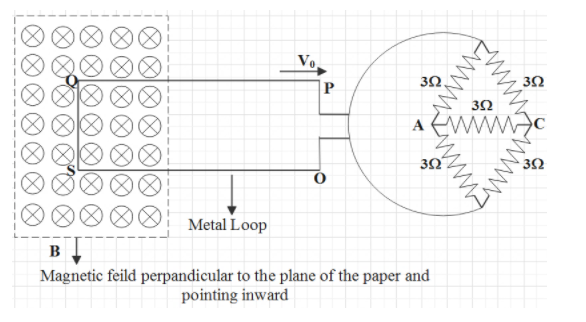
A square metal wire loop of side 10cm and resistances $1\Omega $ is moved with constant velocity ${{v}_{0}}$ in a uniform magnetic field of induction $B=2Wb{{m}^{-2}}$, as shown in figure. The magnetic field lines are perpendicular to the plane of loop and directed into the paper. The loop is connected to the network of resistances, each of value $3\Omega $. The resistance of the lead wires OS and PQ is negligible. What should be the speed of the loop so as to have a steady current of 1mA in the loop?
$\begin{align}
& A)2m{{s}^{-1}} \\
& B)2cm{{s}^{-1}} \\
& C)10m{{s}^{-1}} \\
& D)20m{{s}^{-1}} \\
\end{align}$
Answer
 Verified
574.2k+ views
Hint: To find the speed of the loop, initially we need to calculate the effective resistance of the network of resistances using the concept of Wheatstone bridge. Then, we will apply the formulae of induced emf and ohm’s law using the given data from the question and the calculated effective resistance to find the speed of the loop.
Formula used:
$\begin{align}
& \text{Induced emf, }e=Bvl \\
& \text{Ohm }\!\!'\!\!\text{ s law, }V=IR \\
\end{align}$
Complete step by step answer:
Firstly, we will take a look into the network of resistances given in the diagram and calculate the effective resistance.
Here, the figure looks like a Wheatstone bridge. It is an electrical circuit which is used to measure the unknown resistance of any one resistor. The voltage across both the individual series connections are equal. If we closely observe the figure, it looks like there are two legs which individually have two resistors connected in series, and are connected to parallel each other.
In a Wheatstone bridge, we ignore the resistance of the bridge. So, the resistance $3\Omega $ of the wire connected to the bridge will be removed. So the network will look like,
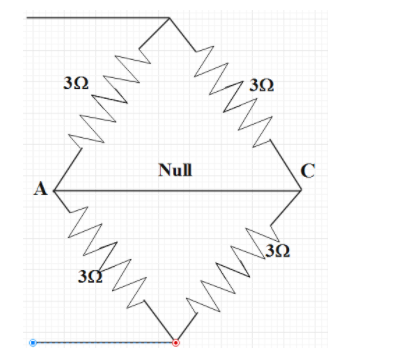
So, the effective resistance of each individual half of the network is \[3+3=6\Omega \] (as they are connected in series).
Now, these both effective resistances of \[6\Omega \] are connected in parallel to each other. Then, the effective resistance of the whole circuit will be,
$\begin{align}
& \dfrac{1}{R'}=\dfrac{1}{6}+\dfrac{1}{6} \\
& \Rightarrow R'=3\Omega \\
\end{align}$
It is also given that the metal wire has a resistance of $1\Omega $ and it is connected in series with the network of resistances. So, the resistance of the entire loop will become,
\[R=1\Omega +3\Omega =4\Omega \]
Now, if magnetic flux in a coil is changed for any cause, a voltage will be developed inside the circuit. This is called induced emf and it is stated by faraday’s law.
We know, induced emf is given by the equation,
$\text{ }e=Bvl$
According to ohm’s law, voltage in a circuit is given by,
$V=IR$
The induced emf in the circuit will be equal to this voltage. That is,
$\text{ }Bvl=IR$
Now, we can find the speed of the loop to have a steady current could be found from this expression.
$\text{ }Bvl=IR$
Where, B is the magnetic field, v is the speed of the loop, l is the wire, I is the current through the circuit and R is the effective resistance.
$\begin{align}
& Bvl=IR \\
& \Rightarrow v=\dfrac{IR}{Bl} \\
& \Rightarrow v=\dfrac{1\times {{10}^{-3}}A\times 4\Omega }{2Wb{{m}^{-2}}\times 0.1m}=0.02m{{s}^{-1}} \\
& \therefore v=2cm{{s}^{-1}} \\
\end{align}$
So, the velocity of the loop to have a steady current of \[1mA\] is found to be $2cm{{s}^{-1}}$. Therefore, option B is correct.
Note:
In order to answer this type of question, the key is to know the concepts of solving effective resistance using a Wheatstone bridge. The effective resistance of two resistances connected in series is given by, $R={{R}_{1}}+{{R}_{2}}$ and parallel is given by $\dfrac{1}{R}=\dfrac{1}{{{R}_{1}}}+\dfrac{1}{{{R}_{2}}}$. Equating voltage from ohm’s law to the induced emf is a vital step in solving this problem. Due to moving the loop with a speed in this case an emf is formed which is nothing but the voltage that causes current flowing in the loop.
Formula used:
$\begin{align}
& \text{Induced emf, }e=Bvl \\
& \text{Ohm }\!\!'\!\!\text{ s law, }V=IR \\
\end{align}$
Complete step by step answer:
Firstly, we will take a look into the network of resistances given in the diagram and calculate the effective resistance.
Here, the figure looks like a Wheatstone bridge. It is an electrical circuit which is used to measure the unknown resistance of any one resistor. The voltage across both the individual series connections are equal. If we closely observe the figure, it looks like there are two legs which individually have two resistors connected in series, and are connected to parallel each other.
In a Wheatstone bridge, we ignore the resistance of the bridge. So, the resistance $3\Omega $ of the wire connected to the bridge will be removed. So the network will look like,
So, the effective resistance of each individual half of the network is \[3+3=6\Omega \] (as they are connected in series).
Now, these both effective resistances of \[6\Omega \] are connected in parallel to each other. Then, the effective resistance of the whole circuit will be,
$\begin{align}
& \dfrac{1}{R'}=\dfrac{1}{6}+\dfrac{1}{6} \\
& \Rightarrow R'=3\Omega \\
\end{align}$
It is also given that the metal wire has a resistance of $1\Omega $ and it is connected in series with the network of resistances. So, the resistance of the entire loop will become,
\[R=1\Omega +3\Omega =4\Omega \]
Now, if magnetic flux in a coil is changed for any cause, a voltage will be developed inside the circuit. This is called induced emf and it is stated by faraday’s law.
We know, induced emf is given by the equation,
$\text{ }e=Bvl$
According to ohm’s law, voltage in a circuit is given by,
$V=IR$
The induced emf in the circuit will be equal to this voltage. That is,
$\text{ }Bvl=IR$
Now, we can find the speed of the loop to have a steady current could be found from this expression.
$\text{ }Bvl=IR$
Where, B is the magnetic field, v is the speed of the loop, l is the wire, I is the current through the circuit and R is the effective resistance.
$\begin{align}
& Bvl=IR \\
& \Rightarrow v=\dfrac{IR}{Bl} \\
& \Rightarrow v=\dfrac{1\times {{10}^{-3}}A\times 4\Omega }{2Wb{{m}^{-2}}\times 0.1m}=0.02m{{s}^{-1}} \\
& \therefore v=2cm{{s}^{-1}} \\
\end{align}$
So, the velocity of the loop to have a steady current of \[1mA\] is found to be $2cm{{s}^{-1}}$. Therefore, option B is correct.
Note:
In order to answer this type of question, the key is to know the concepts of solving effective resistance using a Wheatstone bridge. The effective resistance of two resistances connected in series is given by, $R={{R}_{1}}+{{R}_{2}}$ and parallel is given by $\dfrac{1}{R}=\dfrac{1}{{{R}_{1}}}+\dfrac{1}{{{R}_{2}}}$. Equating voltage from ohm’s law to the induced emf is a vital step in solving this problem. Due to moving the loop with a speed in this case an emf is formed which is nothing but the voltage that causes current flowing in the loop.
Recently Updated Pages
Master Class 12 Economics: Engaging Questions & Answers for Success

Master Class 12 Physics: Engaging Questions & Answers for Success
Master Class 12 English: Engaging Questions & Answers for Success
Master Class 12 Social Science: Engaging Questions & Answers for Success
Master Class 12 Maths: Engaging Questions & Answers for Success
Master Class 12 Business Studies: Engaging Questions & Answers for Success
Trending doubts
Which are the Top 10 Largest Countries of the World?
What are the major means of transport Explain each class 12 social science CBSE
Draw a labelled sketch of the human eye class 12 physics CBSE
Why cannot DNA pass through cell membranes class 12 biology CBSE
Differentiate between insitu conservation and exsitu class 12 biology CBSE
Draw a neat and well labeled diagram of TS of ovary class 12 biology CBSE