




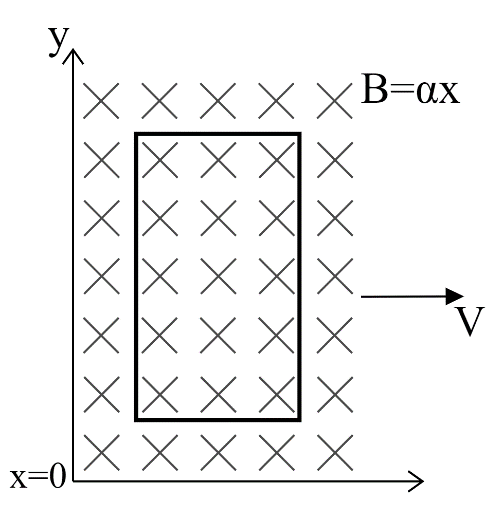
A square loop of length $ L = 0.2m $ and resistance $ R = 80m\Omega $ lies with one of its lengths along the $ x $ -axis as shown in the figure. It moves with speed $ V = 10m{s^{ - 1}} $ in the positive $ x $ -direction in a magnetic field that is into the paper and has a magnitude that varies with $ x $ according to $ B = \alpha x $ where $ \alpha = 0.2T{m^{ - 1}} $ . The magnitude of the induced current is $ I $ ampere. Then the value of $ 10\;I $ is? (Neglect self-inductance of the loop)
Answer
 Verified
549.9k+ views
Hint : As the square loop moves along the $ x $ - axis, the flux passing through the loop changes as the strength of the magnetic field varies with $ x $ . Due to the change in flux, an emf is generated in the loop. From the emf generated and the resistance of the loop, we can find the induced current.
Complete Step By Step Answer:
Let us note down the given data as follow;
Length of loop $ L = 0.2m $
As the loop is square,
Area of the loop $ Area = 0.2m \times 0.2m $
$ \therefore Area = 0.04{m^2} $
Resistance of the loop, $ R = 80m\Omega $
The velocity of the loop, $ V = 10m{s^{ - 1}} $
The magnitude of the magnetic field, $ B = 0.2x $
Now, the loop is moving along the $ x $ - axis. The magnitude of the magnetic field changes with the value of $ x $ .
Thus, as the loop moves forward, the magnetic field passing through the loop increases.
Thus, the magnetic flux passing through the loop changes.
The magnetic flux is calculated as,
$ \phi = BA\cos \theta $
Where, $ \theta $ is the angle between the magnetic field and the area of the loop.
Here, as shown in the figure the magnetic field is going inside the paper and is perpendicular to the loop, and so $ \theta = 0 $
$ \therefore \phi = BA $
$ \therefore \phi = \left( {0.2T{m^{ - 1}}} \right)x \times 0.04{m^2} $
Without considering the units,
$ \therefore \phi = 0.008x $
$ \therefore \phi = \left[ {\left( {8 \times {{10}^{ - 3}}} \right)x} \right]T{m^2} $
By Faraday’s law of induction, when the flux changes inside a loop, an emf equal to the negative rate of change of magnetic flux is induced.
As we only want the magnitude, we will ignore the negative sign,
$ \varepsilon = \dfrac{{d\phi }}{{dt}} $
$ \therefore \varepsilon = \dfrac{d}{{dt}}\left[ {\left( {8 \times {{10}^{ - 3}}} \right)x} \right] $
The constant value comes out of the derivation,
$ \therefore \varepsilon = 8 \times {10^{ - 3}}\dfrac{{dx}}{{dt}} $
Now, the rate of change of position is equal to the velocity
$ \therefore \varepsilon = 8 \times {10^{ - 3}} \times V $
Substituting the given value of velocity
$ \therefore \varepsilon = 8 \times {10^{ - 3}} \times 10m{s^{ - 1}} $
Without considering the units,
$ \therefore \varepsilon = 8 \times {10^{ - 3}} \times 10 $
$ \therefore \varepsilon = 8 \times {10^{ - 2}}V $
Now, by ohm’s law, the ratio of the emf to the resistance of the loop is equal to the induced current.
$ \therefore I = \dfrac{\varepsilon }{R} $
Substituting the given values,
$ \therefore I = \dfrac{{8 \times {{10}^{ - 2}}V}}{{80m\Omega }} $
Without considering the units,
$ \therefore I = \dfrac{{8 \times {{10}^{ - 2}}}}{{80 \times {{10}^{ - 3}}}} $
$ \therefore I = \dfrac{{8 \times {{10}^{ - 2}}}}{{8 \times {{10}^{ - 4}}}} $
Canceling the common terms and shifting the power to the numerator,
$ \therefore I = 100A $
Here, we need to find the value of $ 10\;A $
$ \therefore 10I = 1000A $ .
Note :
For the emf induced by moving the loop in the magnetic field, we have a derived formula $ \varepsilon = Blv $ , where $ l $ is the length of the loop. But here we cannot use the direct formula, as the derived formula is for a uniform magnetic field and here we are given a varying magnetic field.
Complete Step By Step Answer:
Let us note down the given data as follow;
Length of loop $ L = 0.2m $
As the loop is square,
Area of the loop $ Area = 0.2m \times 0.2m $
$ \therefore Area = 0.04{m^2} $
Resistance of the loop, $ R = 80m\Omega $
The velocity of the loop, $ V = 10m{s^{ - 1}} $
The magnitude of the magnetic field, $ B = 0.2x $
Now, the loop is moving along the $ x $ - axis. The magnitude of the magnetic field changes with the value of $ x $ .
Thus, as the loop moves forward, the magnetic field passing through the loop increases.
Thus, the magnetic flux passing through the loop changes.
The magnetic flux is calculated as,
$ \phi = BA\cos \theta $
Where, $ \theta $ is the angle between the magnetic field and the area of the loop.
Here, as shown in the figure the magnetic field is going inside the paper and is perpendicular to the loop, and so $ \theta = 0 $
$ \therefore \phi = BA $
$ \therefore \phi = \left( {0.2T{m^{ - 1}}} \right)x \times 0.04{m^2} $
Without considering the units,
$ \therefore \phi = 0.008x $
$ \therefore \phi = \left[ {\left( {8 \times {{10}^{ - 3}}} \right)x} \right]T{m^2} $
By Faraday’s law of induction, when the flux changes inside a loop, an emf equal to the negative rate of change of magnetic flux is induced.
As we only want the magnitude, we will ignore the negative sign,
$ \varepsilon = \dfrac{{d\phi }}{{dt}} $
$ \therefore \varepsilon = \dfrac{d}{{dt}}\left[ {\left( {8 \times {{10}^{ - 3}}} \right)x} \right] $
The constant value comes out of the derivation,
$ \therefore \varepsilon = 8 \times {10^{ - 3}}\dfrac{{dx}}{{dt}} $
Now, the rate of change of position is equal to the velocity
$ \therefore \varepsilon = 8 \times {10^{ - 3}} \times V $
Substituting the given value of velocity
$ \therefore \varepsilon = 8 \times {10^{ - 3}} \times 10m{s^{ - 1}} $
Without considering the units,
$ \therefore \varepsilon = 8 \times {10^{ - 3}} \times 10 $
$ \therefore \varepsilon = 8 \times {10^{ - 2}}V $
Now, by ohm’s law, the ratio of the emf to the resistance of the loop is equal to the induced current.
$ \therefore I = \dfrac{\varepsilon }{R} $
Substituting the given values,
$ \therefore I = \dfrac{{8 \times {{10}^{ - 2}}V}}{{80m\Omega }} $
Without considering the units,
$ \therefore I = \dfrac{{8 \times {{10}^{ - 2}}}}{{80 \times {{10}^{ - 3}}}} $
$ \therefore I = \dfrac{{8 \times {{10}^{ - 2}}}}{{8 \times {{10}^{ - 4}}}} $
Canceling the common terms and shifting the power to the numerator,
$ \therefore I = 100A $
Here, we need to find the value of $ 10\;A $
$ \therefore 10I = 1000A $ .
Note :
For the emf induced by moving the loop in the magnetic field, we have a derived formula $ \varepsilon = Blv $ , where $ l $ is the length of the loop. But here we cannot use the direct formula, as the derived formula is for a uniform magnetic field and here we are given a varying magnetic field.
Recently Updated Pages
Master Class 12 Social Science: Engaging Questions & Answers for Success

Master Class 12 Physics: Engaging Questions & Answers for Success
Master Class 12 Maths: Engaging Questions & Answers for Success
Master Class 12 Economics: Engaging Questions & Answers for Success
Master Class 12 Chemistry: Engaging Questions & Answers for Success
Master Class 12 Business Studies: Engaging Questions & Answers for Success
Trending doubts
Which are the Top 10 Largest Countries of the World?
Draw a labelled sketch of the human eye class 12 physics CBSE
Explain the structure of megasporangium class 12 biology CBSE
What are the major means of transport Explain each class 12 social science CBSE
How many chromosomes are found in human ovum a 46 b class 12 biology CBSE
The diagram of the section of a maize grain is given class 12 biology CBSE