




A square circumscribes a circle, and another square is inscribed in this circle with one vertex at the point of contact. What is the ratio of the areas of the circumscribed and inscribed squares?
Answer
 Verified
622.5k+ views
Hint: A Square circumscribing a circle and another square is inscribed in a circle with one vertex at the point of contact indicates that the one square is circumscribed to a circle and another one is inscribed.
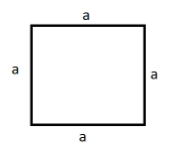
Area of square\[ = {a^2}\]\[ = sid{e^2}\]
Diagonal of square \[ = \sqrt {2\,\,} a\]
Complete step-by -step solution:
Given that a square circumscribed a circle and another square is inscribed in the circle with one vertex at the point of contact let the radius of the circle\[ = r\]
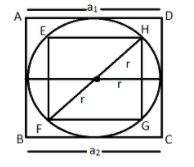
Now in square EFGH, we have:
Diagonal of square \[ = \sqrt {2\,\,} a\]
Diagonal of circle = \[2r\]
In EFGH, \[a = {a_2}\]
As here in the diagram, diagonal of the square is equal to diagonal of the circle. We have:
\[2r = \sqrt 2 \,{a_2}\]
\[{a_2} = \dfrac{{2r}}{{\sqrt 2 }} = \sqrt 2 r........(1)\]
Area of square EAGH is:
\[
{A_{EAGH}} = \left( {{a_2}} \right){}^2 \\
= {(\sqrt 2 r)^2} \\
= 2{r^2}.......(2) \\
\]
Now, considering the square ABCD:
Diagonal of square \[ = \sqrt {2\,\,} a\]
Diagonal of circle = \[2r\]
In EFGH, \[a = {a_1}\]
As here in the diagram, diagonal of the square is equal to diagonal of the circle. We have:
\[{a_1} = 2r\]
Area of square ABCD is:
\[
{A_{ABCD}} = {({a_1})^2} \\
= {(2r)^2} \\
= 4{r^2}.......(3) \\
\]
Now Ratio of Area of square ABCD and area of square EFGH
\[
\dfrac{{{A_{ABCD}}}}{{{A_{EFGH}}}} = \dfrac{{4{r^2}}}{{2{r^2}}} \\
= \dfrac{2}{1} \\
\] (from \[e{q^n}\](2) & (3))
Hence, the areas of the circumscribed and inscribed squares are \[2:1\]
Note:In geometry, the circumscribed circle or circumcircle of a polygon is a circle that passes through all the vertices of the polygon. The centre of this circle is called the circumcenter, and its radius is called the circumradius. A circumscribed square of a circle is a square surrounding a circle such that the circumference of the circle touches the midpoints of the four sides of the square. The diameter of the circle is equal to the side length of the square.
Area of square\[ = {a^2}\]\[ = sid{e^2}\]
Diagonal of square \[ = \sqrt {2\,\,} a\]
Complete step-by -step solution:
Given that a square circumscribed a circle and another square is inscribed in the circle with one vertex at the point of contact let the radius of the circle\[ = r\]
Now in square EFGH, we have:
Diagonal of square \[ = \sqrt {2\,\,} a\]
Diagonal of circle = \[2r\]
In EFGH, \[a = {a_2}\]
As here in the diagram, diagonal of the square is equal to diagonal of the circle. We have:
\[2r = \sqrt 2 \,{a_2}\]
\[{a_2} = \dfrac{{2r}}{{\sqrt 2 }} = \sqrt 2 r........(1)\]
Area of square EAGH is:
\[
{A_{EAGH}} = \left( {{a_2}} \right){}^2 \\
= {(\sqrt 2 r)^2} \\
= 2{r^2}.......(2) \\
\]
Now, considering the square ABCD:
Diagonal of square \[ = \sqrt {2\,\,} a\]
Diagonal of circle = \[2r\]
In EFGH, \[a = {a_1}\]
As here in the diagram, diagonal of the square is equal to diagonal of the circle. We have:
\[{a_1} = 2r\]
Area of square ABCD is:
\[
{A_{ABCD}} = {({a_1})^2} \\
= {(2r)^2} \\
= 4{r^2}.......(3) \\
\]
Now Ratio of Area of square ABCD and area of square EFGH
\[
\dfrac{{{A_{ABCD}}}}{{{A_{EFGH}}}} = \dfrac{{4{r^2}}}{{2{r^2}}} \\
= \dfrac{2}{1} \\
\] (from \[e{q^n}\](2) & (3))
Hence, the areas of the circumscribed and inscribed squares are \[2:1\]
Note:In geometry, the circumscribed circle or circumcircle of a polygon is a circle that passes through all the vertices of the polygon. The centre of this circle is called the circumcenter, and its radius is called the circumradius. A circumscribed square of a circle is a square surrounding a circle such that the circumference of the circle touches the midpoints of the four sides of the square. The diameter of the circle is equal to the side length of the square.
Recently Updated Pages
Master Class 12 Economics: Engaging Questions & Answers for Success

Master Class 12 English: Engaging Questions & Answers for Success
Master Class 12 Social Science: Engaging Questions & Answers for Success
Master Class 12 Maths: Engaging Questions & Answers for Success
Master Class 12 Physics: Engaging Questions & Answers for Success
Master Class 12 Business Studies: Engaging Questions & Answers for Success
Trending doubts
Which are the Top 10 Largest Countries of the World?
Draw a labelled sketch of the human eye class 12 physics CBSE
Differentiate between homogeneous and heterogeneous class 12 chemistry CBSE
Why is the cell called the structural and functional class 12 biology CBSE
Draw ray diagrams each showing i myopic eye and ii class 12 physics CBSE
Which is the correct genotypic ratio of mendel dihybrid class 12 biology CBSE