




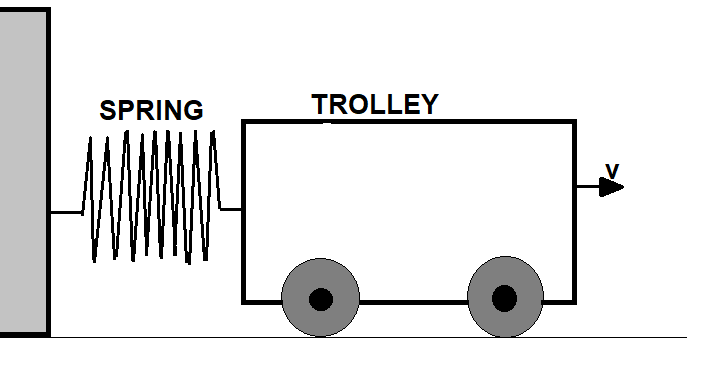
A spring is kept compressed by a small trolley of mass 0.5 kg lying on a smooth horizontal surface as shown in the below fig. When the trolley is released, it is found to move at a speed v= $2m{s^{ - 1}}$. What potential energy did the spring possess when compressed?
Answer
 Verified
556.5k+ views
Hint: When the body is at rest after compressing the spring all the energy is stored in the form of potential energy and as soon as the trolley is released all of the potential energy will be converted into kinetic energy and the trolley will be moved by that energy.
Complete step by step answer:
When the trolley was kept at rest all the energy was stored in the form of kinetic potential energy and when the trolley is allowed to move all the potential energy stored in the spring will be converted into kinetic energy and the trolley will move
As the law of conservation of energy states that the energy can neither be created nor be destroyed only can be converted from one form to another hence here also the whole PE will be converted to kinetic energy
So, the potential energy will be equal to the kinetic energy of the trolley
As we know, \[K.E = \dfrac{1}{2}m{v^2}\]
Here mass the trolley (m) = 0.5kg
And the velocity of the trolley is given as \[v = 2m{s^{ - 1}}\]
Substituting the values, we get
$K.E = \dfrac{1}{2} \times 0.5 \times {2^2}$
$ \Rightarrow K.E = 1j$
Hence potential energy would also have been equal to 1 joule
Final answer: the amount of potential energy stored in the spring was 1 Joule.
Note:
-The whole P.E will be converted into K.E.
-The amount of energy will always remain the sum of K.E and potential energy at all positions except at the position when the trolley was held stationary at that position the K.E was zero.
Complete step by step answer:
When the trolley was kept at rest all the energy was stored in the form of kinetic potential energy and when the trolley is allowed to move all the potential energy stored in the spring will be converted into kinetic energy and the trolley will move
As the law of conservation of energy states that the energy can neither be created nor be destroyed only can be converted from one form to another hence here also the whole PE will be converted to kinetic energy
So, the potential energy will be equal to the kinetic energy of the trolley
As we know, \[K.E = \dfrac{1}{2}m{v^2}\]
Here mass the trolley (m) = 0.5kg
And the velocity of the trolley is given as \[v = 2m{s^{ - 1}}\]
Substituting the values, we get
$K.E = \dfrac{1}{2} \times 0.5 \times {2^2}$
$ \Rightarrow K.E = 1j$
Hence potential energy would also have been equal to 1 joule
Final answer: the amount of potential energy stored in the spring was 1 Joule.
Note:
-The whole P.E will be converted into K.E.
-The amount of energy will always remain the sum of K.E and potential energy at all positions except at the position when the trolley was held stationary at that position the K.E was zero.
Recently Updated Pages
Master Class 12 Economics: Engaging Questions & Answers for Success

Master Class 12 Physics: Engaging Questions & Answers for Success
Master Class 12 English: Engaging Questions & Answers for Success
Master Class 12 Social Science: Engaging Questions & Answers for Success
Master Class 12 Maths: Engaging Questions & Answers for Success
Master Class 12 Business Studies: Engaging Questions & Answers for Success
Trending doubts
Which are the Top 10 Largest Countries of the World?
What are the major means of transport Explain each class 12 social science CBSE
Draw a labelled sketch of the human eye class 12 physics CBSE
Why cannot DNA pass through cell membranes class 12 biology CBSE
Differentiate between insitu conservation and exsitu class 12 biology CBSE
Draw a neat and well labeled diagram of TS of ovary class 12 biology CBSE