




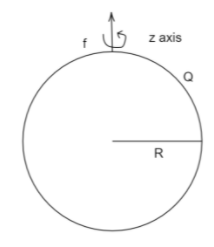
A spherical shell of radius $R$ and uniformly charged with charge $Q$ is rotating about its axis with frequency $f$. Find the magnetic moment of the sphere?
Answer
 Verified
506.1k+ views
Hint:We have given a spherical shell of radius $R$ with uniform charge Q . let it rotate around the z-axis. Let Angular velocity be $\omega $ and frequency is given $f$ . For solving this we should know the area of a sphere $\left( {4\pi {r^2}} \right)$ , spherical polar coordinates. We will divide the sphere into a small ring and then integrate it to find the magnetic moment of the sphere.
Complete step by step answer:
A uniformly charged solid sphere of radius $R$ carries a total charge $Q$ .
So surface charge density will be $\sigma = \dfrac{Q}{A}$ where $A$ is the volume of the sphere
$\sigma = \dfrac{Q}{{4\pi {r^2}}}$
It rotates about its axis with a frequency $ = f$
let its angular velocity $\omega = 2\pi f$
Suppose the angular velocity $\overrightarrow \omega = \omega \widehat z$
To find the magnetic moment of the sphere we can divide the sphere into small charges.
Using spherical polar coordinates $\left( {\rho ,\phi ,\theta } \right)$ with origin at the center of the spherical shell, we consider a small area $dS$ of a circular ring of small width and radius $r$ located at a distance $R$ from the origin on the surface of the sphere.
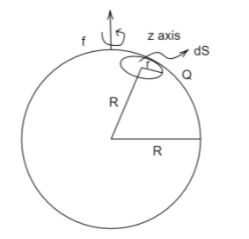
Here $\overrightarrow r = R\operatorname{Sin} \theta \widehat r$ and coordinate $\rho = R$ is constant for each elemental area.
$dq = \sigma dS = \sigma {R^2}\sin \theta d\theta d\phi $
Current in the ring is given by
$dI = dq \times f$
Using the value of $dq$and $f$ from above
$dI = \dfrac{{\omega \sigma {R^2}\sin \theta d\theta d\phi }}{{2\pi }}$
The magnetic dipole moment of the ring is given by the expression in terms of the position vector $\overrightarrow r $ and current density $\overrightarrow J $ as
\[d{\overrightarrow m _{ring}} = \dfrac{1}{2}\int\limits_{ring} {\overrightarrow r } \times \overrightarrow J \]
\[ = \dfrac{1}{2}dI\int\limits_{ring} {\overrightarrow r } \times d\overrightarrow l \]
Where $d\overrightarrow l $ is the element length of the ring.
Line integral becomes equal to the circumference of the ring $ = 2\pi r\sin \theta $
$ = dI(\pi {r^2}{\sin ^2}\theta )\widehat z$
Inserting value of $dI$ in above
$d\overrightarrow m = \dfrac{{\overrightarrow \omega \sigma {R^4}{{\sin }^3}\theta d\theta d\phi }}{2}$
The total magnetic dipole moment is then
$\overrightarrow m = \dfrac{{\overrightarrow \omega \sigma {R^4}}}{2}\int\limits_0^\pi {{{\sin }^3}\theta d\theta \int\limits_0^{2\pi } {d\phi } } $
$\overrightarrow m = \dfrac{{\overrightarrow \omega \sigma {R^4}}}{2} \times \dfrac{4}{3} \times 2\pi $
$\overrightarrow m = \dfrac{4}{3}\pi \sigma {R^4}\overrightarrow \omega $
We have to write in terms of $Q$
So, $\overrightarrow m = \dfrac{4}{3}\pi \left( {\dfrac{Q}{{4\pi {R^2}}}} \right){R^4}\overrightarrow \omega $
$\overrightarrow m = \dfrac{Q}{3}{R^2}\overrightarrow \omega $
This is the required solution.
Note:Using spherical polar coordinates, we can take $dq = \rho d\tau = \rho {r^2}dr\sin \theta d\theta d\phi $, with the contribution to the dipole moment given by $d\overrightarrow m = \dfrac{1}{2}\overrightarrow r \times \overrightarrow J d\tau $ . One method would be to write down the volume integral directly, using $\overrightarrow J = \rho \overrightarrow \nu = \rho \overrightarrow \omega \times \overrightarrow r $ . Where $\rho $is volume charge density $\rho = \dfrac{Q}{V} = \dfrac{Q}{{\dfrac{4}{3}\pi {r^3}}}$
It is easy to see that if an electrically charged body is stationary, then this entire expression vanishes since $J = 0$ everywhere.
Complete step by step answer:
A uniformly charged solid sphere of radius $R$ carries a total charge $Q$ .
So surface charge density will be $\sigma = \dfrac{Q}{A}$ where $A$ is the volume of the sphere
$\sigma = \dfrac{Q}{{4\pi {r^2}}}$
It rotates about its axis with a frequency $ = f$
let its angular velocity $\omega = 2\pi f$
Suppose the angular velocity $\overrightarrow \omega = \omega \widehat z$
To find the magnetic moment of the sphere we can divide the sphere into small charges.
Using spherical polar coordinates $\left( {\rho ,\phi ,\theta } \right)$ with origin at the center of the spherical shell, we consider a small area $dS$ of a circular ring of small width and radius $r$ located at a distance $R$ from the origin on the surface of the sphere.
Here $\overrightarrow r = R\operatorname{Sin} \theta \widehat r$ and coordinate $\rho = R$ is constant for each elemental area.
$dq = \sigma dS = \sigma {R^2}\sin \theta d\theta d\phi $
Current in the ring is given by
$dI = dq \times f$
Using the value of $dq$and $f$ from above
$dI = \dfrac{{\omega \sigma {R^2}\sin \theta d\theta d\phi }}{{2\pi }}$
The magnetic dipole moment of the ring is given by the expression in terms of the position vector $\overrightarrow r $ and current density $\overrightarrow J $ as
\[d{\overrightarrow m _{ring}} = \dfrac{1}{2}\int\limits_{ring} {\overrightarrow r } \times \overrightarrow J \]
\[ = \dfrac{1}{2}dI\int\limits_{ring} {\overrightarrow r } \times d\overrightarrow l \]
Where $d\overrightarrow l $ is the element length of the ring.
Line integral becomes equal to the circumference of the ring $ = 2\pi r\sin \theta $
$ = dI(\pi {r^2}{\sin ^2}\theta )\widehat z$
Inserting value of $dI$ in above
$d\overrightarrow m = \dfrac{{\overrightarrow \omega \sigma {R^4}{{\sin }^3}\theta d\theta d\phi }}{2}$
The total magnetic dipole moment is then
$\overrightarrow m = \dfrac{{\overrightarrow \omega \sigma {R^4}}}{2}\int\limits_0^\pi {{{\sin }^3}\theta d\theta \int\limits_0^{2\pi } {d\phi } } $
$\overrightarrow m = \dfrac{{\overrightarrow \omega \sigma {R^4}}}{2} \times \dfrac{4}{3} \times 2\pi $
$\overrightarrow m = \dfrac{4}{3}\pi \sigma {R^4}\overrightarrow \omega $
We have to write in terms of $Q$
So, $\overrightarrow m = \dfrac{4}{3}\pi \left( {\dfrac{Q}{{4\pi {R^2}}}} \right){R^4}\overrightarrow \omega $
$\overrightarrow m = \dfrac{Q}{3}{R^2}\overrightarrow \omega $
This is the required solution.
Note:Using spherical polar coordinates, we can take $dq = \rho d\tau = \rho {r^2}dr\sin \theta d\theta d\phi $, with the contribution to the dipole moment given by $d\overrightarrow m = \dfrac{1}{2}\overrightarrow r \times \overrightarrow J d\tau $ . One method would be to write down the volume integral directly, using $\overrightarrow J = \rho \overrightarrow \nu = \rho \overrightarrow \omega \times \overrightarrow r $ . Where $\rho $is volume charge density $\rho = \dfrac{Q}{V} = \dfrac{Q}{{\dfrac{4}{3}\pi {r^3}}}$
It is easy to see that if an electrically charged body is stationary, then this entire expression vanishes since $J = 0$ everywhere.
Recently Updated Pages
Master Class 12 Social Science: Engaging Questions & Answers for Success

Master Class 12 Physics: Engaging Questions & Answers for Success
Master Class 12 Maths: Engaging Questions & Answers for Success
Master Class 12 Economics: Engaging Questions & Answers for Success
Master Class 12 Chemistry: Engaging Questions & Answers for Success
Master Class 12 Business Studies: Engaging Questions & Answers for Success
Trending doubts
Draw a labelled sketch of the human eye class 12 physics CBSE
What are the major means of transport Explain each class 12 social science CBSE
How many 176Omega resistors in parallel are required class 12 physics CBSE
What are the advantages of vegetative propagation class 12 biology CBSE
What is corrosion Explain its advantages and disad class 12 chemistry CBSE
When was the first election held in India a 194748 class 12 sst CBSE