




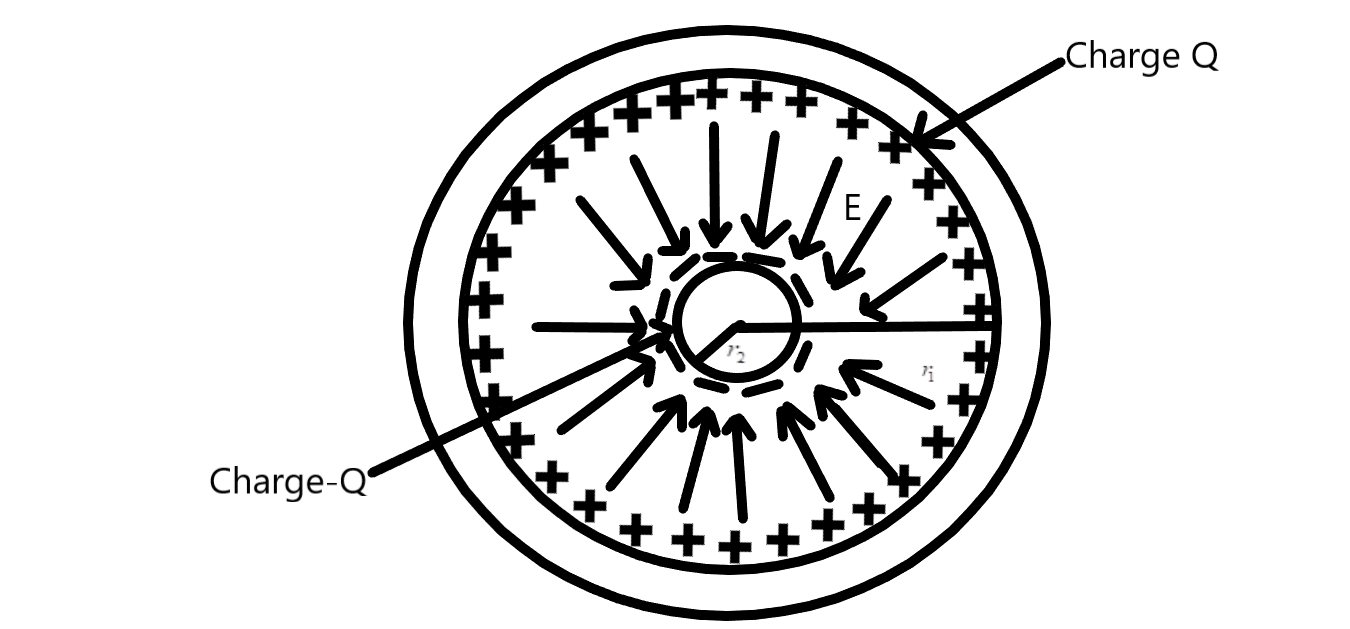
A spherical capacitor consists of two concentric spherical conductors, held in position by suitable insulating support (fig.). Show the capacitance of spherical capacitor is given by
$c = \dfrac{{4\pi { \in _ \circ }{r_1}{r_2}}}{{{r_1} - {r_2}}}$ where ${r_1}$ and ${r_2}$ are the radii of outer and inner spheres, respectively.
Answer
 Verified
625.8k+ views
Hint: Capacitance is the ability of the component to store the energy in form of electrical charge. It is expressed in the ratio of charge (Q) to the potential difference (V). Capacitor has two plates separated by a distance having equal and opposite charge.
Complete step-by-step solution -
According to the question:
Radius of outer shell= ${r_1}$
Radius of inner shell=${r_2}$
The inner surface of the outer shell has charge +Q and the outer surface of inner shell is –Q
Potential between two shells is given by
$V\dfrac{Q}{{4\pi { \in _ \circ }{r_2}}} - \dfrac{Q}{{4\pi { \in _ \circ }{r_1}}}$
As we know that ${ \in _ \circ }$ is permittivity of free space
$
V = \dfrac{Q}{{4\pi { \in _ \circ }}}\left[ {\dfrac{1}{{{r_2}}} - \dfrac{1}{{{r_1}}}} \right] \\
V = \dfrac{{Q\left( {{r_1} - {r_2}} \right)}}{{4\pi { \in _ \circ }{r_1}{r_2}}} \\
$
Capacitance of the given system is given by,
$C = \dfrac{Q}{V}$ and capacitance is measured in farad.
$C = \dfrac{{4\pi { \in _ \circ }{r_1}{r_2}}}{{{r_1} - {r_2}}}$
Hence proved.
Capacitors are widely used in electronic circuits to perform a variety of tasks, such as filtering, smoothing, bypassing etc. AC is able to get through it and get a dc block this is known as a coupling capacitor. The coupling capacitors are essential components in amplifier circuits.
In analog circuits, a coupling capacitor is used to connect two circuits such that only AC signal from the first circuit passes through the next circuit while DC is blocked.
Note: There are two main types of coupling categories: Mechanical flexing and Material flexing. There are different types of capacitor such as polyester capacitor, trimmer capacitor, PCB mounted electrolytic capacitor, motor run capacitor and lots more.
Complete step-by-step solution -
According to the question:
Radius of outer shell= ${r_1}$
Radius of inner shell=${r_2}$
The inner surface of the outer shell has charge +Q and the outer surface of inner shell is –Q
Potential between two shells is given by
$V\dfrac{Q}{{4\pi { \in _ \circ }{r_2}}} - \dfrac{Q}{{4\pi { \in _ \circ }{r_1}}}$
As we know that ${ \in _ \circ }$ is permittivity of free space
$
V = \dfrac{Q}{{4\pi { \in _ \circ }}}\left[ {\dfrac{1}{{{r_2}}} - \dfrac{1}{{{r_1}}}} \right] \\
V = \dfrac{{Q\left( {{r_1} - {r_2}} \right)}}{{4\pi { \in _ \circ }{r_1}{r_2}}} \\
$
Capacitance of the given system is given by,
$C = \dfrac{Q}{V}$ and capacitance is measured in farad.
$C = \dfrac{{4\pi { \in _ \circ }{r_1}{r_2}}}{{{r_1} - {r_2}}}$
Hence proved.
Capacitors are widely used in electronic circuits to perform a variety of tasks, such as filtering, smoothing, bypassing etc. AC is able to get through it and get a dc block this is known as a coupling capacitor. The coupling capacitors are essential components in amplifier circuits.
In analog circuits, a coupling capacitor is used to connect two circuits such that only AC signal from the first circuit passes through the next circuit while DC is blocked.
Note: There are two main types of coupling categories: Mechanical flexing and Material flexing. There are different types of capacitor such as polyester capacitor, trimmer capacitor, PCB mounted electrolytic capacitor, motor run capacitor and lots more.
Recently Updated Pages
Master Class 12 Business Studies: Engaging Questions & Answers for Success

Master Class 12 Biology: Engaging Questions & Answers for Success
Master Class 12 Chemistry: Engaging Questions & Answers for Success
Class 12 Question and Answer - Your Ultimate Solutions Guide
Master Class 11 Social Science: Engaging Questions & Answers for Success
Master Class 11 English: Engaging Questions & Answers for Success
Trending doubts
Which is more stable and why class 12 chemistry CBSE
Which are the Top 10 Largest Countries of the World?
Draw a labelled sketch of the human eye class 12 physics CBSE
Differentiate between homogeneous and heterogeneous class 12 chemistry CBSE
What are the major means of transport Explain each class 12 social science CBSE
Sulphuric acid is known as the king of acids State class 12 chemistry CBSE