




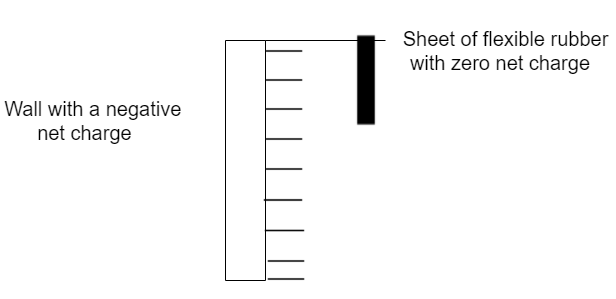
A sphere of non-conducting wall is given a negative net charge. Next, a sheet of very flexible rubber with zero net charge is suspended from the ceiling near the charged wall as shown below. The rubber sheet will:
A) Not be affected by the charges on the wall since rubber is an insulator.
B) Not be affected by the charged wall because the rubber sheet has zero net charge.
C) Bend away from the wall due to the electrical repulsion between the electrons in the rubber and the charges on the wall.
D) Bend away from the wall due to polarisation of the rubber molecules by the charged wall.
E) Bend towards the wall due to the polarization of the rubber molecules by the charged wall.
Answer
 Verified
621.3k+ views
Hint: Dipole is defined as the pair of equal and opposite charges separated by a small distance. There is no net charge on the dipole. When a dipole is present in an electric field, it experiences a torque. The field of dipole is less effective than electric field at large distances.
Complete step by step solution:
Step I:
When an electric dipole is placed in a uniform electric field, then it aligns itself along the direction of the electric field. The direction of charge from negative to positive will be the same as that of the electric field. This happens because the forces acting on the charge are equal in magnitude and opposite in direction. The net force acting on the dipole will be zero.
Step II:
Given that there is a net negative charge on the non conducting wall, so when a sheet of rubber is suspended through the ceiling, it gets attracted towards the wall. As it is now placed in an electric field, it will align itself such that the positive charge will induce near the wall and the negative charge will induce far away from the wall. After the charge is induced, the wall and the rubber will attract each other and rubber will bend towards the wall.
Therefore Option E is the right answer.
Note: It is to be noted that if the dipole is placed in a uniform electric field, then it experiences a torque, but no net force. On the other hand if the dipole is placed in a non uniform electric field then it will experience a net torque as well as a net force.
Complete step by step solution:
Step I:
When an electric dipole is placed in a uniform electric field, then it aligns itself along the direction of the electric field. The direction of charge from negative to positive will be the same as that of the electric field. This happens because the forces acting on the charge are equal in magnitude and opposite in direction. The net force acting on the dipole will be zero.
Step II:
Given that there is a net negative charge on the non conducting wall, so when a sheet of rubber is suspended through the ceiling, it gets attracted towards the wall. As it is now placed in an electric field, it will align itself such that the positive charge will induce near the wall and the negative charge will induce far away from the wall. After the charge is induced, the wall and the rubber will attract each other and rubber will bend towards the wall.
Therefore Option E is the right answer.
Note: It is to be noted that if the dipole is placed in a uniform electric field, then it experiences a torque, but no net force. On the other hand if the dipole is placed in a non uniform electric field then it will experience a net torque as well as a net force.
Recently Updated Pages
Basicity of sulphurous acid and sulphuric acid are

Master Class 12 Economics: Engaging Questions & Answers for Success
Master Class 12 Biology: Engaging Questions & Answers for Success
Master Class 11 English: Engaging Questions & Answers for Success
Master Class 11 Physics: Engaging Questions & Answers for Success
Master Class 11 Computer Science: Engaging Questions & Answers for Success
Trending doubts
Draw a labelled sketch of the human eye class 12 physics CBSE
The chemical formula of tear gas is A CO Cl 2 B C 10 class 12 chemistry CBSE
Draw ray diagrams each showing i myopic eye and ii class 12 physics CBSE
Which are the Top 10 Largest Countries of the World?
Differentiate between homogeneous and heterogeneous class 12 chemistry CBSE
Which is the correct genotypic ratio of mendel dihybrid class 12 biology CBSE