




What is a spectrum? Why do we get a spectrum of seven colours when white light is dispersed by a prism?
Answer
 Verified
535.2k+ views
Hint: Here we will understand what spectrum refers to. Then we will discuss the phenomenon of dispersion of white light. We will understand the primary cause behind the splitting of the white light into seven colours. A glass prism has the ability to disperse the white light.
Complete answer:
Spectrum- Spectrum here refers to the visible spectrum which is seen by naked eye. There are more spectra but a human eye can see the wavelength from $ 380{\text{ }}nm $ to about $ 750{\text{ }}nm $ of the spectrum. Thus, the seven distinct colours are visible to the human eye and considered as the visible spectrum.
Dispersion of white light-
The phenomenon of splitting up of white light into seven distinct colours while passing through a glass prism is known as dispersion of white light.
Cause of dispersion of white light-
The dispersion of white light occurs due to the fact that different light have different wavelengths. When they strike the glass surface of the glass prism their velocities become different due to different wavelengths, hence their angle of deviation becomes different. So, they split up into seven colours.
Diagram of dispersion of light:
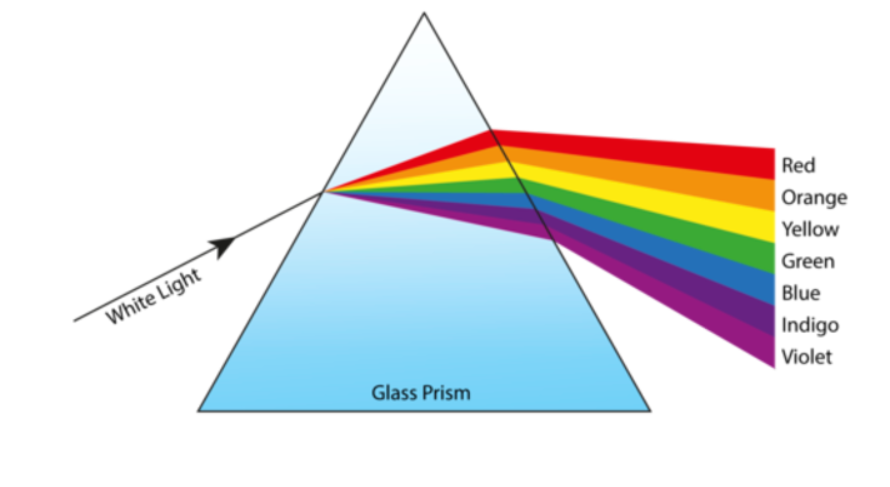
In a glass prism the faces are at some angles to each other. The white light being refracted from the first face splits up into seven components due to their varying wavelengths causing varying angles. Again, they get reflected from the last face of the prism which is also inclined at some angle and hence the components do not merge and come out as distinct seven colours.
Note:
It must be noted that the visible spectrum is just a part of the electromagnetic spectrum. Electromagnetic spectrum comprises various wavelengths from which those which are perceived by the naked eye are considered as visible spectrum. In the case of prisms both dispersion and refraction happens on the both faces of the prism as they are some angles to each other hence, they can produce a spectrum of white light.
Complete answer:
Spectrum- Spectrum here refers to the visible spectrum which is seen by naked eye. There are more spectra but a human eye can see the wavelength from $ 380{\text{ }}nm $ to about $ 750{\text{ }}nm $ of the spectrum. Thus, the seven distinct colours are visible to the human eye and considered as the visible spectrum.
Dispersion of white light-
The phenomenon of splitting up of white light into seven distinct colours while passing through a glass prism is known as dispersion of white light.
Cause of dispersion of white light-
The dispersion of white light occurs due to the fact that different light have different wavelengths. When they strike the glass surface of the glass prism their velocities become different due to different wavelengths, hence their angle of deviation becomes different. So, they split up into seven colours.
Diagram of dispersion of light:
In a glass prism the faces are at some angles to each other. The white light being refracted from the first face splits up into seven components due to their varying wavelengths causing varying angles. Again, they get reflected from the last face of the prism which is also inclined at some angle and hence the components do not merge and come out as distinct seven colours.
Note:
It must be noted that the visible spectrum is just a part of the electromagnetic spectrum. Electromagnetic spectrum comprises various wavelengths from which those which are perceived by the naked eye are considered as visible spectrum. In the case of prisms both dispersion and refraction happens on the both faces of the prism as they are some angles to each other hence, they can produce a spectrum of white light.
Recently Updated Pages
Master Class 12 Business Studies: Engaging Questions & Answers for Success

Master Class 12 Chemistry: Engaging Questions & Answers for Success
Master Class 12 Biology: Engaging Questions & Answers for Success
Class 12 Question and Answer - Your Ultimate Solutions Guide
Master Class 11 English: Engaging Questions & Answers for Success
Master Class 11 Social Science: Engaging Questions & Answers for Success
Trending doubts
Which are the Top 10 Largest Countries of the World?
Draw a labelled sketch of the human eye class 12 physics CBSE
The end of compass needle which points towards north class 12 physics CBSE
Differentiate between homogeneous and heterogeneous class 12 chemistry CBSE
In order to find out the different types of gametes class 12 biology NEET_UG
Why is the cell called the structural and functional class 12 biology CBSE