




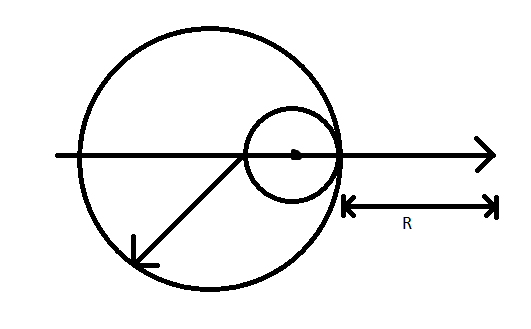
A solid sphere of uniform density and radius $R$ applies a gravitational force of attraction equal to ${{F}_{1}}$ on a particle placed at a distance $2R$ from the centre of the sphere. A spherical cavity of radius $R/2$ is now made in the sphere as shown in the figure. The sphere with the cavity now applies a gravitational force ${{F}_{2}}$ on the same particle. The ratio ${{F}_{1}}/{{F}_{2}}$ is
Answer
 Verified
666.6k+ views
Hint: This problem can be solved by first finding out the gravitational force due to the sphere at the distance and then finding the gravitational force due to the sphere in the cavity by considering the cavity as a body of negative mass and subtracting the gravitational force due to this negative mass from the gravitational force due to the full sphere. Therefore, we can get the two forces and find out the required ratio.
Formula used:
The magnitude of the attractive gravitational force ${{F}_{g}}$ exerted by a mass $M$ on another mass $m$ is given by
${{F}_{g}}=\dfrac{GMm}{{{R}^{2}}}$
where $R$ is the distance between the centres of the two bodies and $G=6.67\times {{10}^{-11}}{{m}^{3}}k{{g}^{-1}}{{s}^{-2}}$ is the universal gravitational constant.
This force attracts the body of mass $m$ towards the centre of the body of mass $M$.
The volume $V$ of a sphere of radius $R$ is given by
$V=\dfrac{4}{3}\pi {{R}^{3}}$
Complete step by step answer:
As explained in the hint, we will first find the gravitational force due to the full sphere and then find the gravitational force due to the sphere with the cavity by subtracting the gravitational force due to the cavity (which we will consider as a negative mass) from the gravitational force due to the full sphere.
Now, let us consider the mass of the particle at the point to be of unit mass $m=1kg$ to ease our calculations.
Now, let the density of the sphere be $\rho $.
The radius of the full sphere is $R$.
Let the mass of the full sphere be $M$.
Let the volume of the full sphere be $V$.
The radius of the cavity is $R/2$.
Let the mass of the spherical cavity be ${{m}_{cavity}}$.
Let the volume of the spherical cavity be ${{V}_{cavity}}$
The volume $V$ of a sphere of radius $R$ is given by
$V=\dfrac{4}{3}\pi {{R}^{3}}$ --(1)
Now, $\text{Mass = Volume}\times \text{Density}$ --(2)
Therefore, using (1) and (2),
we get the mass of the full sphere $M$ as
$M=V\times \rho $
$\therefore M=\dfrac{4}{3}\pi {{R}^{3}}\rho $ --(3)
Now, we get the mass of the cavity as
${{m}_{cavity}}={{V}_{cavity}}\times \left( -\rho \right)$ (Since, it is a cavity, we have considered negative density)
$\therefore {{m}_{cavity}}=\dfrac{4}{3}\pi {{\left( \dfrac{R}{2} \right)}^{3}}\left( -\rho \right)=-\dfrac{4}{3}\pi \dfrac{{{R}^{3}}}{8}\rho $ ---(4)
The magnitude of the attractive gravitational force ${{F}_{g}}$ exerted by a mass $M$ on another mass $m$ is given by
${{F}_{g}}=\dfrac{GMm}{{{R}^{2}}}$ --(5)
where $R$ is the distance between the centres of the two bodies and $G=6.67\times {{10}^{-11}}{{m}^{3}}k{{g}^{-1}}{{s}^{-2}}$ is the universal gravitational constant.
This force attracts the body of mass $m$ towards the centre of the body of mass $M$.
Therefore, using (5), we will get the gravitational force on the particle of unit mass at the required point as
${{F}_{1}}=\dfrac{GM\left( 1 \right)}{{{\left( 2R \right)}^{2}}}=\dfrac{GM}{4{{R}^{2}}}$ --(6)
Now, the gravitational force due to the sphere with the cavity on the particle of unit mass at the required point will be the sum of the gravitational force due to the full sphere and that due to the cavity (which will be negative in magnitude)
$\therefore {{F}_{2}}=\dfrac{GM\left( 1 \right)}{{{\left( 2R \right)}^{2}}}+\dfrac{G{{m}_{cavity}}\left( 1 \right)}{{{\left( \dfrac{R}{2}+R \right)}^{2}}}=\dfrac{GM}{4{{R}^{2}}}+\dfrac{G{{m}_{cavity}}}{{{\left( \dfrac{3R}{2} \right)}^{2}}}=\dfrac{GM}{4{{R}^{2}}}+\dfrac{G{{m}_{cavity}}}{\dfrac{9{{R}^{2}}}{4}}=\dfrac{GM}{4{{R}^{2}}}+\dfrac{4G{{m}_{cavity}}}{9{{R}^{2}}}$ --(7)
$\left( \because {{F}_{cavity}}=\dfrac{G{{m}_{cavity}}\left( 1 \right)}{{{\left( \dfrac{R}{2}+R \right)}^{2}}} \right)$ , where ${{F}_{cavity}}$ is the gravitational force due to the cavity on the particle of unit mass at the required point. From the figure and the question, it is evident that the distance between the centre of the cavity and the particle is $\dfrac{R}{2}+R$. ]
Now, putting (3) in (6), we get,
${{F}_{1}}=\dfrac{G}{4{{R}^{2}}}\times \dfrac{4}{3}\pi {{R}^{3}}\rho =\dfrac{G\pi R\rho }{3}$ --(8)
Now, putting (3) and (4) in (7), we get,
$\begin{align}
& {{F}_{2}}=\left( \dfrac{G}{4{{R}^{2}}}\times \dfrac{4}{3}\pi {{R}^{3}}\rho \right)+\left( \dfrac{4G}{9{{R}^{2}}}\times \left( -\dfrac{4}{3}\pi \dfrac{{{R}^{3}}}{8}\rho \right) \right) \\
& =\dfrac{G\pi R\rho }{3}+\left( -\dfrac{2G\pi R\rho }{27} \right)=\dfrac{G\pi R\rho }{3}-\dfrac{2G\pi R\rho }{27}=\dfrac{9G\pi R\rho -2G\pi R\rho }{27}=\dfrac{7G\pi R\rho }{27} \\
\end{align}$ --(9)
Therefore, the required ratio ${{F}_{1}}/{{F}_{2}}$ is
$\dfrac{{{F}_{1}}}{{{F}_{2}}}=\dfrac{\dfrac{G\pi R\rho }{3}}{\dfrac{7G\pi R\rho }{27}}=\dfrac{27\times G\pi R\rho }{3\times 7G\pi R\rho }=\dfrac{9}{7}$.
Hence, the required ratio is $\dfrac{{{F}_{1}}}{{{F}_{2}}}=\dfrac{9}{7}$.
Note: It does not matter what value of the mass of the particle at the point we consider, since, it will anyway get cancelled out while writing the final answer in the form of a ratio. However, to avoid another unnecessary variable and make the calculations simpler, we consider the particle to be of unit mass. In such questions, where the final answer is in the form of a ratio, it is best not to go into extensive calculation for each individual quantity but write it in the form of variables as they have a chance of getting cancelled in the end. For example, we did not take the constant value of $G$ and plug it in the calculations as it got cancelled in the end anyway. If we had plugged in the value, it would have only further complicated our calculations.
Students get confused about how to solve problems involving a cavity. The best approach to solving such types of problems is to consider the cavity as a theoretical negative mass with negative material density. In this way we can find out the effect of the cavity easily.
Formula used:
The magnitude of the attractive gravitational force ${{F}_{g}}$ exerted by a mass $M$ on another mass $m$ is given by
${{F}_{g}}=\dfrac{GMm}{{{R}^{2}}}$
where $R$ is the distance between the centres of the two bodies and $G=6.67\times {{10}^{-11}}{{m}^{3}}k{{g}^{-1}}{{s}^{-2}}$ is the universal gravitational constant.
This force attracts the body of mass $m$ towards the centre of the body of mass $M$.
The volume $V$ of a sphere of radius $R$ is given by
$V=\dfrac{4}{3}\pi {{R}^{3}}$
Complete step by step answer:
As explained in the hint, we will first find the gravitational force due to the full sphere and then find the gravitational force due to the sphere with the cavity by subtracting the gravitational force due to the cavity (which we will consider as a negative mass) from the gravitational force due to the full sphere.
Now, let us consider the mass of the particle at the point to be of unit mass $m=1kg$ to ease our calculations.
Now, let the density of the sphere be $\rho $.
The radius of the full sphere is $R$.
Let the mass of the full sphere be $M$.
Let the volume of the full sphere be $V$.
The radius of the cavity is $R/2$.
Let the mass of the spherical cavity be ${{m}_{cavity}}$.
Let the volume of the spherical cavity be ${{V}_{cavity}}$
The volume $V$ of a sphere of radius $R$ is given by
$V=\dfrac{4}{3}\pi {{R}^{3}}$ --(1)
Now, $\text{Mass = Volume}\times \text{Density}$ --(2)
Therefore, using (1) and (2),
we get the mass of the full sphere $M$ as
$M=V\times \rho $
$\therefore M=\dfrac{4}{3}\pi {{R}^{3}}\rho $ --(3)
Now, we get the mass of the cavity as
${{m}_{cavity}}={{V}_{cavity}}\times \left( -\rho \right)$ (Since, it is a cavity, we have considered negative density)
$\therefore {{m}_{cavity}}=\dfrac{4}{3}\pi {{\left( \dfrac{R}{2} \right)}^{3}}\left( -\rho \right)=-\dfrac{4}{3}\pi \dfrac{{{R}^{3}}}{8}\rho $ ---(4)
The magnitude of the attractive gravitational force ${{F}_{g}}$ exerted by a mass $M$ on another mass $m$ is given by
${{F}_{g}}=\dfrac{GMm}{{{R}^{2}}}$ --(5)
where $R$ is the distance between the centres of the two bodies and $G=6.67\times {{10}^{-11}}{{m}^{3}}k{{g}^{-1}}{{s}^{-2}}$ is the universal gravitational constant.
This force attracts the body of mass $m$ towards the centre of the body of mass $M$.
Therefore, using (5), we will get the gravitational force on the particle of unit mass at the required point as
${{F}_{1}}=\dfrac{GM\left( 1 \right)}{{{\left( 2R \right)}^{2}}}=\dfrac{GM}{4{{R}^{2}}}$ --(6)
Now, the gravitational force due to the sphere with the cavity on the particle of unit mass at the required point will be the sum of the gravitational force due to the full sphere and that due to the cavity (which will be negative in magnitude)
$\therefore {{F}_{2}}=\dfrac{GM\left( 1 \right)}{{{\left( 2R \right)}^{2}}}+\dfrac{G{{m}_{cavity}}\left( 1 \right)}{{{\left( \dfrac{R}{2}+R \right)}^{2}}}=\dfrac{GM}{4{{R}^{2}}}+\dfrac{G{{m}_{cavity}}}{{{\left( \dfrac{3R}{2} \right)}^{2}}}=\dfrac{GM}{4{{R}^{2}}}+\dfrac{G{{m}_{cavity}}}{\dfrac{9{{R}^{2}}}{4}}=\dfrac{GM}{4{{R}^{2}}}+\dfrac{4G{{m}_{cavity}}}{9{{R}^{2}}}$ --(7)
$\left( \because {{F}_{cavity}}=\dfrac{G{{m}_{cavity}}\left( 1 \right)}{{{\left( \dfrac{R}{2}+R \right)}^{2}}} \right)$ , where ${{F}_{cavity}}$ is the gravitational force due to the cavity on the particle of unit mass at the required point. From the figure and the question, it is evident that the distance between the centre of the cavity and the particle is $\dfrac{R}{2}+R$. ]
Now, putting (3) in (6), we get,
${{F}_{1}}=\dfrac{G}{4{{R}^{2}}}\times \dfrac{4}{3}\pi {{R}^{3}}\rho =\dfrac{G\pi R\rho }{3}$ --(8)
Now, putting (3) and (4) in (7), we get,
$\begin{align}
& {{F}_{2}}=\left( \dfrac{G}{4{{R}^{2}}}\times \dfrac{4}{3}\pi {{R}^{3}}\rho \right)+\left( \dfrac{4G}{9{{R}^{2}}}\times \left( -\dfrac{4}{3}\pi \dfrac{{{R}^{3}}}{8}\rho \right) \right) \\
& =\dfrac{G\pi R\rho }{3}+\left( -\dfrac{2G\pi R\rho }{27} \right)=\dfrac{G\pi R\rho }{3}-\dfrac{2G\pi R\rho }{27}=\dfrac{9G\pi R\rho -2G\pi R\rho }{27}=\dfrac{7G\pi R\rho }{27} \\
\end{align}$ --(9)
Therefore, the required ratio ${{F}_{1}}/{{F}_{2}}$ is
$\dfrac{{{F}_{1}}}{{{F}_{2}}}=\dfrac{\dfrac{G\pi R\rho }{3}}{\dfrac{7G\pi R\rho }{27}}=\dfrac{27\times G\pi R\rho }{3\times 7G\pi R\rho }=\dfrac{9}{7}$.
Hence, the required ratio is $\dfrac{{{F}_{1}}}{{{F}_{2}}}=\dfrac{9}{7}$.
Note: It does not matter what value of the mass of the particle at the point we consider, since, it will anyway get cancelled out while writing the final answer in the form of a ratio. However, to avoid another unnecessary variable and make the calculations simpler, we consider the particle to be of unit mass. In such questions, where the final answer is in the form of a ratio, it is best not to go into extensive calculation for each individual quantity but write it in the form of variables as they have a chance of getting cancelled in the end. For example, we did not take the constant value of $G$ and plug it in the calculations as it got cancelled in the end anyway. If we had plugged in the value, it would have only further complicated our calculations.
Students get confused about how to solve problems involving a cavity. The best approach to solving such types of problems is to consider the cavity as a theoretical negative mass with negative material density. In this way we can find out the effect of the cavity easily.
Recently Updated Pages
If x a + bt + ct2 where x is in meters and t is in class 11 physics CBSE

A car covers the first half distance between two places class 11 physics CBSE
The resultant of two vectors overrightarrow P and overrightarrow class 11 physics CBSE
Find the value of cos 135 class 11 maths CBSE
A mass M is held in place by an applied force F and class 11 physics CBSE
A solution of glucose in water is labelled as 10 dfracwv class 11 chemistry CBSE
Trending doubts
Find the value of the expression given below sin 30circ class 11 maths CBSE
One Metric ton is equal to kg A 10000 B 1000 C 100 class 11 physics CBSE
Draw a diagram of nephron and explain its structur class 11 biology CBSE
10 examples of friction in our daily life
Proton was discovered by A Thomson B Rutherford C Chadwick class 11 chemistry CBSE
Bond order ofO2 O2+ O2 and O22 is in order A O2 langle class 11 chemistry CBSE