




A solid sphere of radius $ R $ is charged uniformly. The electrostatic potential $ V $ is plotted as a function of distance $ r $ from the centre of the sphere. Which of the given below represents the best $ V $ vs $ r $ curve?
(A)
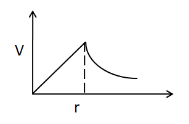
(B)
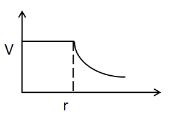
(C)
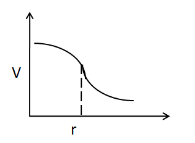
(D)
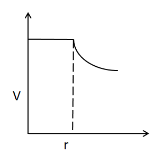
Answer
 Verified
593.7k+ views
Hint: To solve this question, we need to use the relation between the electrostatic potential and the electric field. Then, we have to use the expressions for the electric field inside and outside a sphere and calculate the electrostatic potential in the regions inside and outside the sphere, from that relation.
Formula used: The formulae which are used to solve this question are given by
$\Rightarrow E = - \dfrac{{dV}}{{dr}} $, here $ E $ is the electric field, $ V $ is the electrostatic potential, and $ r $ is the distance.
$\Rightarrow {E_i} = \dfrac{{KQr}}{{{R^3}}} $, here $ {E_i} $ is the electric field inside a sphere of radius $ R $ and carrying a charge of $ Q $, at a distance of $ r $ from its centre.
$\Rightarrow {E_0} = \dfrac{{KQ}}{{{r^2}}} $, here $ {E_0} $ is the electric field outside a sphere of radius $ R $ and carrying a charge of $ Q $, at a distance of $ r $ from its centre.
Complete step by step answer
We know that the electric field is related to the electrostatic potential by the relation
$\Rightarrow E = - \dfrac{{dV}}{{dr}} $
So the potential becomes
$\Rightarrow V = - \int\limits_\infty ^r {Edr} $...........................(1) (Potential at a point is always defined with respect to infinity)
Let the charge on the given solid sphere be $ Q $.
We know that the electric field outside the sphere at a distance of $ r $ from its centre is given by
$\Rightarrow {E_0} = \dfrac{{KQ}}{{{r^2}}} $
So from (1) the potential outside the solid sphere becomes
$\Rightarrow {V_0} = - \int\limits_\infty ^r {\dfrac{{KQ}}{{{r^2}}}dr} $
$ \Rightarrow {V_0} = - KQ\left[ {\dfrac{{ - 1}}{r}} \right]_\infty ^r $
On substituting the limits, we get
$\Rightarrow {V_0} = \dfrac{{KQ}}{r} $...........................(2)
Substituting $ r = R $ in the above equation, we get the potential on the surface of the solid sphere as
$\Rightarrow {V_S} = \dfrac{{KQ}}{R} $...........................(3)
Now, we also know that the electric field inside a solid sphere is given by
$\Rightarrow {E_i} = \dfrac{{KQr}}{{{R^3}}} $
So from (1) the potential inside the solid sphere becomes
$\Rightarrow {V_i} = - \int\limits_\infty ^r {\dfrac{{KQr}}{{{R^3}}}dr} $
We can break the path of integral as
$\Rightarrow V - {V_S} = - \int\limits_R^r {\dfrac{{KQr}}{{{R^3}}}dr} $
$ \Rightarrow {V_i} = {V_S} - \dfrac{{KQ}}{{{R^3}}}\left[ {\dfrac{{{r^2}}}{2}} \right]_R^r $
Substituting the limits we get
$\Rightarrow {V_i} = {V_S} - \dfrac{{KQ}}{{{R^3}}}\left\{ {\left[ {\dfrac{{{r^2}}}{2}} \right] - \left[ {\dfrac{{{R^2}}}{2}} \right]} \right\} $
$ \Rightarrow {V_i} = {V_S} + \dfrac{{KQ}}{{2R}} - \dfrac{{KQ{r^2}}}{{2{R^3}}} $
From (3)
$\Rightarrow {V_i} = \dfrac{{KQ}}{R} + \dfrac{{KQ}}{{2R}} - \dfrac{{KQ{r^2}}}{{2{R^3}}} $
$ \Rightarrow {V_i} = \dfrac{{3KQ}}{{2R}} - \dfrac{{KQ{r^2}}}{{2{R^3}}} $...........................(4)
So the $ V $ vs. $ r $ curve is
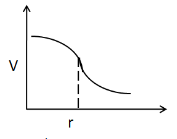
Hence, the correct answer is option C.
Note
The expressions of the electric fields at the inside and the outside regions of the solid spheres can be easily obtained by the application of the Gauss theorem. For this we just need to choose a spherical Gaussian surface at the desired location.
Formula used: The formulae which are used to solve this question are given by
$\Rightarrow E = - \dfrac{{dV}}{{dr}} $, here $ E $ is the electric field, $ V $ is the electrostatic potential, and $ r $ is the distance.
$\Rightarrow {E_i} = \dfrac{{KQr}}{{{R^3}}} $, here $ {E_i} $ is the electric field inside a sphere of radius $ R $ and carrying a charge of $ Q $, at a distance of $ r $ from its centre.
$\Rightarrow {E_0} = \dfrac{{KQ}}{{{r^2}}} $, here $ {E_0} $ is the electric field outside a sphere of radius $ R $ and carrying a charge of $ Q $, at a distance of $ r $ from its centre.
Complete step by step answer
We know that the electric field is related to the electrostatic potential by the relation
$\Rightarrow E = - \dfrac{{dV}}{{dr}} $
So the potential becomes
$\Rightarrow V = - \int\limits_\infty ^r {Edr} $...........................(1) (Potential at a point is always defined with respect to infinity)
Let the charge on the given solid sphere be $ Q $.
We know that the electric field outside the sphere at a distance of $ r $ from its centre is given by
$\Rightarrow {E_0} = \dfrac{{KQ}}{{{r^2}}} $
So from (1) the potential outside the solid sphere becomes
$\Rightarrow {V_0} = - \int\limits_\infty ^r {\dfrac{{KQ}}{{{r^2}}}dr} $
$ \Rightarrow {V_0} = - KQ\left[ {\dfrac{{ - 1}}{r}} \right]_\infty ^r $
On substituting the limits, we get
$\Rightarrow {V_0} = \dfrac{{KQ}}{r} $...........................(2)
Substituting $ r = R $ in the above equation, we get the potential on the surface of the solid sphere as
$\Rightarrow {V_S} = \dfrac{{KQ}}{R} $...........................(3)
Now, we also know that the electric field inside a solid sphere is given by
$\Rightarrow {E_i} = \dfrac{{KQr}}{{{R^3}}} $
So from (1) the potential inside the solid sphere becomes
$\Rightarrow {V_i} = - \int\limits_\infty ^r {\dfrac{{KQr}}{{{R^3}}}dr} $
We can break the path of integral as
$\Rightarrow V - {V_S} = - \int\limits_R^r {\dfrac{{KQr}}{{{R^3}}}dr} $
$ \Rightarrow {V_i} = {V_S} - \dfrac{{KQ}}{{{R^3}}}\left[ {\dfrac{{{r^2}}}{2}} \right]_R^r $
Substituting the limits we get
$\Rightarrow {V_i} = {V_S} - \dfrac{{KQ}}{{{R^3}}}\left\{ {\left[ {\dfrac{{{r^2}}}{2}} \right] - \left[ {\dfrac{{{R^2}}}{2}} \right]} \right\} $
$ \Rightarrow {V_i} = {V_S} + \dfrac{{KQ}}{{2R}} - \dfrac{{KQ{r^2}}}{{2{R^3}}} $
From (3)
$\Rightarrow {V_i} = \dfrac{{KQ}}{R} + \dfrac{{KQ}}{{2R}} - \dfrac{{KQ{r^2}}}{{2{R^3}}} $
$ \Rightarrow {V_i} = \dfrac{{3KQ}}{{2R}} - \dfrac{{KQ{r^2}}}{{2{R^3}}} $...........................(4)
So the $ V $ vs. $ r $ curve is
Hence, the correct answer is option C.
Note
The expressions of the electric fields at the inside and the outside regions of the solid spheres can be easily obtained by the application of the Gauss theorem. For this we just need to choose a spherical Gaussian surface at the desired location.
Recently Updated Pages
Master Class 12 Business Studies: Engaging Questions & Answers for Success

Master Class 12 Biology: Engaging Questions & Answers for Success
Master Class 12 Chemistry: Engaging Questions & Answers for Success
Class 12 Question and Answer - Your Ultimate Solutions Guide
Master Class 11 Social Science: Engaging Questions & Answers for Success
Master Class 11 English: Engaging Questions & Answers for Success
Trending doubts
Which is more stable and why class 12 chemistry CBSE
Which are the Top 10 Largest Countries of the World?
Draw a labelled sketch of the human eye class 12 physics CBSE
Differentiate between homogeneous and heterogeneous class 12 chemistry CBSE
What are the major means of transport Explain each class 12 social science CBSE
Sulphuric acid is known as the king of acids State class 12 chemistry CBSE