




A solid cylinder rolls without slipping on an inclined plane at an angle $\theta $. Find the linear acceleration of the cylinder. Mass of the cylinder is M.
(A). $a=\dfrac{1}{3}g\sin \theta $
(B). $a=\dfrac{2}{3}g\sin \theta $
(C). $a=\dfrac{1}{3}g\cos \theta $
(D). $a=\dfrac{2}{3}g\cos \theta $
Answer
 Verified
589.2k+ views
Hint: The cylinder is rolling down an inclined plane therefore, it possesses both rotational and translatory motion. As its motion is in a plane, it will have forces acting along the x- axis as well as along the y-axis. Resolving the forces acting on it, we can form equations for it for rotational as well as translatory and use it to find the value of acceleration.
Formulas used:
$mg\sin \theta -F=ma$
$\alpha =\dfrac{a}{r}$
$Fr=I\alpha $
Complete step-by-step solution:
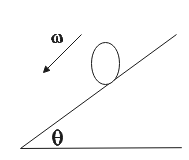
A cylinder is rolling without slipping on an inclined surface inclined at an angle $\theta $. The forces acting the cylinder will be-
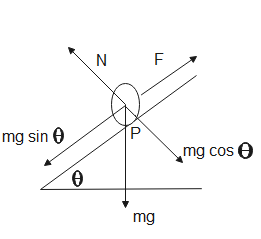
From the given figure, we have,
$N=mg\cos \theta $ - (1)
The forces acting along the inclined are-
$mg\sin \theta -F=ma$
$\therefore F=mg\sin \theta -ma$ - (2)
For the condition of rolling without slipping, the velocity at the point in contact with the surface must be equal to the velocity of the centre of mass.
$\begin{align}
& {{v}_{cm}}={{v}_{\tau }} \\
& \therefore v={{v}_{\tau }} \\
\end{align}$
Here,${{v}_{cm}}$ is the velocity of the centre of mass
${{v}_{\tau }}$ is the velocity of point P.
Therefore,
$\omega =\dfrac{v}{r}$, $\omega $ is the angular velocity
Similarly,
$\alpha =\dfrac{a}{r}$
Here,
$\alpha $ is the angular acceleration
$a$ is the linear acceleration
$r$ is distance from the axis of rotation.
For its angular motion,
$\tau =I\alpha $
Here,
$\tau $ is the torque
$I$ is the moment of inertia
$\therefore Fr=I\alpha $
We substitute the value of $F$ from eq (2) to get,
$\begin{align}
& (mg\sin \theta -ma)r=\dfrac{1}{2}m{{r}^{2}}\times \dfrac{a}{r} \\
& \Rightarrow mgr\sin \theta -mar=\dfrac{mar}{2} \\
& \Rightarrow mgr\sin \theta =\dfrac{3}{2}mar \\
& \therefore a=\dfrac{2}{3}g\sin \theta \\
\end{align}$
Therefore, the acceleration of the solid cylinder when rolling without slipping is $\dfrac{2}{3}g\sin \theta $.
Therefore, the correct option is (B).
Note:
The linear velocity at point P is tangential to the motion of the cylinder. For the cylinder to roll without slipping, the total velocity of point P must be zero. ${{v}_{cm}}$and${{v}_{\tau }}$ are in opposite directions. The normal reaction is the force acting between two surfaces which prevent them from passing through each other.
Formulas used:
$mg\sin \theta -F=ma$
$\alpha =\dfrac{a}{r}$
$Fr=I\alpha $
Complete step-by-step solution:
A cylinder is rolling without slipping on an inclined surface inclined at an angle $\theta $. The forces acting the cylinder will be-
From the given figure, we have,
$N=mg\cos \theta $ - (1)
The forces acting along the inclined are-
$mg\sin \theta -F=ma$
$\therefore F=mg\sin \theta -ma$ - (2)
For the condition of rolling without slipping, the velocity at the point in contact with the surface must be equal to the velocity of the centre of mass.
$\begin{align}
& {{v}_{cm}}={{v}_{\tau }} \\
& \therefore v={{v}_{\tau }} \\
\end{align}$
Here,${{v}_{cm}}$ is the velocity of the centre of mass
${{v}_{\tau }}$ is the velocity of point P.
Therefore,
$\omega =\dfrac{v}{r}$, $\omega $ is the angular velocity
Similarly,
$\alpha =\dfrac{a}{r}$
Here,
$\alpha $ is the angular acceleration
$a$ is the linear acceleration
$r$ is distance from the axis of rotation.
For its angular motion,
$\tau =I\alpha $
Here,
$\tau $ is the torque
$I$ is the moment of inertia
$\therefore Fr=I\alpha $
We substitute the value of $F$ from eq (2) to get,
$\begin{align}
& (mg\sin \theta -ma)r=\dfrac{1}{2}m{{r}^{2}}\times \dfrac{a}{r} \\
& \Rightarrow mgr\sin \theta -mar=\dfrac{mar}{2} \\
& \Rightarrow mgr\sin \theta =\dfrac{3}{2}mar \\
& \therefore a=\dfrac{2}{3}g\sin \theta \\
\end{align}$
Therefore, the acceleration of the solid cylinder when rolling without slipping is $\dfrac{2}{3}g\sin \theta $.
Therefore, the correct option is (B).
Note:
The linear velocity at point P is tangential to the motion of the cylinder. For the cylinder to roll without slipping, the total velocity of point P must be zero. ${{v}_{cm}}$and${{v}_{\tau }}$ are in opposite directions. The normal reaction is the force acting between two surfaces which prevent them from passing through each other.
Recently Updated Pages
Master Class 12 Business Studies: Engaging Questions & Answers for Success

Master Class 12 Biology: Engaging Questions & Answers for Success
Master Class 12 Chemistry: Engaging Questions & Answers for Success
Class 12 Question and Answer - Your Ultimate Solutions Guide
Master Class 11 Social Science: Engaging Questions & Answers for Success
Master Class 11 English: Engaging Questions & Answers for Success
Trending doubts
Which is more stable and why class 12 chemistry CBSE
Which are the Top 10 Largest Countries of the World?
Draw a labelled sketch of the human eye class 12 physics CBSE
Differentiate between homogeneous and heterogeneous class 12 chemistry CBSE
What are the major means of transport Explain each class 12 social science CBSE
Sulphuric acid is known as the king of acids State class 12 chemistry CBSE