




A solid ball of radius R has a charge density $\rho $given by \[\rho = {\rho _0}\left( {1 - {\text{ }}r/R} \right)\] for \[0{\text{ }} < {\text{ }}r < R\]. The electric field outside the ball is:
A. $\dfrac{{{\rho _0}{R^3}}}{{{\varepsilon _0}{r^2}}}$
B. $\dfrac{{{\rho _0}{R^3}}}{{12{\varepsilon _0}{r^2}}}$
C. $\dfrac{{4{\rho _0}{R^3}}}{{3{\varepsilon _0}{r^2}}}$
D. $\dfrac{{3{\rho _0}{R^3}}}{{4{\varepsilon _0}{r^2}}}$
Answer
 Verified
596.1k+ views
Hint: Using the formula for charge density outside the charged sphere, we will establish a relation. Then to find the charge distribution in the sphere, we will integrate it over the given limits and determine it. Finally, upon substitution of this value of charge in the relation we established earlier, we will be able to determine the electric field outside the ball.
Formula used:
Electric field outside the ball: ${E_{out}} = \dfrac{1}{{4\pi {\varepsilon _0}}}\dfrac{q}{{{r^2}}}$
Where $r$ is the distance from the center of the ball to outside and is expressed in meter $(m)$, ${\varepsilon _0}$ is the permittivity of air and has an approximate value of \[1\] in vacuum, $q$ is the charge on the sphere and is expressed in Coulombs $(C)$ and ${E_{out}}$ is the electric field outside the ball and is expressed in Newton per Coulomb $(N/C)$.
Charge density: $q = \smallint \rho dv$
Where $q$ is the charge on the sphere and is expressed in Coulombs $(C)$ and $dv$ is the change in volume of the sphere and is expressed in meter cube $({m^3})$.
Complete step by step answer:
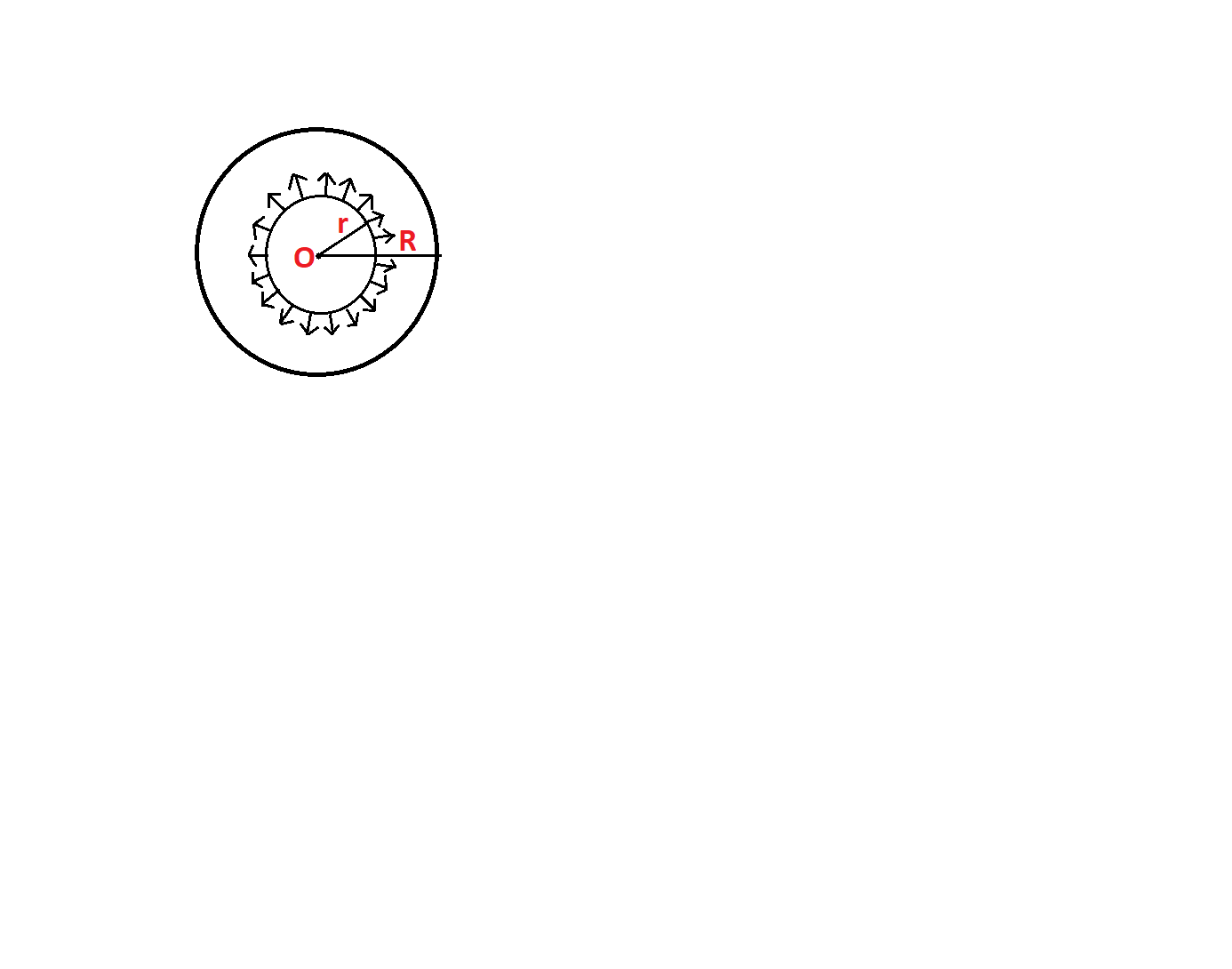
It is given that the charge density of the sphere is \[\rho = {\rho _0}\left( {1 - {\text{ }}r/R} \right)\] over a distance range of \[0{\text{ }} < {\text{ }}r < R\].
Assuming the sphere is in vacuum, the charge density of it from the surface to the periphery is
\[q = \smallint \rho dv{ = _0}{\smallint ^R}{\rho _0}\left( {1 - {\text{ }}r/R} \right)dv\]
But, $dv = 4\pi {r^2}dv$ where $dv$ is the rate of change of radius $r$.
Substituting this we get,
$q{ = _0}{\smallint ^R}{\rho _0}\left( {1 - \dfrac{r}{R}} \right)4\pi {r^2}dv$
Upon further simplification and substitution of limit we get,
$q = \dfrac{{\pi {\rho _0}{R^3}}}{3}$
We know that the intensity of electric field outside a charged sphere is given by the equation ${E_{out}} = \dfrac{1}{{4\pi {\varepsilon _0}}}\dfrac{q}{{{r^2}}}$
Upon substitution of the value of charge calculated for the given sphere we get,
${E_{out}} = \dfrac{1}{{4\pi {\varepsilon _0}}}\dfrac{q}{{{r^2}}} = \dfrac{1}{{4\pi {\varepsilon _0}}}\dfrac{1}{{{r^2}}} \times \dfrac{{\pi {\rho _0}{R^3}}}{3}$
Simplifying we establish the following relation,
$
{E_{out}} = \dfrac{1}{{4\pi {\varepsilon _0}}}\dfrac{1}{{{r^2}}} \times \dfrac{{\pi {\rho _0}{R^3}}}{3} \\
\Rightarrow {E_{out}} = \dfrac{{{\rho _0}{R^3}}}{{12{\varepsilon _0}{r^2}}} \\
$
So, the correct answer is “Option B”.
Note:
The value of the range of charge distribution is from the center of the sphere to the periphery.
The range denotes that the charge density can be calculated for any point between the center to the edges.
Formula used:
Electric field outside the ball: ${E_{out}} = \dfrac{1}{{4\pi {\varepsilon _0}}}\dfrac{q}{{{r^2}}}$
Where $r$ is the distance from the center of the ball to outside and is expressed in meter $(m)$, ${\varepsilon _0}$ is the permittivity of air and has an approximate value of \[1\] in vacuum, $q$ is the charge on the sphere and is expressed in Coulombs $(C)$ and ${E_{out}}$ is the electric field outside the ball and is expressed in Newton per Coulomb $(N/C)$.
Charge density: $q = \smallint \rho dv$
Where $q$ is the charge on the sphere and is expressed in Coulombs $(C)$ and $dv$ is the change in volume of the sphere and is expressed in meter cube $({m^3})$.
Complete step by step answer:
It is given that the charge density of the sphere is \[\rho = {\rho _0}\left( {1 - {\text{ }}r/R} \right)\] over a distance range of \[0{\text{ }} < {\text{ }}r < R\].
Assuming the sphere is in vacuum, the charge density of it from the surface to the periphery is
\[q = \smallint \rho dv{ = _0}{\smallint ^R}{\rho _0}\left( {1 - {\text{ }}r/R} \right)dv\]
But, $dv = 4\pi {r^2}dv$ where $dv$ is the rate of change of radius $r$.
Substituting this we get,
$q{ = _0}{\smallint ^R}{\rho _0}\left( {1 - \dfrac{r}{R}} \right)4\pi {r^2}dv$
Upon further simplification and substitution of limit we get,
$q = \dfrac{{\pi {\rho _0}{R^3}}}{3}$
We know that the intensity of electric field outside a charged sphere is given by the equation ${E_{out}} = \dfrac{1}{{4\pi {\varepsilon _0}}}\dfrac{q}{{{r^2}}}$
Upon substitution of the value of charge calculated for the given sphere we get,
${E_{out}} = \dfrac{1}{{4\pi {\varepsilon _0}}}\dfrac{q}{{{r^2}}} = \dfrac{1}{{4\pi {\varepsilon _0}}}\dfrac{1}{{{r^2}}} \times \dfrac{{\pi {\rho _0}{R^3}}}{3}$
Simplifying we establish the following relation,
$
{E_{out}} = \dfrac{1}{{4\pi {\varepsilon _0}}}\dfrac{1}{{{r^2}}} \times \dfrac{{\pi {\rho _0}{R^3}}}{3} \\
\Rightarrow {E_{out}} = \dfrac{{{\rho _0}{R^3}}}{{12{\varepsilon _0}{r^2}}} \\
$
So, the correct answer is “Option B”.
Note:
The value of the range of charge distribution is from the center of the sphere to the periphery.
The range denotes that the charge density can be calculated for any point between the center to the edges.
Recently Updated Pages
Master Class 12 Social Science: Engaging Questions & Answers for Success

Master Class 12 Physics: Engaging Questions & Answers for Success
Master Class 12 Maths: Engaging Questions & Answers for Success
Master Class 12 Economics: Engaging Questions & Answers for Success
Master Class 12 Chemistry: Engaging Questions & Answers for Success
Master Class 12 Business Studies: Engaging Questions & Answers for Success
Trending doubts
Which are the Top 10 Largest Countries of the World?
Draw a labelled sketch of the human eye class 12 physics CBSE
Explain the structure of megasporangium class 12 biology CBSE
What are the major means of transport Explain each class 12 social science CBSE
How many chromosomes are found in human ovum a 46 b class 12 biology CBSE
The diagram of the section of a maize grain is given class 12 biology CBSE