




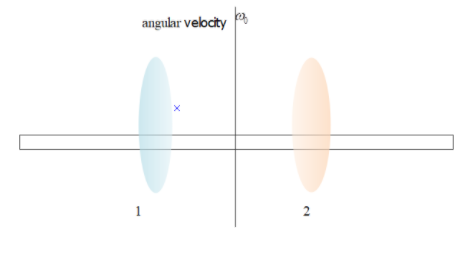
A smooth uniform rod of length l and mass m has two identical beads of negligible size, each of mass m, which can slide freely along the rod. Initially, the two beads are at the centre of the rod and the system is rotating with an angular velocity ${{\omega }_{0}}$ about an axis perpendicular to the rod and passing through the midpoint of the rod (see figure). There are no external forces. When the beads reach the ends of the rod, the angular velocity of the system is
Answer
 Verified
623.4k+ views
Hint: When the two given beads each of mass m are at the centre of the rod, calculate the moment of inertia of the beads. Next, at the final position, when they are at the end of the rod, calculate the moment of inertia. As there’s no external force acting on the system, the net angular momentum is conserved for the beads.
Formulas used:
$J=I{{\omega }_{{}}}$
Complete answer:
Let us assume the angular momentum of the beads before and after the change in the position of the beads as ${{J}_{in}},{{J}_{f}}$ respectively. Now, let’s first calculate the moment of inertia of the beads when they are present at the centre of the rod.
$I=\dfrac{M{{L}^{2}}}{12}$ when they are at the centre of the rod.
After moving, they move to the end of the rod.
At the end of the rod, the moment of inertia will be equal to
$\begin{align}
& I=(\dfrac{M{{L}^{2}}}{12}+2m{{(\dfrac{L}{2})}^{2}}) \\
& \\
\end{align}$
As there’s no external force acting on the system, the net angular momentum is conserved.
I.e.
$\begin{align}
& {{J}_{in}}={{J}_{f}} \\
& \dfrac{M{{L}^{2}}}{12}{{\omega }_{0}}=I=(\dfrac{M{{L}^{2}}}{12}+2m{{(\dfrac{L}{2})}^{2}})\omega \\
& \Rightarrow \dfrac{M}{12}{{\omega }_{0}}=(\dfrac{M}{12}+\dfrac{m}{2})\omega \\
& \Rightarrow \omega =\dfrac{M{{\omega }_{0}}}{M+6m} \\
\end{align}$
There, the above is the angular acceleration of the system when the beads reach the ends of the rod.
Additional information:
Angular momentum is equivalent to the rotational linear momentum. Angular momentum is conserved quantity. The total angular momentum of a system when no external force is acting on it is always conserved. There are two types of angular momentums. One is spin angular momentum and the other is orbital angular momentum. Spin angular momentum is the angular momentum about the object's centre of mass coordinate. The orbital angular momentum is the angular momentum of the object about a chosen origin. We can say, the total angular momentum as the sum of the spin and orbital angular momentum. Orbital angular momentum is always parallel and directly proportional to the angular velocity. Spin sometimes is parallel and sometimes not.
Note:
During the calculation of the final moment of inertia of the particles, the net mass is taken as twice the mass as two beads are present. The distance travelled by each of the beads is half the length, therefore the distance travelled is half of the length of the rod and the mass of the beads is the total mass of the beads.
Formulas used:
$J=I{{\omega }_{{}}}$
Complete answer:
Let us assume the angular momentum of the beads before and after the change in the position of the beads as ${{J}_{in}},{{J}_{f}}$ respectively. Now, let’s first calculate the moment of inertia of the beads when they are present at the centre of the rod.
$I=\dfrac{M{{L}^{2}}}{12}$ when they are at the centre of the rod.
After moving, they move to the end of the rod.
At the end of the rod, the moment of inertia will be equal to
$\begin{align}
& I=(\dfrac{M{{L}^{2}}}{12}+2m{{(\dfrac{L}{2})}^{2}}) \\
& \\
\end{align}$
As there’s no external force acting on the system, the net angular momentum is conserved.
I.e.
$\begin{align}
& {{J}_{in}}={{J}_{f}} \\
& \dfrac{M{{L}^{2}}}{12}{{\omega }_{0}}=I=(\dfrac{M{{L}^{2}}}{12}+2m{{(\dfrac{L}{2})}^{2}})\omega \\
& \Rightarrow \dfrac{M}{12}{{\omega }_{0}}=(\dfrac{M}{12}+\dfrac{m}{2})\omega \\
& \Rightarrow \omega =\dfrac{M{{\omega }_{0}}}{M+6m} \\
\end{align}$
There, the above is the angular acceleration of the system when the beads reach the ends of the rod.
Additional information:
Angular momentum is equivalent to the rotational linear momentum. Angular momentum is conserved quantity. The total angular momentum of a system when no external force is acting on it is always conserved. There are two types of angular momentums. One is spin angular momentum and the other is orbital angular momentum. Spin angular momentum is the angular momentum about the object's centre of mass coordinate. The orbital angular momentum is the angular momentum of the object about a chosen origin. We can say, the total angular momentum as the sum of the spin and orbital angular momentum. Orbital angular momentum is always parallel and directly proportional to the angular velocity. Spin sometimes is parallel and sometimes not.
Note:
During the calculation of the final moment of inertia of the particles, the net mass is taken as twice the mass as two beads are present. The distance travelled by each of the beads is half the length, therefore the distance travelled is half of the length of the rod and the mass of the beads is the total mass of the beads.
Recently Updated Pages
Master Class 12 Business Studies: Engaging Questions & Answers for Success

Master Class 12 Chemistry: Engaging Questions & Answers for Success
Master Class 12 Biology: Engaging Questions & Answers for Success
Class 12 Question and Answer - Your Ultimate Solutions Guide
Master Class 11 English: Engaging Questions & Answers for Success
Master Class 11 Social Science: Engaging Questions & Answers for Success
Trending doubts
Which are the Top 10 Largest Countries of the World?
Draw a labelled sketch of the human eye class 12 physics CBSE
Differentiate between homogeneous and heterogeneous class 12 chemistry CBSE
In order to find out the different types of gametes class 12 biology NEET_UG
Why is the cell called the structural and functional class 12 biology CBSE
Draw ray diagrams each showing i myopic eye and ii class 12 physics CBSE