



A small tank is $\dfrac{2}{5}$ full of water is then poured into a large empty tank which has a capacity that is twice that of the small tank. What fraction of a large tank is filled with water?
Answer
 Verified
664.5k+ views
Hint: Focus on the point that the volume of water for both the vessels will be equal. Start by taking the volume of the small tank be x. As it is given that the volume of the large tank is twice of the small tank, i.e., 2x. The volume of water is $\dfrac{2}{5}$ of the small tank, i.e., $\dfrac{2}{5}x$ . So, find the fraction of the volume of water to the volume of the large tank to get the answer.
Complete step-by-step answer:
Let us start the solution to the above question by letting the volume of the small tank be x.
As it is given that the volume of the large tank is twice that of the small tank, so we can say that the volume of the larger tank is 2x.

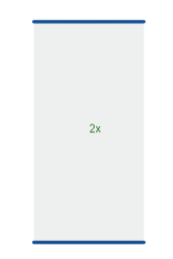
Also, the volume of water is $\dfrac{2}{5}$ of the small tank, so, we can say that the volume of water present is $\dfrac{2}{5}x$ . Now when the water is poured in the larger tank the volume of water is not changed, so the volume of water in the large tank is still $\dfrac{2}{5}x$ and the capacity of the large tank is 2x.
$\text{Fraction of large tank filled}=\dfrac{\text{volume of water}}{\text{volume of large tank}}=\dfrac{\dfrac{2}{5}x}{2x}=\dfrac{1}{5}$
Therefore, the answer to the above question is $\dfrac{1}{5}$.
Note:The point where students generally make a mistake is as soon as they read the words ‘volume of water’ they think about 3-D mensuration, volume of cylinder and let the radius and height of the cylinder to be variables, which will eventually give the answer in the above question as well but would be much more complex and time consuming, so it is a prescribed thing that you always read the question properly and try to figure out the constraints, and if a specific shape is mentioned then go for mensuration.
Complete step-by-step answer:
Let us start the solution to the above question by letting the volume of the small tank be x.
As it is given that the volume of the large tank is twice that of the small tank, so we can say that the volume of the larger tank is 2x.
Also, the volume of water is $\dfrac{2}{5}$ of the small tank, so, we can say that the volume of water present is $\dfrac{2}{5}x$ . Now when the water is poured in the larger tank the volume of water is not changed, so the volume of water in the large tank is still $\dfrac{2}{5}x$ and the capacity of the large tank is 2x.
$\text{Fraction of large tank filled}=\dfrac{\text{volume of water}}{\text{volume of large tank}}=\dfrac{\dfrac{2}{5}x}{2x}=\dfrac{1}{5}$
Therefore, the answer to the above question is $\dfrac{1}{5}$.
Note:The point where students generally make a mistake is as soon as they read the words ‘volume of water’ they think about 3-D mensuration, volume of cylinder and let the radius and height of the cylinder to be variables, which will eventually give the answer in the above question as well but would be much more complex and time consuming, so it is a prescribed thing that you always read the question properly and try to figure out the constraints, and if a specific shape is mentioned then go for mensuration.
Recently Updated Pages
What are the two major island groups in India class 9 social science CBSE

What is Jhum cultivation class 9 biology CBSE
Write an Article on Save Earth Save Life
Silk is obtained from of the silk moth APupa BLarva class 9 chemistry CBSE
Write chemical formulas of the following compounds class 9 chemistry CBSE
The Indo Gangetic Plains of India are fertile due to class 9 social science CBSE
Trending doubts
Fill the blanks with the suitable prepositions 1 The class 9 english CBSE
Difference Between Plant Cell and Animal Cell
Name 10 Living and Non living things class 9 biology CBSE
What is the full form of pH?
On an outline map of India show its neighbouring c class 9 social science CBSE
What is pollution? How many types of pollution? Define it