




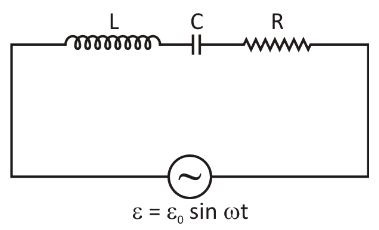
A series \[LCR\] circuit consists of an inductor \[L\] a capacitor \[C\] and a resistor \[R\] connected across a source of emf \[\varepsilon = {\varepsilon _0}\] \[\sin \omega t\]. When \[\omega L = \dfrac{1}{{\omega C}}\] the current in the circuit is \[Io\] and if angular frequency of the source is changed to \[\omega '\], the current in the circuit becomes \[\dfrac{{Io}}{2}\], then the value of \[\left| {\omega 'L = \dfrac{1}{{\omega 'C}}} \right|\] is
A. \[R\]
B. \[\sqrt 3 R\]
C. \[\sqrt {15} R\]
D. \[Zero\]
Answer
 Verified
591.3k+ views
Hint: First of all, we will find the expression for the impedance. After that the expression of current, which involves resistance and impedance. We will put the as half the initial value to get another expression. We will manipulate these two expressions and try to obtain the result.
Formula used:
The impedance in the above circuit can be calculated by using the formula as below,
\[Let,Z = \left| {\omega L - \dfrac{1}{{\omega C}}} \right| = 0\]
and current is given by using the formula,
\[{I_0} = \dfrac{{{\varepsilon _0}}}{{\sqrt {{R_1} + {Z^2}} }}\]
Where,
\[{I_0}\] is the current.
\[{\varepsilon _0}\] is the e.m.f.
\[R\] is the resistance.
\[Z\] is the impedance.
Complete step by step solution:
So, at the resonance state we know that the impedance will be zero i.e,
\[Let,Z = \left| {\omega L - \dfrac{1}{{\omega C}}} \right| = 0\]
Then by formula we get, current \[Io\]
\[{I_0} = \dfrac{{{\varepsilon _0}}}{{\sqrt {{R^2} + {Z^2}} }}\] …… (1)
If \[\omega \] changes to \[\omega '\] we get,
\[Z' = \left| {\omega 'L - \dfrac{1}{{\omega 'C}}} \right|\]
\[Then,{I_0} = \dfrac{{{I_0}}}{2}\]
\[ \Rightarrow \dfrac{{{I_0}}}{2} = \dfrac{{{\varepsilon _0}}}{{\sqrt {{R_1} + Z'} }}\] …… (2)
From equation (1) and (2) we get,
\[ \Rightarrow 2\sqrt {{R^2} + Z'} = \sqrt {{R^2} + Z'} \]
\[ \therefore Z' = \sqrt 3 R\]
Since Impedance is zero at resonance so the correct answer is option B.
Note:It must be remembered that in an Ideal case of inductance and capacitance have an imaginary reactive impedance with respective to frequency. The impedance of inductance case increases as frequency is increased. However, it is important to note that the impedance of capacitance decreases as frequency is increased. Depending on the character of the reactance element of the impedance (whether inductance or capacitance) the alternating current both the lags or the leads of the voltage.
Formula used:
The impedance in the above circuit can be calculated by using the formula as below,
\[Let,Z = \left| {\omega L - \dfrac{1}{{\omega C}}} \right| = 0\]
and current is given by using the formula,
\[{I_0} = \dfrac{{{\varepsilon _0}}}{{\sqrt {{R_1} + {Z^2}} }}\]
Where,
\[{I_0}\] is the current.
\[{\varepsilon _0}\] is the e.m.f.
\[R\] is the resistance.
\[Z\] is the impedance.
Complete step by step solution:
So, at the resonance state we know that the impedance will be zero i.e,
\[Let,Z = \left| {\omega L - \dfrac{1}{{\omega C}}} \right| = 0\]
Then by formula we get, current \[Io\]
\[{I_0} = \dfrac{{{\varepsilon _0}}}{{\sqrt {{R^2} + {Z^2}} }}\] …… (1)
If \[\omega \] changes to \[\omega '\] we get,
\[Z' = \left| {\omega 'L - \dfrac{1}{{\omega 'C}}} \right|\]
\[Then,{I_0} = \dfrac{{{I_0}}}{2}\]
\[ \Rightarrow \dfrac{{{I_0}}}{2} = \dfrac{{{\varepsilon _0}}}{{\sqrt {{R_1} + Z'} }}\] …… (2)
From equation (1) and (2) we get,
\[ \Rightarrow 2\sqrt {{R^2} + Z'} = \sqrt {{R^2} + Z'} \]
\[ \therefore Z' = \sqrt 3 R\]
Since Impedance is zero at resonance so the correct answer is option B.
Note:It must be remembered that in an Ideal case of inductance and capacitance have an imaginary reactive impedance with respective to frequency. The impedance of inductance case increases as frequency is increased. However, it is important to note that the impedance of capacitance decreases as frequency is increased. Depending on the character of the reactance element of the impedance (whether inductance or capacitance) the alternating current both the lags or the leads of the voltage.
Recently Updated Pages
Master Class 12 Business Studies: Engaging Questions & Answers for Success

Master Class 12 Biology: Engaging Questions & Answers for Success
Master Class 12 Chemistry: Engaging Questions & Answers for Success
Class 12 Question and Answer - Your Ultimate Solutions Guide
Master Class 11 Social Science: Engaging Questions & Answers for Success
Master Class 11 English: Engaging Questions & Answers for Success
Trending doubts
Which is more stable and why class 12 chemistry CBSE
Which are the Top 10 Largest Countries of the World?
Draw a labelled sketch of the human eye class 12 physics CBSE
Differentiate between homogeneous and heterogeneous class 12 chemistry CBSE
What are the major means of transport Explain each class 12 social science CBSE
Sulphuric acid is known as the king of acids State class 12 chemistry CBSE