




A semicircular arc of radius r and a straight wire along the diameter, both are carrying the same current i. Find out magnetic force per unit length on the small element P, which is at the centre of curvature?
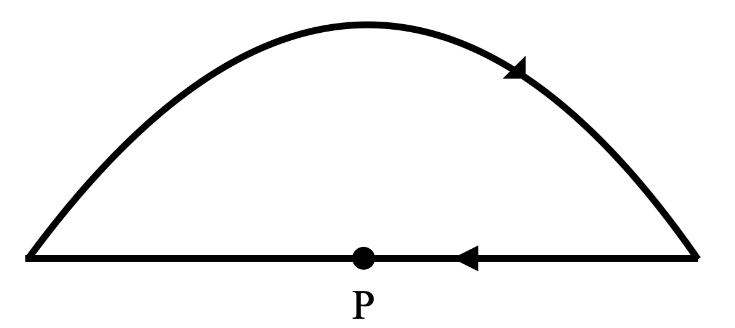
A. $\left( \dfrac{{{\mu }_{0}}{{i}^{2}}}{4r} \right)$
B. $\left( \dfrac{{{\mu }_{0}}{{i}^{2}}}{2r} \right)$
C. $\left( \dfrac{{{\mu }_{0}}{{i}^{2}}}{r} \right)$
D. $\left( \dfrac{2{{\mu }_{0}}{{i}^{2}}}{r} \right)$
Answer
 Verified
637.8k+ views
Hint: Biot-Savart’s law confirms that there won’t be any magnetic field at P due to the straight wire. Because, the point lies on the wire. We need to find the magnetic field at P due to the semicircular arc. We can find the force using the formula,
$F=Bil$
Where,
$B$ is the magnetic field at that location
$i$ is the current
$l$ is the length of the wire.
Formula Used:
Magnetic field due to the semicircular arc,
$B=\dfrac{{{\mu }_{0}}i}{4r}$
Where,
${{\mu }_{0}}$ is the permittivity of the material
$i$ is the current through the arc
$r$ is the radius of the arc
Force per unit length is,
$\dfrac{F}{l}=Bi$
Where,
$B$ is the magnetic field
$i$ is the current through the point
Complete step by step answer:
The radius of the semicircular arc is = r
Current passing through the loop = i
We can find the magnetic field due to a semicircular arc at the centre using Biot-Savart’s law. It is given by,
$B=\dfrac{{{\mu }_{0}}i}{4r}$
Where,
${{\mu }_{0}}$ is the permittivity of the material
$i$ is the current through the arc
$r$ is the radius of the arc
So, at point P the magnetic field is,
$B=\dfrac{{{\mu }_{0}}i}{4r}$
Now, the current flowing through wire at P is i
The force per unit length due to the Magnetic field on a wire is,
$\dfrac{F}{l}=Bi$...................(1)
Where,
$F$ is the force on the wire
$B$ is the magnetic field at that location
$i$ is the current going through the wire
$l$ is the length of the wire
So, in this case, the force per unit area will be given by,
$\dfrac{F}{l}=Bi$
$\Rightarrow \dfrac{F}{l}=(\dfrac{{{\mu }_{0}}i}{4r})i$
$\Rightarrow \dfrac{F}{l}=\dfrac{{{\mu }_{0}}{{i}^{2}}}{4r}$
So, the magnetic force per unit length is
$\dfrac{{{\mu }_{0}}{{i}^{2}}}{4r}$
Hence, the correct option is (A).
Note: You can divide the entire loop into different segments. Find the magnetic field due to each segment. Don’t consider the segments which are aligned with the point at which we are finding the magnetic field. After that we can use the simple equation (1) to find force per unit length.
$F=Bil$
Where,
$B$ is the magnetic field at that location
$i$ is the current
$l$ is the length of the wire.
Formula Used:
Magnetic field due to the semicircular arc,
$B=\dfrac{{{\mu }_{0}}i}{4r}$
Where,
${{\mu }_{0}}$ is the permittivity of the material
$i$ is the current through the arc
$r$ is the radius of the arc
Force per unit length is,
$\dfrac{F}{l}=Bi$
Where,
$B$ is the magnetic field
$i$ is the current through the point
Complete step by step answer:
The radius of the semicircular arc is = r
Current passing through the loop = i
We can find the magnetic field due to a semicircular arc at the centre using Biot-Savart’s law. It is given by,
$B=\dfrac{{{\mu }_{0}}i}{4r}$
Where,
${{\mu }_{0}}$ is the permittivity of the material
$i$ is the current through the arc
$r$ is the radius of the arc
So, at point P the magnetic field is,
$B=\dfrac{{{\mu }_{0}}i}{4r}$
Now, the current flowing through wire at P is i
The force per unit length due to the Magnetic field on a wire is,
$\dfrac{F}{l}=Bi$...................(1)
Where,
$F$ is the force on the wire
$B$ is the magnetic field at that location
$i$ is the current going through the wire
$l$ is the length of the wire
So, in this case, the force per unit area will be given by,
$\dfrac{F}{l}=Bi$
$\Rightarrow \dfrac{F}{l}=(\dfrac{{{\mu }_{0}}i}{4r})i$
$\Rightarrow \dfrac{F}{l}=\dfrac{{{\mu }_{0}}{{i}^{2}}}{4r}$
So, the magnetic force per unit length is
$\dfrac{{{\mu }_{0}}{{i}^{2}}}{4r}$
Hence, the correct option is (A).
Note: You can divide the entire loop into different segments. Find the magnetic field due to each segment. Don’t consider the segments which are aligned with the point at which we are finding the magnetic field. After that we can use the simple equation (1) to find force per unit length.
Recently Updated Pages
Master Class 12 Business Studies: Engaging Questions & Answers for Success

Master Class 12 Chemistry: Engaging Questions & Answers for Success
Master Class 12 Biology: Engaging Questions & Answers for Success
Class 12 Question and Answer - Your Ultimate Solutions Guide
Master Class 11 English: Engaging Questions & Answers for Success
Master Class 11 Social Science: Engaging Questions & Answers for Success
Trending doubts
Which are the Top 10 Largest Countries of the World?
Draw a labelled sketch of the human eye class 12 physics CBSE
Differentiate between homogeneous and heterogeneous class 12 chemistry CBSE
Differentiate between Pyramid of energy and pyramid class 12 biology CBSE
Why is the cell called the structural and functional class 12 biology CBSE
Draw the diagram of the pyramid of energy Explain In class 12 biology CBSE