




A ring of radius \[R\] is with uniformly distributed charge \[Q\] on it. A charge \[q\] is now placed at the centre of the ring. Find the increment in tension in the ring.
Answer
 Verified
613.8k+ views
Hint:In this question, calculate the linear charge density of the ring and represent the linear charge density by \[\lambda \]. Linear charge density is directly proportional to the charge stored and inversely proportional to the circumference of the ring.
Complete step by step answerAs we know that when a charge \[ + q\] is placed at the centre of the ring, the wire gets stretched due to mutual electrostatic repulsion between the positive charge and each element of the wire having positive charge \[dQ\]. And stretching causes the internal restoring forces resulting in an additional tension in the wire of the ring.
Now we consider the figure \[\left( 1 \right)\] as,
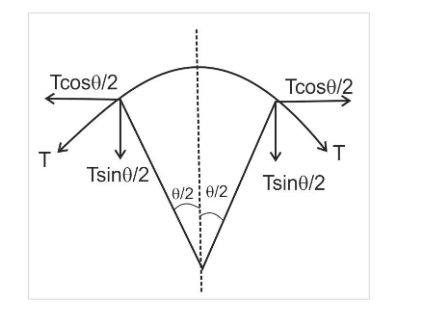
Figure\[\left( 1 \right)\]
Let us consider the linear charge density of the ring is \[\lambda \]. The linear density is the charge per unit length. Linear density tells about the charge stored in a particular area.
\[ \Rightarrow \lambda = \dfrac{Q}{{2\pi R}}\]
Where, \[Q\] is the charge \[R\] is the radius of the ring.
Now, calculate the force acting between a small section \[dx\] of the ring and the charge \[q\] in the centre will be,
\[ \Rightarrow T = \dfrac{{kq\lambda dx}}{{{R^2}}}......\left( 1 \right)\]
Where, \[T\] is the force acting in a small section of the ring.
Now consider, if \[\theta \] be the angle subtended at the center by \[dx\]. \[\theta \] is very small, and the force acting in the small section of the ring will be,
\[ \Rightarrow T\theta = 2T\sin \dfrac{\theta }{2}\]
We can write
\[ \Rightarrow \dfrac{{dx}}{R} = \theta \]
Now, we substitute the value in equation (1) as,
\[ \Rightarrow T = \dfrac{{kq\lambda \theta }}{R}\]
Therefore, the force should be equal to \[T = \dfrac{{kq\lambda \theta }}{R}\].
Now, substitute the value of \[\lambda \] in the force equation as,
\[ \Rightarrow T = \dfrac{{kq\left( {\dfrac{Q}{{2\pi R}}} \right)\theta }}{R}\]
We know that the value of $k$ is $\dfrac{1}{{4\pi {\varepsilon _0}}}$, so the equation become
\[\therefore T = \dfrac{{Qq}}{{8{\pi ^2}{\varepsilon _0}{R^2}}}\]
Therefore, the increment in the tension of the ring will be equal to \[\dfrac{{Qq}}{{8{\pi ^2}{\varepsilon _0}{R^2}}}\].
Note:As we know that, if the angle \[\theta \] be the angle subtended at the centre by \[dx\]. The angle \[\theta \] is very small, and the force acting in the small section of the ring will be equal to the charge stored in the particular area.
Complete step by step answerAs we know that when a charge \[ + q\] is placed at the centre of the ring, the wire gets stretched due to mutual electrostatic repulsion between the positive charge and each element of the wire having positive charge \[dQ\]. And stretching causes the internal restoring forces resulting in an additional tension in the wire of the ring.
Now we consider the figure \[\left( 1 \right)\] as,
Figure\[\left( 1 \right)\]
Let us consider the linear charge density of the ring is \[\lambda \]. The linear density is the charge per unit length. Linear density tells about the charge stored in a particular area.
\[ \Rightarrow \lambda = \dfrac{Q}{{2\pi R}}\]
Where, \[Q\] is the charge \[R\] is the radius of the ring.
Now, calculate the force acting between a small section \[dx\] of the ring and the charge \[q\] in the centre will be,
\[ \Rightarrow T = \dfrac{{kq\lambda dx}}{{{R^2}}}......\left( 1 \right)\]
Where, \[T\] is the force acting in a small section of the ring.
Now consider, if \[\theta \] be the angle subtended at the center by \[dx\]. \[\theta \] is very small, and the force acting in the small section of the ring will be,
\[ \Rightarrow T\theta = 2T\sin \dfrac{\theta }{2}\]
We can write
\[ \Rightarrow \dfrac{{dx}}{R} = \theta \]
Now, we substitute the value in equation (1) as,
\[ \Rightarrow T = \dfrac{{kq\lambda \theta }}{R}\]
Therefore, the force should be equal to \[T = \dfrac{{kq\lambda \theta }}{R}\].
Now, substitute the value of \[\lambda \] in the force equation as,
\[ \Rightarrow T = \dfrac{{kq\left( {\dfrac{Q}{{2\pi R}}} \right)\theta }}{R}\]
We know that the value of $k$ is $\dfrac{1}{{4\pi {\varepsilon _0}}}$, so the equation become
\[\therefore T = \dfrac{{Qq}}{{8{\pi ^2}{\varepsilon _0}{R^2}}}\]
Therefore, the increment in the tension of the ring will be equal to \[\dfrac{{Qq}}{{8{\pi ^2}{\varepsilon _0}{R^2}}}\].
Note:As we know that, if the angle \[\theta \] be the angle subtended at the centre by \[dx\]. The angle \[\theta \] is very small, and the force acting in the small section of the ring will be equal to the charge stored in the particular area.
Recently Updated Pages
Master Class 12 Business Studies: Engaging Questions & Answers for Success

Master Class 12 Chemistry: Engaging Questions & Answers for Success
Master Class 12 Biology: Engaging Questions & Answers for Success
Class 12 Question and Answer - Your Ultimate Solutions Guide
Master Class 11 English: Engaging Questions & Answers for Success
Master Class 11 Social Science: Engaging Questions & Answers for Success
Trending doubts
Which are the Top 10 Largest Countries of the World?
Draw a labelled sketch of the human eye class 12 physics CBSE
The end of compass needle which points towards north class 12 physics CBSE
Differentiate between homogeneous and heterogeneous class 12 chemistry CBSE
In order to find out the different types of gametes class 12 biology NEET_UG
Why is the cell called the structural and functional class 12 biology CBSE