




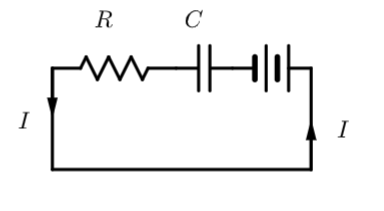
A resistor and a capacitor are connected to an A.C. supply of $200\,V$, $50\,Hz$ in series. The current in the circuit is $2\,A$. If the power consumed in the circuit is $100\,W$ then the capacitive reactance in the circuit is
(A) $100\,\Omega $
(B) $25\,\Omega $
(C) $\sqrt {125 \times 75} \,\Omega $
(D) $400\,\Omega $
Answer
 Verified
608.4k+ views
Hint: Take a formula for ohm’s law and apply the product of the current and resistance in the place of potential difference to make the new formula. Then substitute the given values from the question to obtain the value of resistance developed in the circuit. With the help of the value of resistance, the capacitance is calculated using the capacitance resistance relation.
Formulae Used:
(1) According to the Ohm’s law of heating,
$P = VI$
Where $P$ is the power consumed in the circuit, $V$ is the potential difference obtained across the circuit and $I$ is the current passed through the circuit.
(2) By the relation of potential difference and current,
$V = IR$
Where, $R$ is the resistance in the circuit.
(3) According to the capacitance formula,
$C = \sqrt {\left( {{C_r}^2 + {R^2}} \right)} $
Where $C$ is the capacitance of the circuit and ${C_r}$ is the capacitive reactance of the circuit.
Complete step-by-step solution:
Given data in the question are,
Current in the circuit, $I = 2\,A$
Power consumed in the circuit, $P = 100\,W$
Potential difference, $V = 200\,V$
By the formula of ohm’s law,
$P = VI$
Substituting the formula (2) in the above formula
$P = {I^{{2^{}}}}R$
Substituting the values of current and power in the above equation.
$100 = {\left( 2 \right)^2} \times R$
$100 = 4 \times R$
Finding the values of resistance by bringing it to the LHS
$R = \dfrac{{100}}{4}$
$R = 25\,\Omega $
The value of the resistance developed in the circuit is obtained as $25\,\Omega $.
According to the formula of capacitance,
$C = \sqrt {\left( {{C_r}^2 + {R^2}} \right)} $
The above formula is also equal to $C = \dfrac{{{V_{rms}}}}{{{I_{rms}}}}$
$\sqrt {\left( {{C_r}^2 + {R^2}} \right)} = \dfrac{{{V_{rms}}}}{{{I_{rms}}}}$
Taking square root on both sides and substituting the values
${C_r}^2 = {\left( {\dfrac{{200}}{2}} \right)^2} - {25^2}$
${C_r} = \sqrt {\left( {{{100}^2} - {{25}^2}} \right)} $
${C_r} = \sqrt {9375} $
${C_r} = \sqrt {\left( {125 \times 75} \right)} \,\Omega $
Thus option (C) is correct.
Note:- Remember that ohm’s law is changed according to the given parameters in the question using the relationship $V = IR$. The unit of resistance is Ohm $\left( \Omega \right)$. Care must be taken in the substitution part of the given problem.
Formulae Used:
(1) According to the Ohm’s law of heating,
$P = VI$
Where $P$ is the power consumed in the circuit, $V$ is the potential difference obtained across the circuit and $I$ is the current passed through the circuit.
(2) By the relation of potential difference and current,
$V = IR$
Where, $R$ is the resistance in the circuit.
(3) According to the capacitance formula,
$C = \sqrt {\left( {{C_r}^2 + {R^2}} \right)} $
Where $C$ is the capacitance of the circuit and ${C_r}$ is the capacitive reactance of the circuit.
Complete step-by-step solution:
Given data in the question are,
Current in the circuit, $I = 2\,A$
Power consumed in the circuit, $P = 100\,W$
Potential difference, $V = 200\,V$
By the formula of ohm’s law,
$P = VI$
Substituting the formula (2) in the above formula
$P = {I^{{2^{}}}}R$
Substituting the values of current and power in the above equation.
$100 = {\left( 2 \right)^2} \times R$
$100 = 4 \times R$
Finding the values of resistance by bringing it to the LHS
$R = \dfrac{{100}}{4}$
$R = 25\,\Omega $
The value of the resistance developed in the circuit is obtained as $25\,\Omega $.
According to the formula of capacitance,
$C = \sqrt {\left( {{C_r}^2 + {R^2}} \right)} $
The above formula is also equal to $C = \dfrac{{{V_{rms}}}}{{{I_{rms}}}}$
$\sqrt {\left( {{C_r}^2 + {R^2}} \right)} = \dfrac{{{V_{rms}}}}{{{I_{rms}}}}$
Taking square root on both sides and substituting the values
${C_r}^2 = {\left( {\dfrac{{200}}{2}} \right)^2} - {25^2}$
${C_r} = \sqrt {\left( {{{100}^2} - {{25}^2}} \right)} $
${C_r} = \sqrt {9375} $
${C_r} = \sqrt {\left( {125 \times 75} \right)} \,\Omega $
Thus option (C) is correct.
Note:- Remember that ohm’s law is changed according to the given parameters in the question using the relationship $V = IR$. The unit of resistance is Ohm $\left( \Omega \right)$. Care must be taken in the substitution part of the given problem.
Recently Updated Pages
Master Class 12 Business Studies: Engaging Questions & Answers for Success

Master Class 12 Chemistry: Engaging Questions & Answers for Success
Master Class 12 Biology: Engaging Questions & Answers for Success
Class 12 Question and Answer - Your Ultimate Solutions Guide
Master Class 11 English: Engaging Questions & Answers for Success
Master Class 11 Maths: Engaging Questions & Answers for Success
Trending doubts
Which is more stable and why class 12 chemistry CBSE
Which are the Top 10 Largest Countries of the World?
Draw a labelled sketch of the human eye class 12 physics CBSE
Differentiate between homogeneous and heterogeneous class 12 chemistry CBSE
What are the major means of transport Explain each class 12 social science CBSE
Sulphuric acid is known as the king of acids State class 12 chemistry CBSE