




A regular hexagon is inscribed in a circle of radius 6 cm. Find its area(in sq cm).
a. \[48\sqrt 3 \]
b. \[54\sqrt 3 \]
c. \[48\sqrt 2 \]
d. \[54\sqrt 2 \]
Answer
 Verified
669k+ views
Hint:
Here we will be using the given information for forming the figure based on that. Then we will be finding the sides of the regular hexagon.
Complete step by step solution:
There is a regular hexagon. This regular hexagon is inscribed in a circle of radius 6 cm.
As per the given information, we know that a regular hexagon is inscribed in a circle of radius 6 cm, so we proceed by drawing the figure first
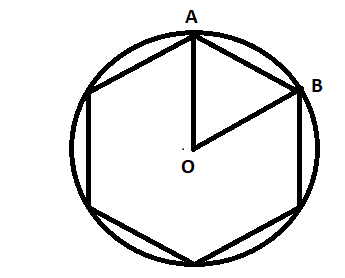
Here, we know that the angle subtended by the sides of a regular polygon (in this case hexagon) is equal to \[\dfrac{{2\pi }}{n}\] where n is the number of sides of the regular polygon.
In this case, \[n = 6\]. Thus, the angle \[\angle AOB = \dfrac{{2\pi }}{6} = {60^ \circ }\].
Now, we know that in triangle AOB, OA=OB, since both are radii of the same circle. So, we can say that triangle OAB is an equilateral triangle.
Thus, the side AB is of length 6 units.
The formula for area of an equilateral triangle is \[\dfrac{{\sqrt 3 }}{4}{\left( {side} \right)^2}\]
Since the length of the side of regular hexagon is 6 cm, so the area of the equilateral triangle AOB is
\[\begin{array}{l}
\dfrac{{\sqrt 3 }}{4}{\left( {side} \right)^2} = \dfrac{{\sqrt 3 }}{4}{\left( 6 \right)^2}\\
= \dfrac{{\sqrt 3 }}{4}\left( {36} \right)\\
= 9\sqrt 3
\end{array}\]
Since there are six such equilateral triangles, the area of the regular hexagon is \[6 \times 9\sqrt 3 = 54\sqrt 3 \]sq cm.
Hence, the correct option is b.
Note:
We can directly use the formula for the area of a hexagon. There are six equilateral triangles in a hexagon
Here we will be using the given information for forming the figure based on that. Then we will be finding the sides of the regular hexagon.
Complete step by step solution:
There is a regular hexagon. This regular hexagon is inscribed in a circle of radius 6 cm.
As per the given information, we know that a regular hexagon is inscribed in a circle of radius 6 cm, so we proceed by drawing the figure first
Here, we know that the angle subtended by the sides of a regular polygon (in this case hexagon) is equal to \[\dfrac{{2\pi }}{n}\] where n is the number of sides of the regular polygon.
In this case, \[n = 6\]. Thus, the angle \[\angle AOB = \dfrac{{2\pi }}{6} = {60^ \circ }\].
Now, we know that in triangle AOB, OA=OB, since both are radii of the same circle. So, we can say that triangle OAB is an equilateral triangle.
Thus, the side AB is of length 6 units.
The formula for area of an equilateral triangle is \[\dfrac{{\sqrt 3 }}{4}{\left( {side} \right)^2}\]
Since the length of the side of regular hexagon is 6 cm, so the area of the equilateral triangle AOB is
\[\begin{array}{l}
\dfrac{{\sqrt 3 }}{4}{\left( {side} \right)^2} = \dfrac{{\sqrt 3 }}{4}{\left( 6 \right)^2}\\
= \dfrac{{\sqrt 3 }}{4}\left( {36} \right)\\
= 9\sqrt 3
\end{array}\]
Since there are six such equilateral triangles, the area of the regular hexagon is \[6 \times 9\sqrt 3 = 54\sqrt 3 \]sq cm.
Hence, the correct option is b.
Note:
We can directly use the formula for the area of a hexagon. There are six equilateral triangles in a hexagon
Recently Updated Pages
What are the two major island groups in India class 9 social science CBSE

What is Jhum cultivation class 9 biology CBSE
Write an Article on Save Earth Save Life
Silk is obtained from of the silk moth APupa BLarva class 9 chemistry CBSE
Write chemical formulas of the following compounds class 9 chemistry CBSE
The Indo Gangetic Plains of India are fertile due to class 9 social science CBSE
Trending doubts
Fill the blanks with the suitable prepositions 1 The class 9 english CBSE
Difference Between Plant Cell and Animal Cell
What is the full form of pH?
What is pollution? How many types of pollution? Define it
On an outline map of India show its neighbouring c class 9 social science CBSE
What is momentum with examples class 9 physics CBSE