




A red four o’clock flower (RR) is crossed with a white four o’clock flower (WW) and the resulting F1 offspring are all pink (RW). If two of the pink offsprings are crossed, what proportion of genotype would you expect to see in F2 generation?
A) 1RW:2RR:1WW
B) 2RR:1RW:1WW
C) 1RR:2RW:1WW
D) 4RR:0RW:0WW
E) 2RR:0RW:2WW
Answer
 Verified
604.5k+ views
Hint:-This question is related to deviation of Mendel’s law of dominance. It actually shows incomplete dominance where the offspring has a totally different phenotype.
Complete answer:
The offspring produced in F1 generation have a totally different phenotype (pink flowers) as compared to their parents who were red and white. This is actually known as incomplete dominance. When a cross is made between F1-hybrids via self-fertilization, both parental phenotypes i.e. the red colour and white colour reappear in the individuals of F2 generation.
The cross can be explained by following diagram-
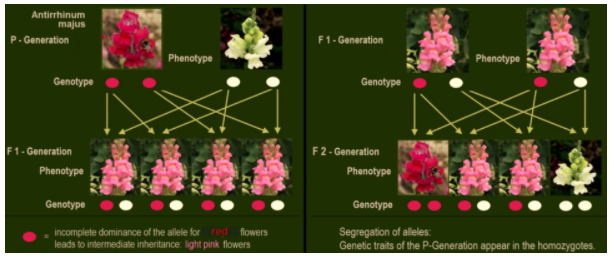
The phenotype and genotype of F2 generations will be-
Thus, the correct answer is- C. 1RR:2RW:1WW.
Note: Although incomplete dominance is a deviation of law of dominance, it only deviates from law of dominance. It follows the remaining two laws which are the law of independent assortment and law of segregation.
Complete answer:
The offspring produced in F1 generation have a totally different phenotype (pink flowers) as compared to their parents who were red and white. This is actually known as incomplete dominance. When a cross is made between F1-hybrids via self-fertilization, both parental phenotypes i.e. the red colour and white colour reappear in the individuals of F2 generation.
The cross can be explained by following diagram-
The phenotype and genotype of F2 generations will be-
| Genotype | RW | RW | WW |
| Genotype ratio | 1 | 2 | 1 |
| Phenotype | Red | Pink | White |
| Phenotype ratio | 1 | 2 | 1 |
Thus, the correct answer is- C. 1RR:2RW:1WW.
Note: Although incomplete dominance is a deviation of law of dominance, it only deviates from law of dominance. It follows the remaining two laws which are the law of independent assortment and law of segregation.
Recently Updated Pages
Master Class 12 Business Studies: Engaging Questions & Answers for Success

Master Class 12 Chemistry: Engaging Questions & Answers for Success
Master Class 12 Biology: Engaging Questions & Answers for Success
Class 12 Question and Answer - Your Ultimate Solutions Guide
Master Class 11 English: Engaging Questions & Answers for Success
Master Class 11 Maths: Engaging Questions & Answers for Success
Trending doubts
Which is more stable and why class 12 chemistry CBSE
Which are the Top 10 Largest Countries of the World?
Draw a labelled sketch of the human eye class 12 physics CBSE
Differentiate between homogeneous and heterogeneous class 12 chemistry CBSE
What are the major means of transport Explain each class 12 social science CBSE
Sulphuric acid is known as the king of acids State class 12 chemistry CBSE