




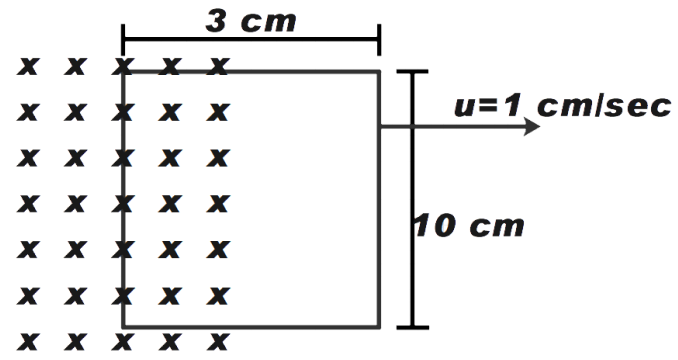
A rectangular loop of side 10 cm and 3 cm moving out of a region of uniform magnetic field of 0.5 T directed normal to the loop. If we want to move the loop with a constant velocity 1 cm/sec, then the required mechanical force is (Resistance of loop is 1milliohm)
A. \[2.25\times {{10}^{-3}}N\]
B. \[4.5\times {{10}^{-3}}N\]
C. \[9\times {{10}^{-3}}N\]
D. \[1.25\times {{10}^{-3}}N\]
Answer
 Verified
613.8k+ views
Hint: In this question we are asked to calculate the mechanical force. We know that force on a wire is given as the product of the magnetic field, length of the wire in the magnetic field and current. We will first calculate the value of current as other parameters such as magnetic field and length is known to us. Therefore, using these values we will calculate the force required.
Formula used:
\[V=\dfrac{d\phi }{dt}\]
\[i=\dfrac{V}{R}\]
\[F=ilB\]
Complete answer:
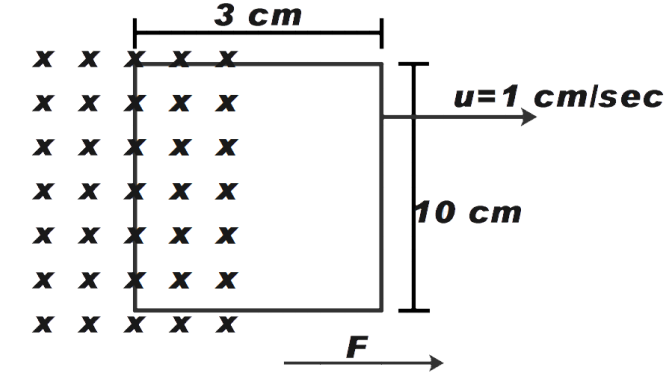
We asked to calculate the force required to move the loop with constant velocity of 1 cm/sec.
We know,
\[F=ilB\]
We have been given the length as 3 cm i.e. 0.03 m and resistance as 1 milli ohm which is \[1\times {{10}^{-3}}\Omega \]
Therefore, solving for current i,
We know that emf is given by,
\[V=\dfrac{d\phi }{dt}\] …………….. (1)
Where, \[d\phi \] is the change in flux, which is given by
\[\phi =BA\cos \theta \] …………. (2)
here\[\cos \theta \]is taken as 1
After substituting (2) in equation (1)
We get,
\[V=\dfrac{d(0.5\times 0.03x)}{dt}\] ……………. (since Area = 0.03x)
Therefore,
\[V=\dfrac{15}{1000}\dfrac{dx}{dt}\]
We know, \[\dfrac{dx}{dt}\] is the velocity of the loop
Therefore, after substituting
We get,
\[V=\dfrac{15}{1000}\times \dfrac{1}{100}\]
Therefore,
\[V=15\times {{10}^{-5}}\] …………. (3)
Now, we know from Ohm’s law that,
\[i=\dfrac{V}{R}\]
After substituting values
We get,
\[i=\dfrac{15\times {{10}^{-5}}}{1\times {{10}^{-3}}}\]
Therefore,
\[i=15\times {{10}^{-2}}\]
Now, substitute the value of i in equation (1)
We get,
\[F=15\times {{10}^{-2}}\times 3\times {{10}^{-2}}\times 0.5\]
Therefore,
\[F=2.25\times {{10}^{-3}}\] N
So, the correct answer is “Option A”.
Note:
Magnetic field is a vector quantity that describes the magnetic influence on moving electric charges or electric current. A charge moving in a magnetic field experiences a force perpendicular to its own velocity and the magnetic field. Magnetic flux is defined as the number of magnetic field lines passing through a given closed surface area.
Formula used:
\[V=\dfrac{d\phi }{dt}\]
\[i=\dfrac{V}{R}\]
\[F=ilB\]
Complete answer:
We asked to calculate the force required to move the loop with constant velocity of 1 cm/sec.
We know,
\[F=ilB\]
We have been given the length as 3 cm i.e. 0.03 m and resistance as 1 milli ohm which is \[1\times {{10}^{-3}}\Omega \]
Therefore, solving for current i,
We know that emf is given by,
\[V=\dfrac{d\phi }{dt}\] …………….. (1)
Where, \[d\phi \] is the change in flux, which is given by
\[\phi =BA\cos \theta \] …………. (2)
here\[\cos \theta \]is taken as 1
After substituting (2) in equation (1)
We get,
\[V=\dfrac{d(0.5\times 0.03x)}{dt}\] ……………. (since Area = 0.03x)
Therefore,
\[V=\dfrac{15}{1000}\dfrac{dx}{dt}\]
We know, \[\dfrac{dx}{dt}\] is the velocity of the loop
Therefore, after substituting
We get,
\[V=\dfrac{15}{1000}\times \dfrac{1}{100}\]
Therefore,
\[V=15\times {{10}^{-5}}\] …………. (3)
Now, we know from Ohm’s law that,
\[i=\dfrac{V}{R}\]
After substituting values
We get,
\[i=\dfrac{15\times {{10}^{-5}}}{1\times {{10}^{-3}}}\]
Therefore,
\[i=15\times {{10}^{-2}}\]
Now, substitute the value of i in equation (1)
We get,
\[F=15\times {{10}^{-2}}\times 3\times {{10}^{-2}}\times 0.5\]
Therefore,
\[F=2.25\times {{10}^{-3}}\] N
So, the correct answer is “Option A”.
Note:
Magnetic field is a vector quantity that describes the magnetic influence on moving electric charges or electric current. A charge moving in a magnetic field experiences a force perpendicular to its own velocity and the magnetic field. Magnetic flux is defined as the number of magnetic field lines passing through a given closed surface area.
Recently Updated Pages
Master Class 12 Business Studies: Engaging Questions & Answers for Success

Master Class 12 Chemistry: Engaging Questions & Answers for Success
Master Class 12 Biology: Engaging Questions & Answers for Success
Class 12 Question and Answer - Your Ultimate Solutions Guide
Master Class 9 General Knowledge: Engaging Questions & Answers for Success
Master Class 9 Maths: Engaging Questions & Answers for Success
Trending doubts
Which are the Top 10 Largest Countries of the World?
Draw a labelled sketch of the human eye class 12 physics CBSE
Differentiate between homogeneous and heterogeneous class 12 chemistry CBSE
Sulphuric acid is known as the king of acids State class 12 chemistry CBSE
Why is the cell called the structural and functional class 12 biology CBSE
A dentist uses a small mirror that gives a magnification class 12 physics CBSE